O Capability Maturity Model Integration (CMMI) emergiu como um importante estrutura for organizations striving to enhance their process efficiency, particularly in fields like software development, systems engineering, and IT service management. Originating from the Capability Maturity Model (CMM), CMMI offers a comprehensive roteiro Para que as organizações alcancem um desempenho superior por meio de cinco níveis distintos de maturidade: Inicial, Gerenciado, Definido, Gerenciado Quantitativamente e Otimizando.
Principais conclusões
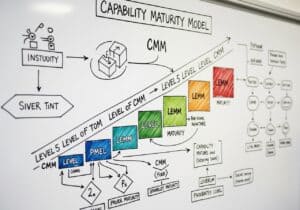
- CMMI aprimora capacidade do processo para organizações
- Cinco níveis de maturidade orientam o crescimento organizacional progressivo.
- As áreas de processo se alinham com o nível de maturidade para um desempenho aprimorado.
- Os métodos de avaliação avaliam o status de conformidade e melhoria.
- A adoção do CMMI resulta em melhor qualidade e previsibilidade.
Definição e Propósito da Integração do Modelo de Maturidade de Capacidade (CMMI)
O Capability Maturity Model Integration (CMMI) serve como uma estrutura organizada com o objetivo de aprimorar os processos organizacionais. O CMMI fornece às organizações as ferramentas essenciais para otimizar o desenvolvimento de software, a engenharia de sistemas, a gestão de serviços de TI e outras áreas relacionadas. Sua implementação leva ao estabelecimento de práticas padronizadas, garantindo consistência e previsibilidade em diversos projetos.

Um dos principais objetivos do CMMI é delinear um caminho claro para que as organizações evoluam de suas práticas atuais para processos mais maduros e eficientes. O modelo oferece uma série de boas práticas que as organizações podem adotar passo a passo, promovendo a melhoria contínua.
O CMMI está dividido em diferentes constelações, cada uma adaptada para atender às necessidades específicas de cada setor.
- CMMI para Desenvolvimento (CMMI-DEV)
- CMMI para Serviços (CMMI-SVC)
- CMMI para Aquisições (CMMI-ACQ)
Essa adaptabilidade permite que as organizações selecionem a configuração CMMI mais adequada aos seus objetivos e desafios operacionais. A estrutura enfatiza a importância de estabelecer uma cultura centrada no pensamento orientado a processos e na aprendizagem organizacional.
Dica: Considere realizar um exercício de "Descoberta de Processos" em sua organização antes da adoção do CMMI. Isso envolve mapear seus processos existentes para identificar lacunas e áreas de melhoria. Essa preparação pode agilizar a implementação subsequente do CMMI e fortalecer o engajamento das partes interessadas, proporcionando maior clareza sobre as capacidades atuais e as necessidades futuras.
History and Evolution from Capability Maturity Model CMM to CMMI
The Capability Maturity Model (CMM) was initially developed by the Software Engineering Institute (SEI) at Carnegie Mellon University in the late 1980s. Its primary goal was to help organizations assess and improve their software development processes. CMM introduced a structured framework that outlined five maturity levels, progressively allowing organizations to evolve from chaotic processes to highly optimized ones. This model was initially largely centered on software engineering and provided a foundation for organizations to evaluate their practices and implement improvements in software quality, cost, and schedule performance.

As engineering and management expanded to systems engineering and IT service management, the need for a more integrated approach became evident. Thus, in 2002, CMMI was introduced, merging multiple process improvement frameworks into a single model.
CMMI integrated best practices from CMM, the Systems Engineering Capability Model, and the Integrated Product Development Capability Model, among others.
The model retained the five maturity levels but expanded the process areas significantly. For example, CMMI introduced additional focus areas such as risk management and integrated project management, making it more versatile for different sectors.
| Ano | Model | Main Focus |
|---|---|---|
| 1989 | CMM | Software Development |
| 2002 | CMMI | Integrated Process Improvement |
Dica: when adopting CMMI, organizations should conduct a gap analysis of their current processes against the CMMI framework to identify areas for improvement effectively.
The Five Maturity Levels of CMMI Framework
The five maturity levels of the Capability Maturity Model Integration (CMMI) framework serve as a structured path for organizations aiming to improve their processes. Each level builds upon the previous one, representing a progression towards enhanced process capability and institutionalization. The characteristics of each stage are defined as follows:

Maturity Level 1: Initial
- Characteristics: processes at this level are typically ad hoc and chaotic. Work may get completed, but it’s often unpredictable, reactive, and frequently delayed and over budget. Success relies heavily on individual effort rather than defined processes.
- Organizational growth: the organization begins to recognize the need for process improvement but lacks established practices.
Maturity Level 2: Managed
- Characteristics: basic project management processes are established to track cost, schedule, and functionality. Projects are planned, performed, measured, and controlled at the project level, but not necessarily standardized across the organization. The discipline is in place to repeat earlier successes on similar projects.
- Organizational growth: the organization starts to manage projects with defined processes, leading to more predictable outcomes for individual projects. There are still issues to resolve at a broader organizational level.
Maturity Level 3: Defined
- Characteristics: processes are well-characterized, documented, standardized, and integrated into the organization’s standard processes. Organization-wide standards provide guidance across projects, programs, and portfolios. All projects use an approved, tailored version of the organization’s standard processes for developing and maintaining products and services. This level is proactive rather than reactive.
- Organizational growth: the organization establishes consistency and a common understanding of processes across different projects and departments. This leads to improved quality and efficiency.
Maturity Level 4: Quantitatively Managed
- Characteristics: the organization collects detailed measures of desempenho do processo and product quality. Both processes and products are quantitatively understood and controlled using statistical and other quantitative techniques. Quantitative objectives for quality and process performance are established and used as criteria in managing processes.
- Organizational growth: the organization gains a deeper understanding of its process capabilities and can predict performance. This allows for data-driven decision-making and more effective control over outcomes.
Maturity Level 5: Optimizing
- Characteristics: this level focuses on continuous process improvement. Improvement is enabled by quantitative feedback from the process and from piloting innovative ideas and tecnologias. The organization is stable yet flexible, capable of adapting to changing business needs and improving its processes proactively.
- Organizational growth: the organization has a culture of continuous improvement and innovation. Processes are continually refined and adapted to meet evolving goals and to enhance performance.
It’s important to note that CMMI can be appraised using two approaches:
- The staged approach, which is described above, yields a maturity level rating from 1 to 5.
- The continuous approach allows an organization to focus on specific process areas and achieve capability levels for each.
Dica: prioritize the engagement of cross-functional equipes when implementing CMMI process areas. Having diverse perspectives can lead to richer insights and more effective adaptations of the processes, ultimately facilitating smoother transitions between maturity levels.
Appraisal Methods for CMMI Evaluation
Appraisal methods employed for Capability Maturity Model Integration (CMMI) compliance primarily fall into two categories: formal and informal appraisals. Formal appraisals, such as the CMMI Institute’s Standard Appraisal Método for Process Improvement (SCAMPI), offer a comprehensive evaluation of an organization’s processes against specific CMMI standards. SCAMPI is designed to provide a structured assessment, which can be beneficial for organizations seeking official recognition of their maturity level. Informal assessments, on the other hand, may utilize self-assessment tools that allow organizations to gauge their own maturity levels without the need for external validação.
SCAMPI In Short
O “Standard CMMI Appraisal Method for Process Improvement” (SCAMPI) works by evaluating an organization’s processes against the Capability Maturity Model Integration (CMMI) framework. It involves a defined process that includes preparation, on-site activities, analysis of objective evidence, generation of findings, and reporting. During the appraisal, a representative sample of an organization’s projects and process instantiations are examined to determine the extent to which CMMI best practices are implemented. This involves identifying and analyzing objective evidence, such as documents and artifacts, and conducting interviews with personnel.
The SCAMPI method has different classes of appraisals (A, B, and C) that vary in rigor and purpose:
- A SCAMPI Class A appraisal is the most formal and is the only one that can result in an official CMMI maturity level rating, which is often used for benchmarking or to meet specific requirements, such as those from the U.S. Department of Defense.
- SCAMPI B appraisals are less rigorous and are often used to gauge progress in process improvement or to prepare for a Class A appraisal, requiring less data and smaller teams.
- SCAMPI C appraisals are the most flexible, can be tailored to specific organizational needs like a quick gap analysis, and can be conducted by a single lead appraiser.
Regardless of the class, the core principle is to compare existing processes to the CMMI model, identify strengths and weaknesses, and provide a basis for process improvement.
For very detailed SCAMPI methodology, we recommend our dedicated article:

The selection of an appropriate appraisal method depends on several factors, including the organization’s current maturity level, project size, and specific compliance needs. This process is often guided by a clear understanding of the organization’s goals and the resources available for appraisal. For instance, a government defense contractor may prioritize SCAMPI A for compliance with federal contracting requirements, while a smaller IT service company may choose a self-assessment pathway to gauge readiness for CMMI adoption.
Dica: it is advisable for organizations to perform periodic self-assessments prior to formal appraisals to identify gaps and areas for improvement. This proactive approach allows teams to prepare adequately and maximize the benefits realized from formal evaluations.
The implementation of CMMI can drive significant change in organizational culture.
Employees may initially perceive the model as bureaucratic and restrictive; however, once embedded within the company, it can promote a culture of continuous improvement.
Dica: envolver stakeholders from all levels early in the CMMI adoption process to promote buy-in and alleviate apprehensions regarding changes.
Technological Readiness Levels (TRL) vs CMMI Levels
Technological Readiness Levels (TRL) and CMMI Levels are distinct frameworks used for different assessment purposes.
These are two different beasts not to be confused: TRLs, developed by NASA, measure the maturity of a specific technology, ranging from initial scientific research (TRL 1) to a flight-proven system (TRL 9). This scale helps in evaluating how ready a particular technology is for deployment within a system. In contrast, CMMI, describe in this article, focuses on the maturity of an organization’s processes for developing, delivering, and acquiring products or services.
TRL assesses the maturity of a technology, while CMMI assesses the maturity of an organization’s processes.
Níveis de prontidão tecnológica (TRL) A method for estimating the maturity of technologies during the acquisition phase of a program. | CMMI Levels A process improvement methodology providing organizations with a framework to enhance their ability to develop and maintain quality products and services | |
|---|---|---|
| Prós | Provides a common understanding of technology status; assists in risk management; used for decisions on technology funding and transition. | Increases efficiency and productivity; enhances product and service quality; improves customer satisfaction; helps in risk management and cost reduction. |
| Contras | Readiness does not always align with appropriateness or technology maturity; a mature product may have different readiness for a specific system context; numerous factors like operational environment relevance and architectural mismatch need consideration. | Can face cultural resistance to change; requires strong management support and significant resources (time, budget, personnel); can be complex to understand and implement. |
| Use Cases | Assessing technology maturity for research, development, and deployment; making decisions on advancing and integrating technology. | Improving processes in product development, service delivery, and system management; benchmarking capabilities. |
| Ideal para | Organizations managing research and development of new technologies, particularly in early stages of development and integration. | Organizations seeking to standardize and optimize processes, improve quality, and achieve higher levels of process maturity across various domains. |

CMMI Pro Tips

- Quantitative process management: implement statistical methods to monitor and control process performance. Use control charts and process capability indices (like Cp and Cpk) to evaluate process stability and capability: \(Cp = \frac{USL – LSL}{6\sigma}\) and \(Cpk = \min\left(\frac{USL – \mu}{3\sigma}, \frac{\mu – LSL}{3\sigma}\right)\)
- Integrate Agile with CMMI: when incorporating Agile methodologies, ensure that Agile practices align with CMMI requirements. Use iterative cycles to gather data and improve processes continuously.
- Process Asset Library: create and maintain a Process Asset Library (PAL) that includes templates, guidelines, and lessons learned. This library serves as a repository for continuous improvement and reference.
- Stakeholder engagement: engage stakeholders throughout the process improvement lifecycle. Regular feedback loops and stakeholder assessments ensure alignment with organizational goals and enhance buy-in.
- Measurement and analysis: define key performance indicators (KPIs) for each process area. Use the following formula for calculating the overall process performance index (PPI): \(PPI = \frac{\text{Sum of all KPI scores}}{\text{Number of KPIs}}\)
Conclusão
In closing, the Capability Maturity Model Integration (CMMI) stands as a critical tool for organizations aiming to refine their processes and boost performance across various sectors, including software development, systems engineering, and IT service management. By progressing through its five maturity levels, organizations can not only enhance their project performance but also improve stakeholder satisfaction, as substantiated by the statistic indicating that 72% of CMMI adopters report notable benefits.
Frequently Asked Questions
What is the definition and purpose of Capability Maturity Model Integration (CMMI)?
CMMI is a process improvement framework that provides organizations with essential elements for effective processes. Its purpose is to improve organizational performance by offering a structured approach to process improvement and compliance.
What is the evolution from the Capability Maturity Model (CMM) to CMMI?
CMM was developed in the late 1980s to assess software development processes. CMMI was introduced in the early 2000s as a more comprehensive approach, integrating multiple CMM models into a single framework for broader application across various disciplines.
What are the five maturity levels of the CMMI framework?
The five maturity levels are: Initial, where processes are unpredictable; Managed, which focuses on project management; Defined, emphasizing standardized processes; Quantitatively Managed, using metrics to manage processes; and Optimizing, focusing on continuous improvement.
What are process areas in CMMI and their relationship to maturity levels?
Process areas are specific areas that organizations must address to improve their processes. Each maturity level incorporates a set of process areas that must be addressed before moving to the next maturity level, ensuring structured development.
What appraisal methods are used for CMMI compliance and evaluation?
The Standard CMMI Appraisal Method for Process Improvement (SCAMPI) is the primary method for assessing CMMI compliance. SCAMPI provides structured evaluations and ensures organizations meet required improvement standards through different appraisal types.
Tópicos relacionados
- Integration with Agile methodologies: understanding how CMMI can coexist with Agile practices to enhance project performance.
- Gestão de Mudanças Strategies: techniques for managing changes in processes and practices aligned with CMMI implementation.
- Measurement and Metrics: establishing effective metrics to assess process performance and maturity.
- Customer Involvement: understanding how engaging customers can influence processes aligned with CMMI.
- Impact on Project Management: how CMMI enhances project management capabilities and outcomes.
- CMMI and Organizational Culture: the alignment of an organization’s culture with CMMI goals for better integration.
- Global Perspectives on CMMI: how CMMI practices are adapted and implemented in different cultural contexts globally.
External Links on Capability Maturity Model Integration (CMMI)
Normas internacionais
(Passe o cursor sobre o link para ver nossa descrição do conteúdo)
Glossário de termos utilizados
Capability Maturity Model Integration (CMMI): Uma estrutura de melhoria de processos que fornece às organizações elementos essenciais para uma melhoria eficaz dos processos, com foco em desempenho, qualidade e eficiência em vários domínios, incluindo desenvolvimento de software e prestação de serviços. Consiste em cinco níveis de maturidade para orientar o crescimento organizacional.
Computer Aided Manufacturing (CAM): Uma tecnologia que utiliza software e máquinas controladas por computador para automatizar processos de fabricação, permitindo produção precisa, modificações de projeto e gerenciamento eficiente de recursos em diversos setores.
Contract Manufacturer (CM): Uma empresa que produz bens para outra, geralmente seguindo especificações de design e qualidade específicas. Esse tipo de acordo permite que a empresa contratante se concentre em suas competências essenciais, como marketing e desenvolvimento de produtos, enquanto terceiriza os processos de fabricação.
Key Performance Indicator (KPI): Um valor mensurável que demonstra a eficácia com que uma organização está atingindo seus principais objetivos de negócios, frequentemente usado para avaliar o sucesso no alcance de metas.
Network-attached storage (NAS): Um dispositivo de armazenamento conectado a uma rede que permite o acesso e o compartilhamento de dados entre múltiplos usuários e dispositivos, geralmente oferecendo armazenamento centralizado de arquivos, backup e recursos de gerenciamento. Ele opera independentemente de um computador e pode ser acessado por meio de protocolos de rede padrão.
Personnel Airlock (PAL): a sealed entryway designed to allow personnel to transition between different pressure environments while minimizing contamination and maintaining safety, typically used in space stations, laboratories, or cleanrooms. It features interlocking doors that prevent simultaneous opening.
Process Capability Index (Cpk): a statistical measure that quantifies how well a process can produce output within specified limits, indicating the relationship between the process mean and the nearest specification limit, adjusted for process variability.
Process Performance Index (Ppk): Uma medida estatística que quantifica o quão bem um processo atende aos limites de especificação, calculada usando a média e o desvio padrão do processo. Ela indica a capacidade de um processo produzir resultados dentro de limites definidos, levando em consideração tanto a variabilidade quanto o equilíbrio.
Technological Readiness Levels (TRL): Uma escala utilizada para avaliar a maturidade de uma tecnologia, desde a pesquisa e desenvolvimento básicos até a implantação completa, normalmente categorizada de 1 (conceito) a 9 (uso operacional), facilitando a avaliação e a tomada de decisões nos processos de desenvolvimento tecnológico.