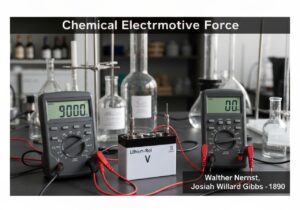
能斯特方程将半电池的还原电位(或电化学电池的总电压)与标准电极电位、温度以及发生氧化还原反应的化学物质的活度(通常用浓度近似表示)联系起来。该方程为[latex]E = E^{circ} – frac{RT}{nF} ln Q[/latex],其中 Q 为反应商。

(图片仅供参考)
能斯特方程将半电池的还原电位(或电化学电池的总电压)与标准电极电位、温度以及发生氧化还原反应的化学物质的活度(通常用浓度近似表示)联系起来。该方程为[latex]E = E^{circ} – frac{RT}{nF} ln Q[/latex],其中 Q 为反应商。
能斯特方程是电化学的基石,它提供了热力学和电池电势之间的定量联系。在公式 [latex]E = E^{circ} – frac{RT}{nF} ln Q[/latex] 中,[latex]E[/latex] 是特定条件下的电池电势,[latex]E^{circ}[/latex] 是标准电池电势,在所有物质活度均为单位活度时测得。[latex]R[/latex] 是通用气体常数,[latex]T[/latex] 是绝对温度,[latex]n[/latex] 是转移的电子摩尔数,[latex]F[/latex] 是法拉第常数。
The term [latex]Q[/latex], the reaction quotient, uses non-equilibrium concentrations. For a generic reaction [latex]aA + bB \rightleftharpoons cC + dD[/latex], [latex]Q = \frac{\{C\}^c \{D\}^d}{\{A\}^a \{B\}^b}[/latex], where {X} denotes activity. This equation shows that cell potential decreases as the reaction proceeds towards equilibrium (Q increases). At equilibrium, [latex]Q = K[/latex] (the equilibrium constant) and [latex]E = 0[/latex], meaning the battery is ‘dead’. The equation is crucial for understanding how concentration changes affect battery voltage and the potential across biological membranes, such as in neurons, where ion concentration gradients create membrane potentials essential for nerve signaling.
能斯特方程
(如果日期未知或不相关,例如“流体力学”,则提供其显著出现的近似估计)
只有注册会员才能免费获取完整尺寸的图片和下载内容。
> 登录 <