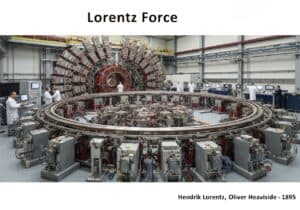
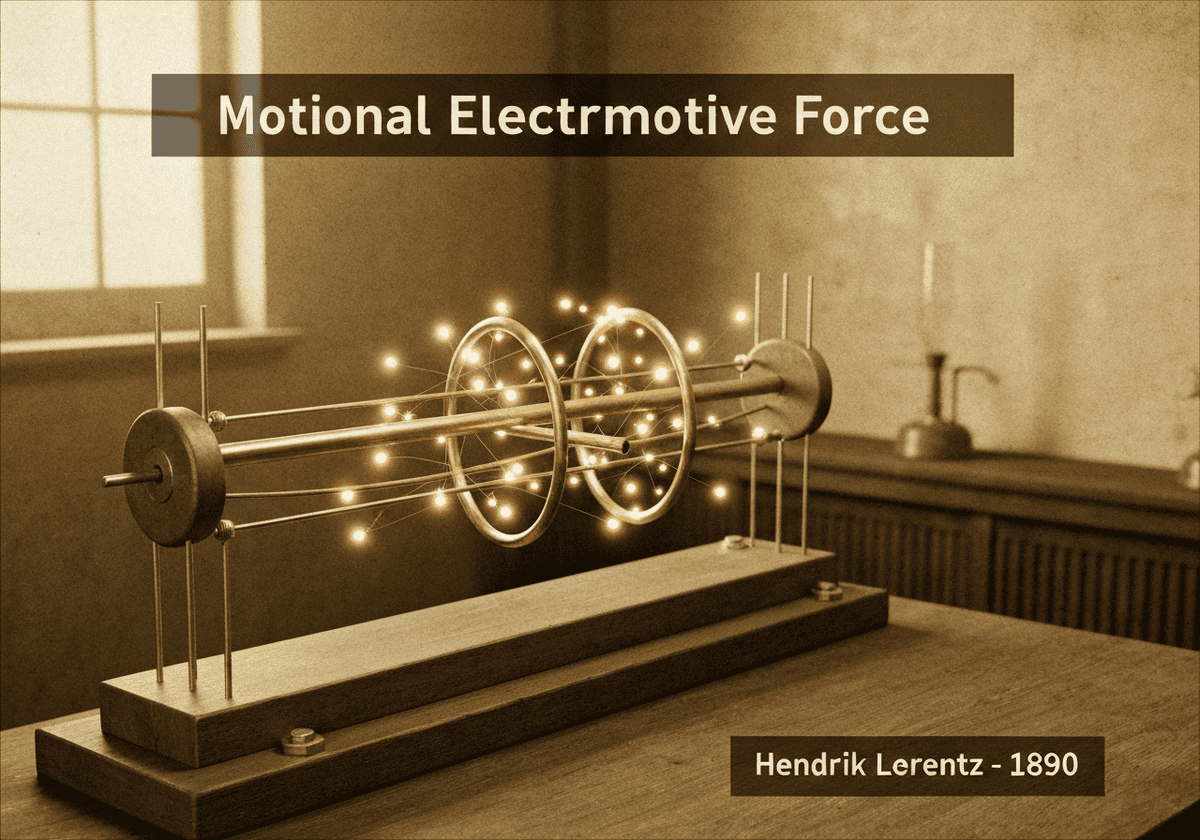
动能 电磁场 当导体在磁场中运动时,就会产生磁场。磁场的分量 洛伦兹力,[latex]mathbf{F} = q(mathbf{v} times mathbf{B})[/latex],作用于导体内的电荷载流子,使它们移动并产生电荷分离。这种分离建立了电场和电势差。由此产生的电动势由线积分 [latex]mathcal{E} = oint (mathbf{v} times mathbf{B}) cdot dmathbf{l}[/latex] 给出。
(图片仅供参考)
动能 电磁场 当导体在磁场中运动时,就会产生磁场。磁场的分量 洛伦兹力,[latex]mathbf{F} = q(mathbf{v} times mathbf{B})[/latex],作用于导体内的电荷载流子,使它们移动并产生电荷分离。这种分离建立了电场和电势差。由此产生的电动势由线积分 [latex]mathcal{E} = oint (mathbf{v} times mathbf{B}) cdot dmathbf{l}[/latex] 给出。

动能 电磁场 is a direct consequence of the 洛伦兹力 acting on mobile charges inside a conductor that is moving relative to a magnetic field. As the conductor moves with velocity [latex]\mathbf{v}[/latex] through a magnetic field [latex]\mathbf{B}[/latex], the free charges (electrons) within it experience a magnetic force [latex]\mathbf{F}_m = q(\mathbf{v} \times \mathbf{B})[/latex]. This force is perpendicular to both the velocity and the magnetic field, causing the charges to accumulate at one end of the conductor, leaving the other end with a net positive charge. This charge separation creates an internal electrostatic field [latex]\mathbf{E}_e[/latex] that opposes the further migration of charges. Equilibrium is reached when the electrostatic force [latex]\mathbf{F}_e = q\mathbf{E}_e[/latex] exactly balances the magnetic force, i.e., [latex]q\mathbf{E}_e = -q(\mathbf{v} \times \mathbf{B})[/latex].
电荷所处的有效电场 [latex]mathbf{E}_{eff} = mathbf{v} times mathbf{B}[/latex] 是一个非保守场,它驱动电流。电动势 (EMF) 是该有效场沿导体长度方向对单位电荷所做的功的积分。对于长度为 [latex]L[/latex] 的直导线,当其垂直于均匀电场 [latex]B[/latex] 运动时,电动势可简化为 [latex]mathcal{E} = BLv[/latex]。虽然动生电动势可以看作是法拉第电磁感应定律(从磁通量变化的角度来看)的一个特例,但洛伦兹力视角则提供了对电荷分离和由此产生的电压机制的更微观的解释。
运动电动势
(如果日期未知或不相关,例如“流体力学”,则提供其显著出现的近似估计)

只有注册会员才能免费获得 100% 的全尺寸图片和下载。.
> 登录 <