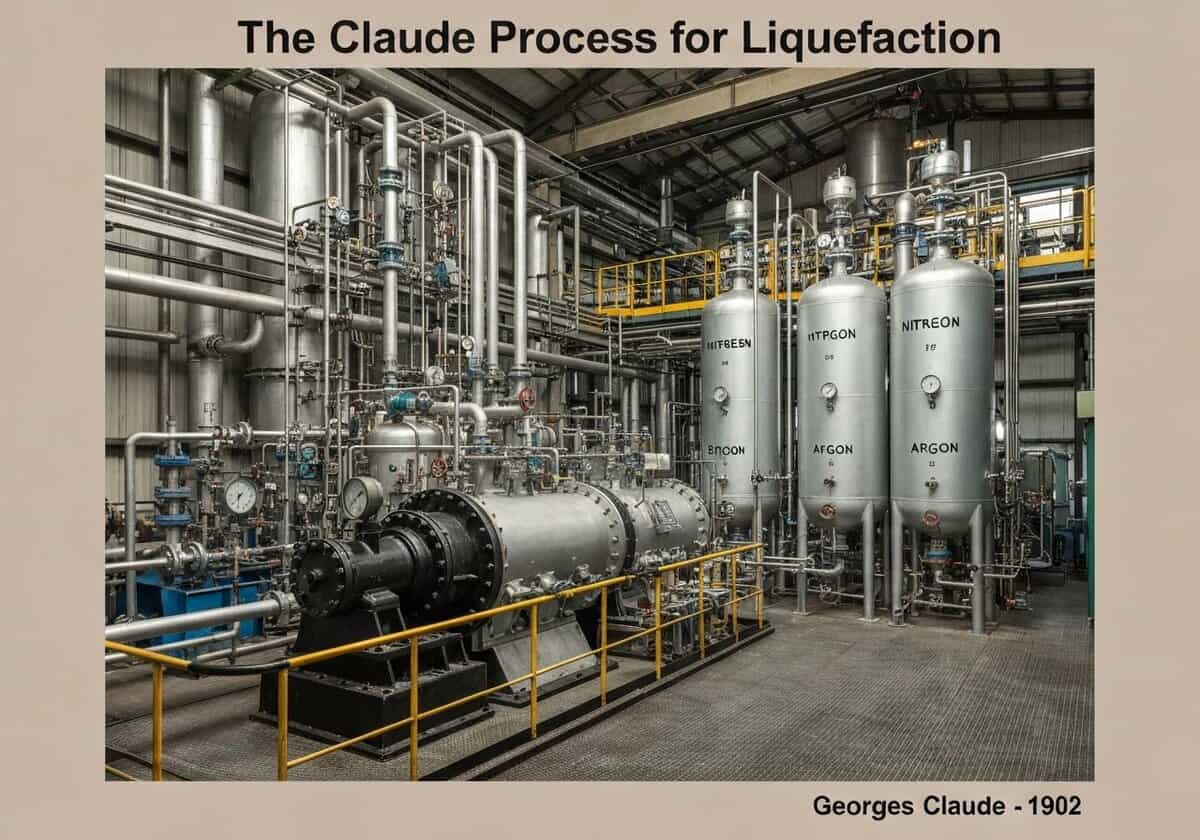
乔治·克劳德认识到仅仅依靠等焓理论的热力学效率低下。 焦耳-汤姆逊效应. He reasoned that making the gas perform external work during expansion would extract more energy and thus produce a greater cooling effect. In his system, the main stream of high-pressure gas is split. One part goes to an expansion engine, where it cools significantly while producing work. This extremely cold gas is then used to pre-cool the other part of the high-pressure stream in a heat exchanger. This second stream then undergoes a final Joule-Thomson expansion to produce the liquid. By combining the bulk cooling from the expander with the final-stage liquefaction from the J-T valve, the Claude cycle achieves higher efficiency and can operate at lower initial pressures than the Linde cycle. The work produced by the expander can also be recovered to help power the initial compressor, further improving overall efficiency. This principle is fundamental to virtually all modern large-scale cryogenic plants.