Product Design, Manufacturing & Innovation Resources
家 » 热力学第三定律

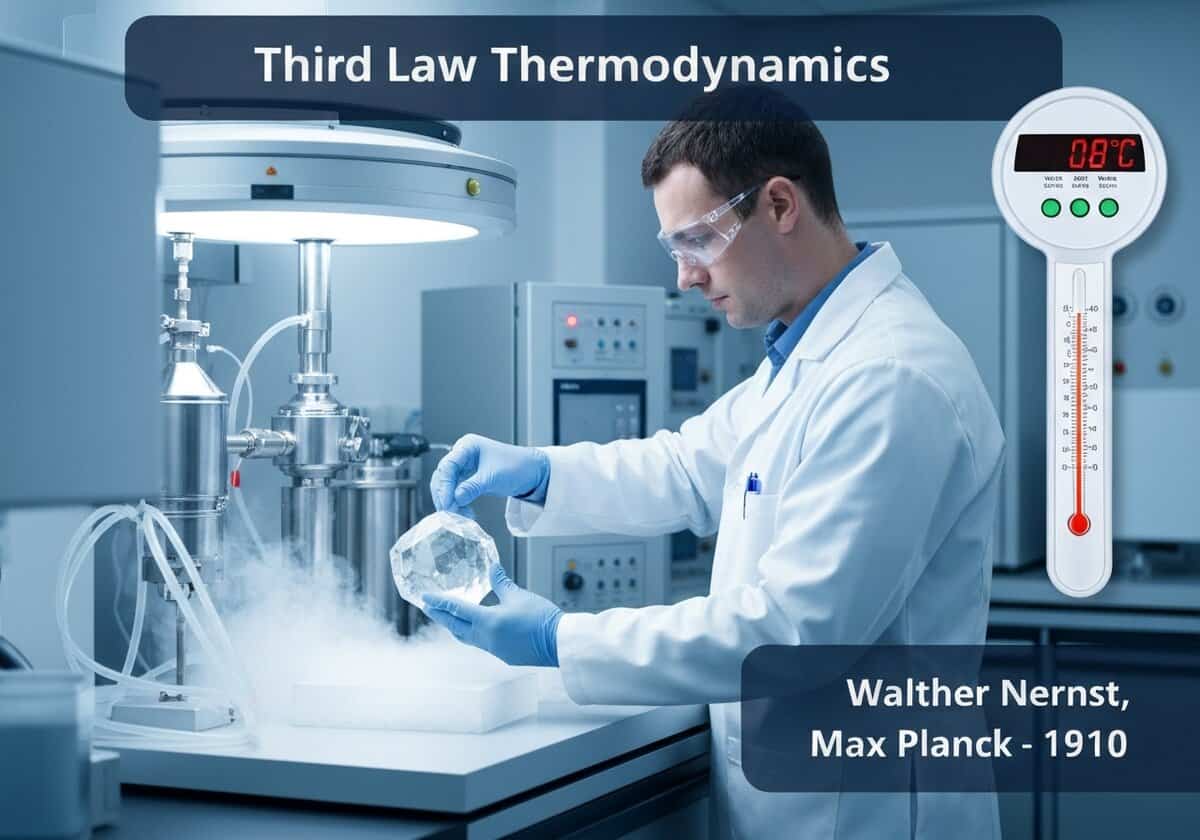
热力学第三定律

1910
  • Walther Nernst
  • Max Planck
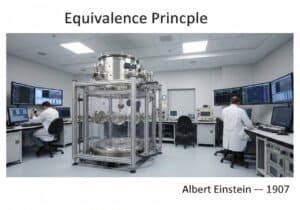
实验室场景,演示低温学中的热力学第三定律。

(图片仅供参考)

The Third Law states that the entropy of a perfect crystal approaches a constant minimum as its temperature approaches absolute zero ([latex]0[/latex] Kelvin). This minimum value is defined as zero. A key consequence is the unattainability of absolute zero in a finite number of steps. This law provides a fundamental reference point for determining the absolute entropy of a substance.
The Third Law originated from Walther Nernst’s work on chemical reactions at low temperatures, formulated as the Nernst Heat Theorem in 1906. He observed that the change in entropy for chemical reactions approaches zero as the temperature approaches absolute zero. Max 普朗克 later extended this to state that the entropy of each individual perfect crystalline substance is itself zero at absolute zero. This provides an absolute, rather than relative, scale for entropy.

The law’s novelty lies in its connection between thermodynamics and the quantum-mechanical nature of matter. At absolute zero, a system is in its ground state, which for a perfect crystal is a unique, non-degenerate state, corresponding to zero entropy ([latex]S = k_B \ln(1) = 0[/latex]). Amorphous materials like glass, however, have residual entropy at absolute zero due to their disordered structure. The law also implies that as [latex]T \rightarrow 0[/latex], specific heats ([latex]C_p[/latex], [latex]C_v[/latex]) and the coefficient of thermal expansion also approach zero. The unattainability principle arises because each step in a cooling process removes a smaller and smaller amount of entropy, requiring an infinite number of steps to reach zero entropy.

UNESCO Nomenclature: 2212
热力学、统计物理学和凝聚态物质

类型

抽象系统

中断

重大的

用法

广泛使用

前体

  • 配方 Second Law and the concept of entropy
  • 液化气体(氧气、氮气、氢气)和达到低温的实验进展
  • 路德维希·玻尔兹曼和 J. 威拉德·吉布斯对统计力学的发展
  • the emergence of quantum theory from Max Planck’s work on black-body radiation

应用程序

  • cryogenics and low-temperature physics
  • 计算化学亲和力和反应平衡常数
  • 材料科学,用于了解晶体结构、缺陷和残余熵
  • research into superconductivity and superfluidity, phenomena that occur near absolute zero
  • 化学物质绝对熵值的测定

专利:

NA

潜在创新理念

  • 开发用于太空应用的具有独特低温特性的新型非晶态金属
  • 量子计算架构在绝对零度附近运行,以最大限度地减少热退相干
  • 基于近零熵原理的天文学超灵敏辐射热计
  • 用于长期、零能量数据存储的完美晶体基态材料
  • 先进的生物组织低温保存技术,最大程度减少冰晶的形成
  • superconducting magnetic energy storage (中小企业) systems with near-zero resistance and energy loss
  • 玻色-爱因斯坦凝聚态操控,为干涉测量创造新的物质状态
  • 能够测量微开尔文范围内温度的温度计,用于基础物理研究
  • 用于创建和稳定高活性分子的低温化学合成
  • 基于第三定律原理的极低能量状态下早期宇宙物理模拟
Related to: third law, absolute zero, entropy, perfect crystal, Nernst heat theorem, unattainability principle, cryogenics, ground state, quantum mechanics, zero-point energy.

历史背景

热力学第三定律

1902
1907
1909
1910
1911-04-08
1913
1915
1902
1904
1907
1909
1910
1912
1915
1915-11

(如果日期未知或不相关,例如“流体力学”,则提供其显著出现的近似估计)

第十年 周年纪念日

只有注册会员才能免费获取完整尺寸的图片和下载内容。

> 登录 <