Product Design, Manufacturing & Innovation Resources
家 » 引力时间膨胀

引力时间膨胀

1915
  • Albert Einstein
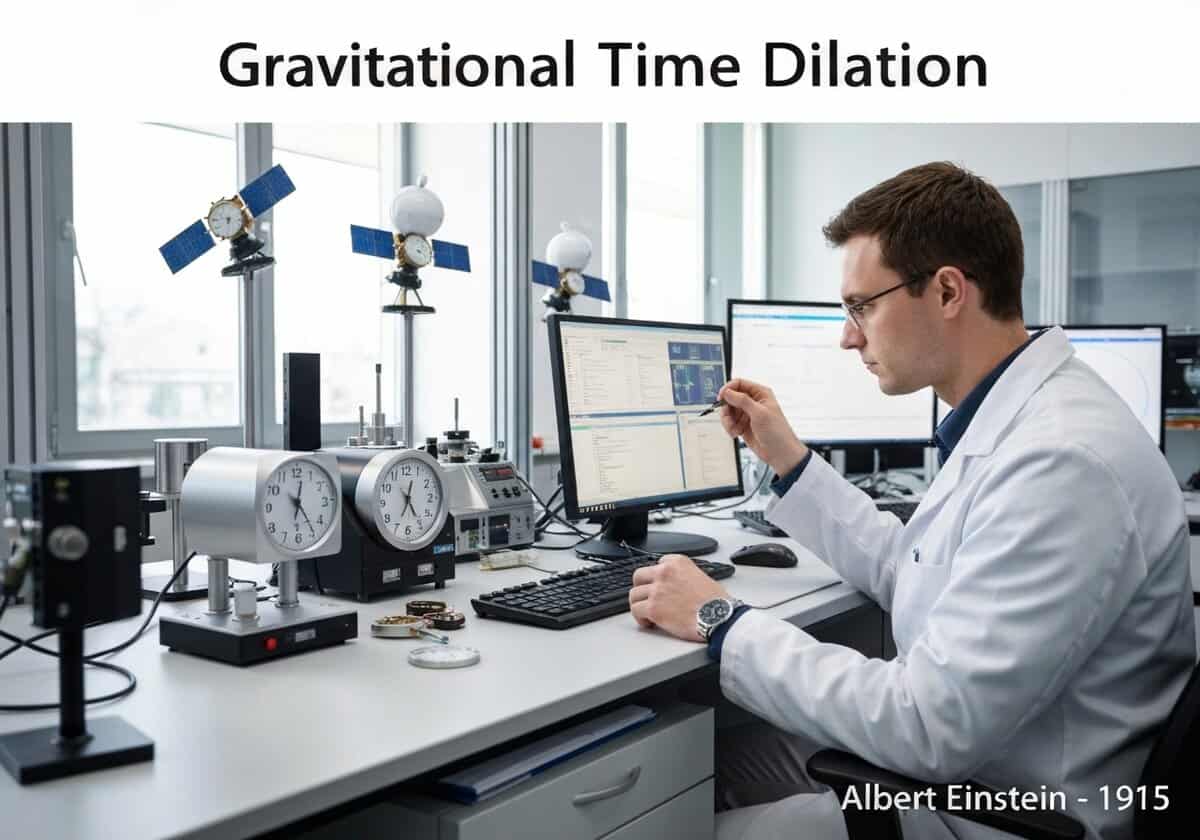
在实验室中进行原子钟校准,演示引力时间膨胀原理。

(图片仅供参考)

广义相对论的一个关键预测是,在不同的引力势下,时间流逝的速率不同。在强引力场(靠近大质量物体)中,时钟的走时会比在弱引力场中慢。这种效应被称为引力时间膨胀,已得到实验验证,并且是GPS等现代技术的关键因素。

引力时间膨胀源于时间流逝速度受时空曲率影响的原理。在引力较强的区域,时间本身的 "流动 "相对于引力较弱的区域要慢一些。这不是对时钟的机械影响,而是时间流逝的实际差异。例如,海平面上的时钟比山上的相同时钟运行得稍慢。对于一个不旋转的球面对称质量,这种效应的公式是 [latex]t_f = t_0 \sqrt{1 - \frac{2GM}{rc^2}}[/latex] ,其中 [latex]t_f[/latex] 是远处观察者的时间,[latex]t_0[/latex] 是引力场中的时间。

This effect was first confirmed experimentally by the Pound-Rebka experiment in 1959, which measured the gravitational redshift of photons (a related phenomenon). The most significant real-world application is the Global Positioning System (GPS). The atomic clocks on GPS satellites are in a weaker gravitational field than clocks on Earth’s surface, so they run faster by about 45 microseconds per day. They also experience special relativistic time dilation due to their high velocity, making them run slower by about 7 microseconds per day. The net effect is that GPS satellite clocks run faster by about 38 microseconds daily. Without correcting for this, GPS navigation errors would accumulate at about 10 kilometers per day, rendering the system useless.


UNESCO Nomenclature: 2211
- 相对论

类型

抽象系统

中断

重大的

用法

广泛使用

前体

  • 狭义相对论及其因速度引起的时间膨胀概念
  • 等效原理
  • 闵可夫斯基时空

应用程序

  • 全球定位系统 (GPS) 卫星需要对特殊和广义相对论时间膨胀进行修正才能准确运行
  • 使用原子钟进行精确计时
  • 了解黑洞和中子星的物理原理
  • 引力红移的天文观测

专利:

NA

潜在创新理念

  • 基于不同重力势能同步时钟的超安全通信信道
  • ‘chronoscaping’ habitats in deep space to alter the perception of time for long-duration missions
  • 用于绘制行星内部地图的重力势能传感器
  • 新一代原子钟利用时间膨胀来测量重力,精度空前
  • 通过将患者置于强烈的、暂时的重力场中,为医疗程序提供时间静止舱
  • 用于探测黑洞或中子星附近物体的先进导航系统
  • 动态考虑局部重力变化的全球时间标准
  • 利用时间膨胀微分来发电
相关内容: 时间膨胀、广义相对论、引力、时空、全球定位系统、原子钟、引力势、红移。

历史背景

引力时间膨胀

1909
1910
1912
1915
1915-11
1916
1918
1909
1910
1911-04-08
1913
1915
1916
1917
1918

(如果日期未知或不相关,例如“流体力学”,则提供其显著出现的近似估计)

第十年 周年纪念日

只有注册会员才能免费获取完整尺寸的图片和下载内容。

> 登录 <