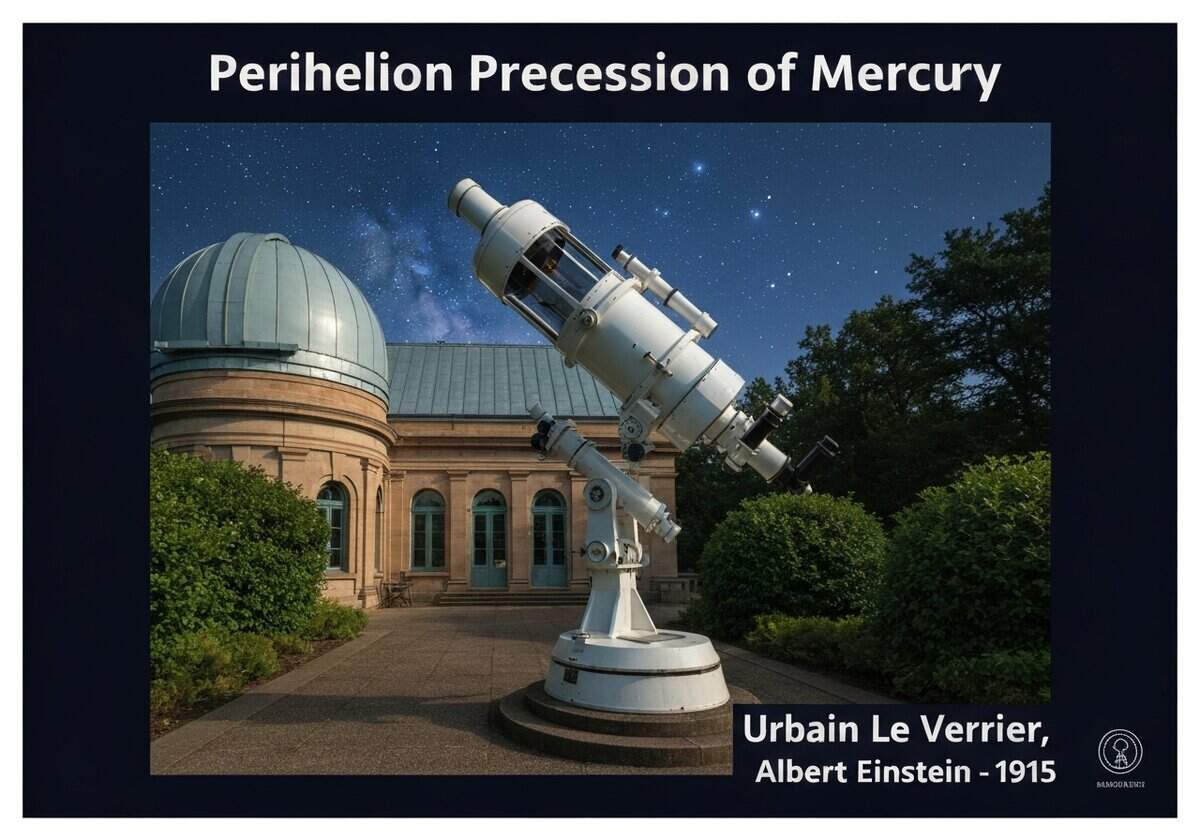
In 1915, Albert Einstein applied his new theory of general relativity to the problem. His calculations showed that the curvature of spacetime caused by the Sun’s mass would introduce a correction to the Newtonian description of gravity. This correction perfectly accounted for the missing 43 arcseconds per century without any ad-hoc parameters. Unlike Newton’s theory, where orbits are closed ellipses (in a two-body system), general relativity predicts that orbits are not closed but trace a rosette pattern. This effect is most pronounced for objects in strong gravitational fields and with eccentric orbits, making Mercury the ideal candidate in our 太阳 system. The successful explanation of Mercury’s perihelion precession was one of the first strong pieces of evidence that general relativity was a more accurate description of gravity than Newton’s theory.