酶催化(生物催化)
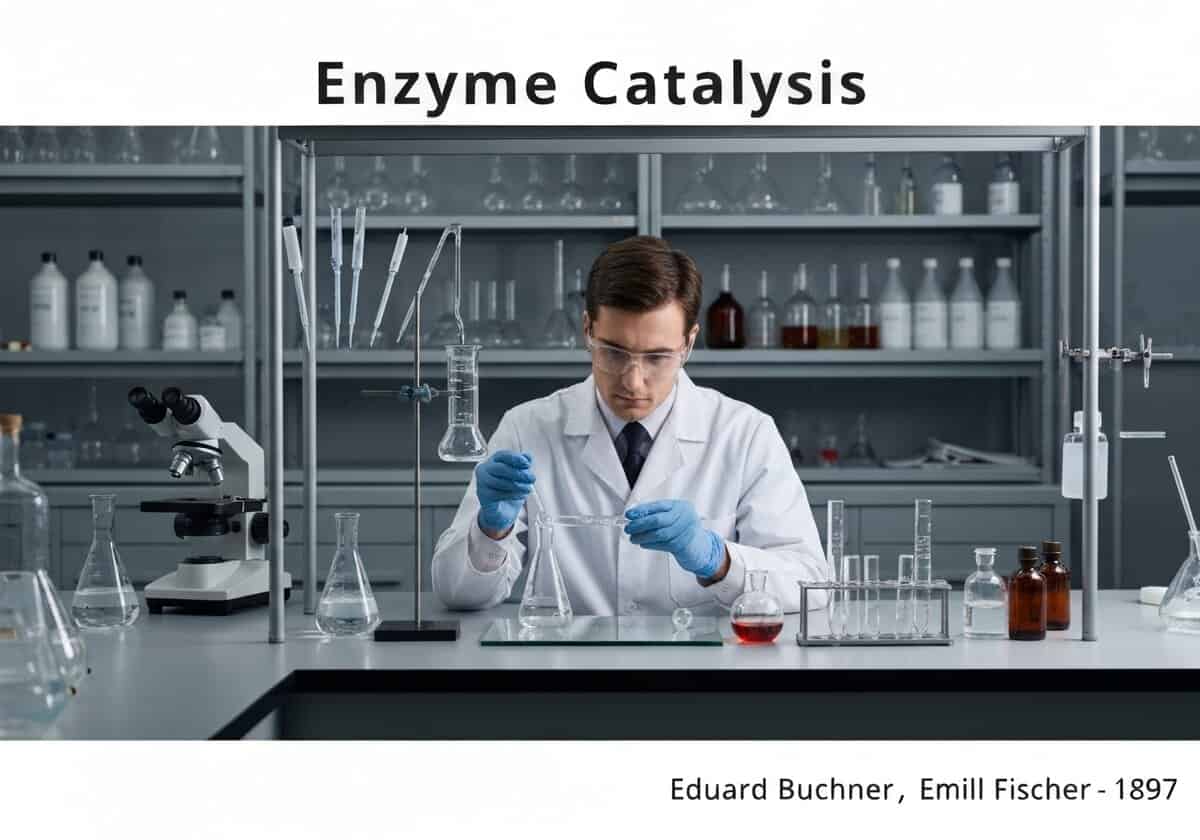
1897
- Eduard Buchner
- Emil Fischer
Enzymes are proteins that act as biological 催化剂 (biocatalysts). They exhibit remarkable specificity and efficiency, often accelerating reactions by factors of millions under mild physiological conditions (temperature, pH). The reaction occurs in a specific region of the enzyme called the active site, which binds the substrate through a lock-and-key or induced-fit mechanism.
Enzyme catalysis represents the pinnacle of catalytic efficiency and selectivity. These complex protein structures create a unique microenvironment within their active site that is perfectly tailored to stabilize the transition state of a specific reaction. This is achieved through a combination of factors: precise orientation of substrates, providing acidic or basic functional groups, straining substrate bonds, and providing an alternative covalent pathway. The kinetics of many enzyme-catalyzed reactions can be described by the Michaelis-Menten equation: [latex]v = \frac{V_{max}[S]}{K_M + [S]}[/latex], where [latex]v[/latex] is the reaction rate, [latex]V_{max}[/latex] is the maximum rate, [latex][S][/latex] is the substrate concentration, and [latex]K_M[/latex] (the Michaelis constant) is the substrate concentration at which the reaction rate is half of [latex]V_{max}[/latex].
Emil Fischer’s original ‘lock-and-key’ model proposed a rigid active site perfectly matching the substrate. This was later refined by Daniel Koshland’s ‘induced-fit’ model, which suggests that the active site is flexible and changes conformation upon substrate binding to achieve optimal catalytic orientation. This specificity is often stereospecific, meaning enzymes can distinguish between stereoisomers, a critical feature for producing enantiomerically pure drugs. While historically used in food production, modern biotechnology has expanded their use to industrial synthesis, diagnostics, and therapeutics through techniques like directed evolution, which allows scientists to engineer enzymes with novel properties.
UNESCO Nomenclature: 2302
– Biochemistry
前体
- Louis Pasteur’s work linking fermentation to living organisms
- 安塞尔姆·帕延 (Anselme Payen) 发现并分离淀粉酶
- Emil Fischer’s lock-and-key theory of enzyme specificity
- Eduard Buchner’s discovery of cell-free fermentation
应用程序
- 高果糖玉米糖浆的生产
- 蛋白酶在洗衣液中的应用
- 手性药物合成
- 奶酪和酸奶生产
- bioremediation to break down pollutants
潜在创新理念
- 由非生物支架制成的人工酶(合成酶)
- 酶可以降解塑料,例如宠物
- 用于工业合成的连续流动反应器中的固定化酶
- 用于医疗诊断和环境监测的酶基生物传感器
- 使用多种酶在单个容器中进行级联反应来构建复杂分子
- 在非水溶剂中起作用的有机合成酶
- 用于高温工业过程的嗜极微生物耐热酶
- 光激活酶(光酶)用于精确控制反应的时空
- 用于捕获和转化二氧化碳的酶
- 体内酶疗法纠正代谢紊乱
Related to: enzyme, biocatalysis, active site, Michaelis-Menten kinetics, specificity, induced fit, lock and key, substrate, protein, directed evolution.