Product Design, Manufacturing & Innovation Resources
Home » Online Tools » PubChem Chemical Information Search

PubChem Chemical Information Search

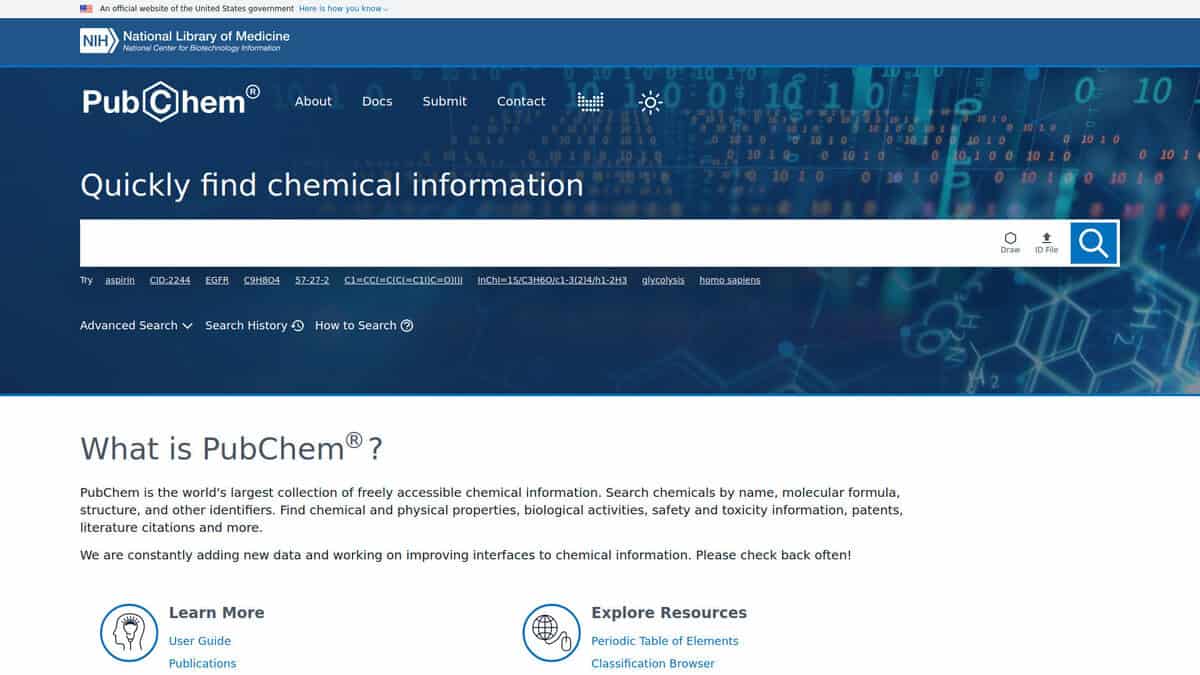
Hosted by the National Library of Medicine, PubChem is a comprehensive, open-access chemical database maintained by the National Center for Biotechnology Information (NCBI) at the National Institutes of Health (NIH). It aggregates data from over 1,000 sources, including government agencies, chemical vendors, and scientific journals, to provide detailed records on more than 119 million unique chemical structures. The platform provides:

  • Chemical nomenclature, structural identifiers (SMILES, InChI), and 2D/3D molecular visualizations.
  • Physicochemical properties, biological activities, and high-throughput screening bioassay results.
  • Safety and toxicity profiles, including Laboratory Chemical Safety Summaries (LCSS) and regulatory data.
  • Integrated patent information and consolidated scientific literature citations linked to specific compounds.

The largest (?) online database and most complete information freely available from what we could test.

Pharmaceutical scientists and medicinal chemists utilize PubChem to identify lead compounds and develop predictive models for drug discovery through high-throughput screening data. Chemical engineers and manufacturing professionals leverage the platform’s Laboratory Chemical Safety Summaries to conduct hazard assessments and ensure regulatory compliance during process design.
Disciplines: Chemistry, Pharmacology, Toxicology, Materials science, Biochemistry, Chemical engineering.
Free alternative to SciFinder, Reaxys, ChemSpider.
PubChem compared with SciFinder, Reaxys and ChemSpider
PubChemSciFinderReaxysChemSpider
Content and size: Three linked databases: Substance, Compound and BioAssay. Figures reported in 2020 were about 111 million compounds, 293 million substances and 1.25 million bioassays.Content and size: A CAS (American Chemical Society) platform covering substances, reactions, literature, patents and regulatory information, with supplier data to compare commercial availability and cost.Content and size: An Elsevier database combining literature and patents with substance records that hold spectra, properties and commercial availability. It also covers in vitro and in vivo bioactivity, toxicity and ADME data, and states 1B+ data points.Content and size: A free chemical structure database from the Royal Society of Chemistry with more than 120 million structures, offering properties plus text and structure searches.
Data origin: Aggregated from 629 data sources in 40 countries as of August 2018, including government agencies, vendors and journals. The data is in the public domain.Data origin: Curated by scientists and enhanced with AI-assisted tools, according to the vendor.Data origin: Described by the vendor as AI and expert curated data connected across the literature and patents.Data origin: Compound data from hundreds of sources, with links back to the originals. Predicted properties and 3D structures are added by external collaborators.
Access and cost: The web interface is free and large datasets can be downloaded by FTP. The PUG-View web service gives programmatic access to chemical annotations.Access and cost: Access is arranged through a demo request. The product page does not publish pricing.Access and cost: Available through Reaxys.com or by contacting Elsevier. API, MCP or flat file access is a separate licence.Access and cost: Free to use. The Royal Society of Chemistry has owned it since 2009 and offers integration services for use in other applications.
Synthesis planning: Curated reaction data supports retrosynthesis and route planning, with predictive tools.Synthesis planning: Shows published and AI-predicted synthesis routes together, and ranks literature-backed reaction conditions with its Conditions Navigator.

Topics covered: PubChem, chemical database, open-access, chemical nomenclature, structural identifiers, SMILES, InChI, molecular visualizations, physicochemical properties, biological activities, safety profiles, toxicity profiles, high-throughput screening, Laboratory Chemical Safety Summaries, regulatory data, patent information, drug discovery, hazard assessments, ISO 17025, ISO 9001, ISO 14001, ASTM E2456, and OECD Guidelines for Testing of Chemicals..

More Resources, Search tools

Suggest your best online tool:

Do you know a better, a complementary or a replacement website to the one listed above ?

> Suggest it here <

10th year anniversary

Full size images and downloads are only available, 100% free, for registered members.

> Login <