Product Design, Manufacturing & Innovation Resources
Home » Online Tools » MakeItFrom Materials Database

MakeItFrom Materials Database

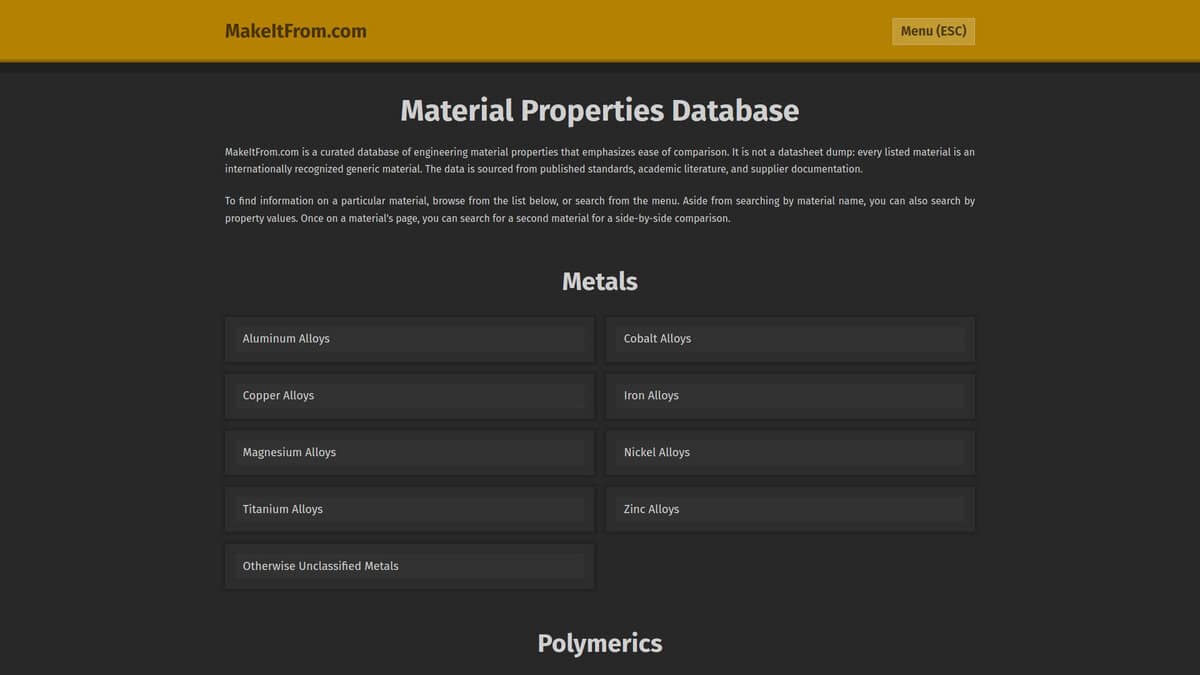
MakeItFrom is a materials property database covering metals, polymers, ceramics and composites. Each material page lists mechanical, thermal, electrical and chemical properties with typical values and ranges, alongside composition and common applications.

Property definitions are explained next to the figures, so a reader who is not a materials specialist can interpret a value such as fatigue strength or thermal diffusivity. Materials can be compared on the same properties.

Engineers use it for first-pass material selection and for checks before opening a licensed database. Product developers and designers screen candidates on stiffness, density and thermal behavior. Treat the values as typical, not as a specification, and confirm critical data with the supplier.
Disciplines: Materials science, Mechanical engineering, Product design, Manufacturing, Metallurgy, Plastics engineering.
Free alternative to Granta EduPack, Matmatch.
MakeItFrom Materials Database compared with Granta EduPack and Matmatch
MakeItFromGranta EduPackMatmatch
Data origin: MakeItFrom compiles its data from a survey of technical literature, including academic books and supplier documentation. Where a property varies with processing, it generally gives a single averaged value.Data origin: The vendor describes a materials and process database, with sustainability and eco-design databases. The full version adds advanced databases with industry-standard data.Data origin: Matmatch connects engineers and material suppliers. Launch coverage states that its data comes from licensed academic and corporate databases and is compiled and checked by its own materials scientists.
Scope: The selection is curated, and the site does not state how many materials it holds. Heat-treatment variants such as 6061-O and 6061-T6 are listed as separate materials.Scope: The Material Universe covers data on 4,000 materials. Selection charts follow the methodology of Prof. Mike Ashby, and the full version adds an advanced materials comparison tool.Scope: The platform advertises more than 31,000 materials that can be discovered, compared and evaluated. Launch coverage lists metals, ceramics, polymers and composites.
Intended users: Visitors can request materials or properties that are not yet listed.Intended users: The software targets educators and students from pre-university to postgraduate level, in three levels, with a separate Introductory version for introductory courses.Intended users: The intended audience includes engineers, product designers and procurement teams looking for materials and suppliers.
Access and cost model: A paid membership option is offered. Terms are published on a separate disclaimer and terms page.Access and cost model: Access is arranged with the vendor. The page offers a demo request or contact form and does not describe the licensing terms.Access and cost model: Launch coverage describes it as a free online materials database. The company page does not discuss pricing.
Reading the values: Wide property ranges can reflect ambiguity in what a material name covers, not only processing variation. Treat values as typical and confirm critical data with the supplier.Reading the values:

More Resources tools

Suggest your best online tool:

Do you know a better, a complementary or a replacement website to the one listed above ?

> Suggest it here <

10th year anniversary

Full size images and downloads are only available, 100% free, for registered members.

> Login <