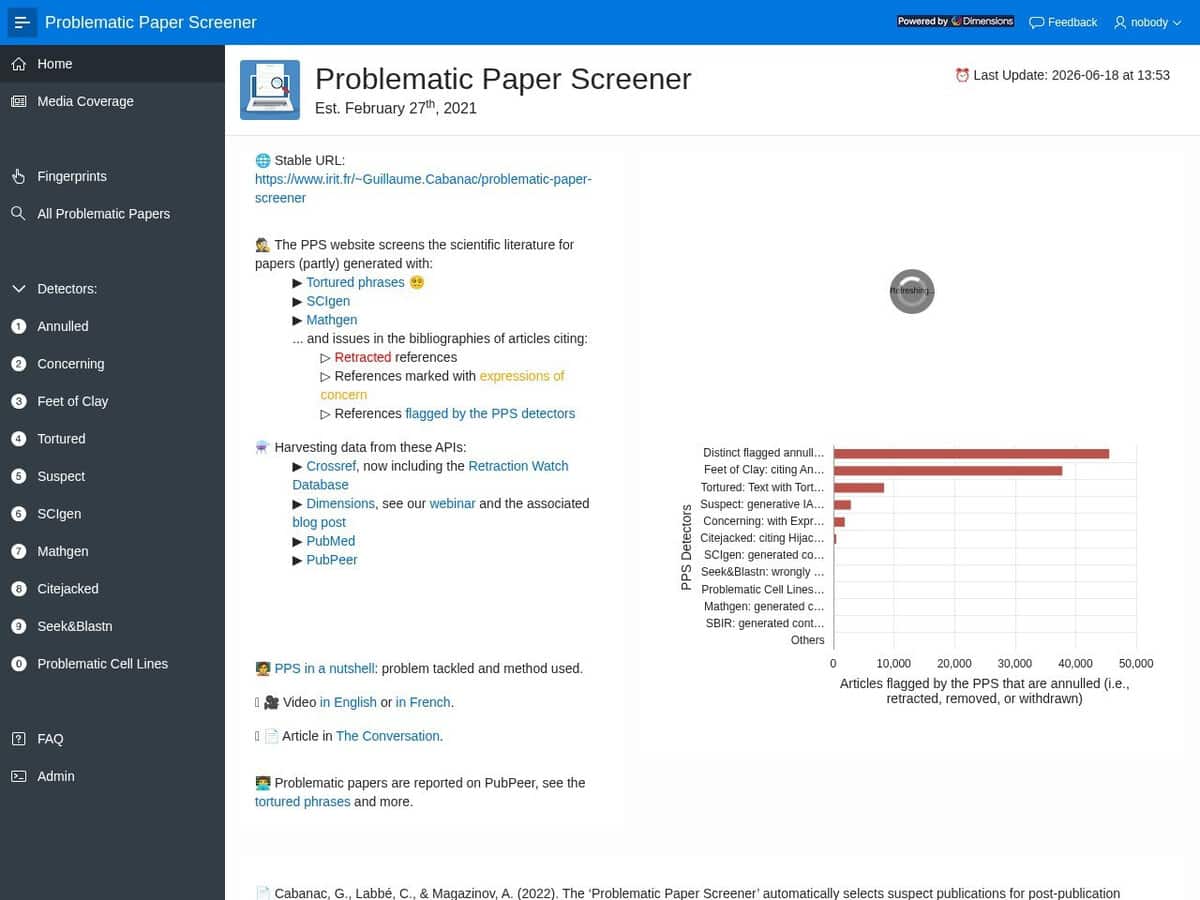
The Problematic Paper Screener (PPS) tool runs automated “fingerprint-queries” against the Dimensions.ai academic search engine, hunting for textual or structural patterns that correlate with known fraud. Malpractices are automatically identified using specific fingerprint-queries submitted to Dimensions.ai, and human peer judgment can then confirm or refute the status of a suspect paper. The public interface also lets users propose new fingerprints, so the detection list keeps growing. (extract from Wikipedia, as text below).
What it actually catches:
- Tortured phrases — garbled paraphrases like “fake neural organization” instead of “artificial neural network,” produced when fraudsters run stolen text through synonym-swapping software to dodge plagiarism checkers.
- Computer-generated gibberish — papers built from nonsense generators like SCIgen and Mathgen, identified via fixed phrases these tools always produce, such as “though many skeptics said it couldn’t be done”.
- ChatGPT fingerprints — leftover snippets of telltale AI-generated text accidentally left in a submitted manuscript, plus several other detector types for things like suspicious citation patterns.
Its track record: the screener has been instrumental in more than 1,000 retractions, and some publishers have built it directly into their editorial workflow to catch suspect papers before publication rather than after. It was named one of ten key developments in science by Nature in 2021. Over 12,000 flagged-but-not-yet-retracted papers have also been integrated into a separate tool called Signals, where they’re collectively cited more than 160,000 times — illustrating how long flagged-but-unretracted fraud can keep circulating and influencing other research before anyone formally acts on it.
It doesn’t replace human editorial judgment, but it does the one thing humans can’t do at scale — continuously scanning tens of millions of papers for fraud fingerprints and surfacing the suspicious ones for a person to actually review.











