FreeFEM compared with ANSYS Mechanical, Abaqus and COMSOL| FreeFEM | ANSYS Mechanical | Abaqus | COMSOL |
|---|
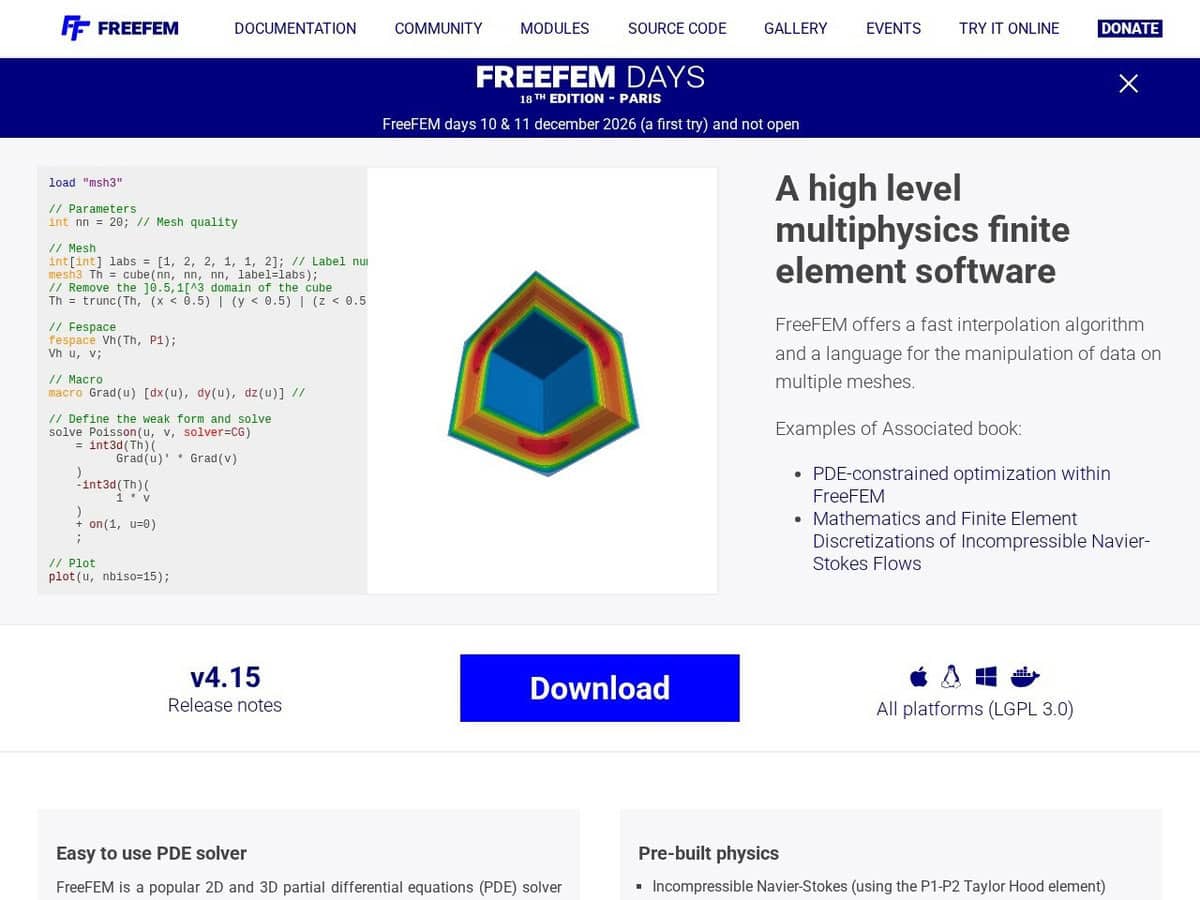
| Technical basis and workflow: FreeFEM solves partial differential equations in 2D and 3D with the finite element method. You write the model as a script in the FreeFEM language, so the variational form and boundary conditions stay explicit and under your control. | Technical basis and workflow: ANSYS Mechanical is a finite element analysis product used to evaluate strength, heat distribution and other physical behaviour of structures and components. It is typically run through the Ansys Workbench environment rather than from scripts. | Technical basis and workflow: Abaqus is a suite of non-linear finite element solvers. Abaqus/Standard is an implicit solver for static and low-speed dynamic problems, Abaqus/Explicit handles high-speed dynamics, impact and crash, and Abaqus/CAE provides the pre- and post-processing. | Technical basis and workflow: COMSOL Multiphysics is a commercial simulation platform for coupled physics problems. Models can be packaged as applications with the Application Builder and hosted with COMSOL Server. |
| Licence and cost model: FreeFEM is open source under the LGPL 3.0 and has no licence fee. It is the only option here that you can use, modify and redistribute freely. | Licence and cost model: Ansys software is sold on an annual subscription basis, so budget for a recurring licence cost. | Licence and cost model: Licensing is token based, per concurrent user and per additional core. It can be bought outright or leased yearly or quarterly, and the price depends on CPU and GPU cores and users, not on functionality. | Licence and cost model: COMSOL offers Named Single User, Locked Single User (CPU), Floating Network and Class Kit licences. Floating licences are counted per concurrent user and suit shared engineering teams. |
| Openness and extensibility: The source code is on GitHub and the language lets you implement your own physics modules. This suits researchers who need a formulation that no commercial solver provides. | | Openness and extensibility: A Python interface automates geometry, meshing, loads and post-processing. User subroutines in Fortran or C++ (for example UMAT and VUMAT for custom materials) extend both solvers. | Openness and extensibility: Applications built with the Application Builder can be hosted inside or outside an organisation with a COMSOL Server licence, which is useful for giving non-specialists a restricted interface. |
| Meshing, solvers and scale: FreeFEM has a built-in mesher (BAMG) and works with Tetgen, Gmsh, Mmg and ParaView. It interfaces with MUMPS, PETSc and HPDDM for parallel solving, and links to the Qarnot and Rescale HPC clouds. | | Meshing, solvers and scale: Abaqus runs in parallel with MPI and threads, supports GPU acceleration and scales over several HPC nodes. Cloud deployment on Azure and AWS is described by the vendor. | Meshing, solvers and scale: All COMSOL licence types support multicore processing and none is tied to one operating system. Floating Network licences also allow remote, cluster and cloud computing on Windows and Linux. |
| Status and ownership: The FreeFEM site gives no version number and points to the GitHub releases page for downloads. An online try-out is available from the site, though a local install is the normal route. | Status and ownership: Synopsys completed its acquisition of Ansys on 17 July 2025, so Ansys is now a Synopsys subsidiary. | Status and ownership: Abaqus is developed by Dassault Systemes under the SIMULIA brand and integrates with CATIA and SOLIDWORKS. | |