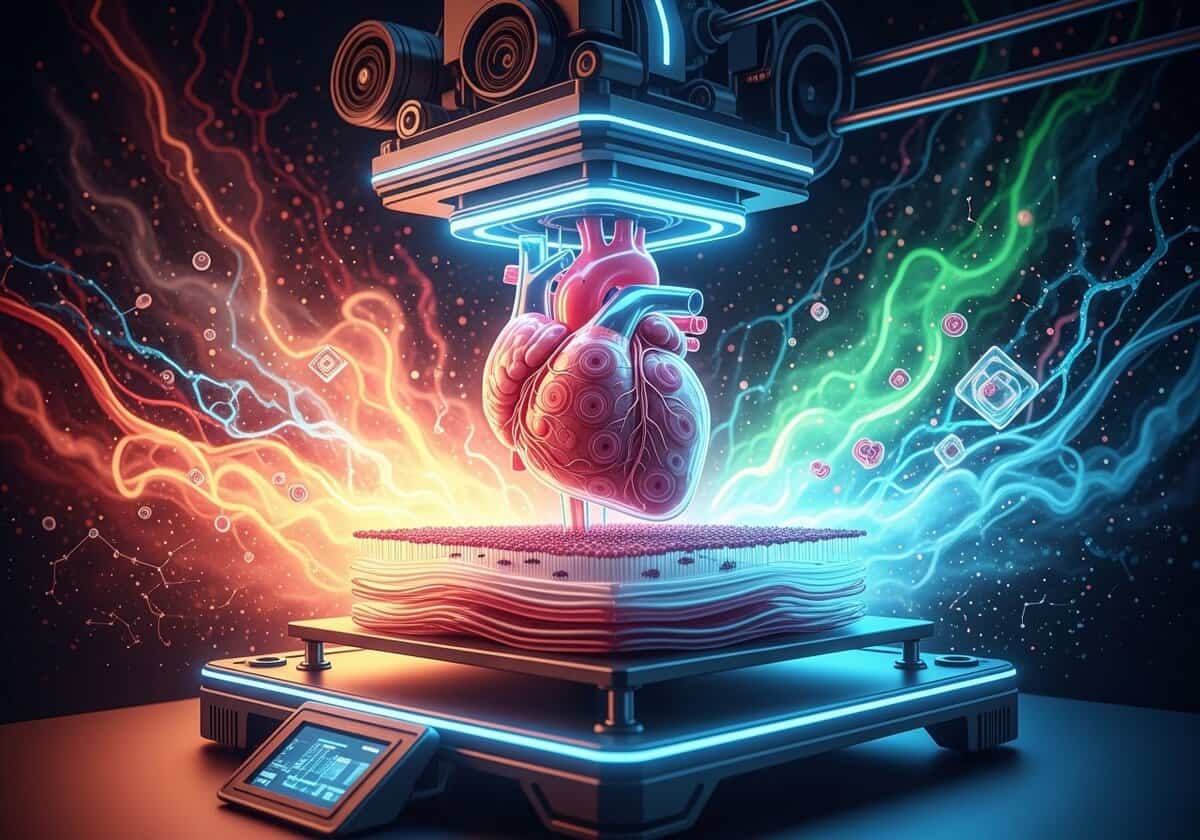
Bio-printing integrates additive fabricación techniques with cellular biology to fabricate three-dimensional, functional living tissues and organ constructs. This domain involves precise deposition of cell-laden bio-inks, biomaterials, and growth factors to replicate native tissue architecture and microenvironment. Advances in scaffold design, vascularization strategies, and multi-material printing have propelled applications in regenerative medicine, drug testing, and personalized therapeutics. The following compilation presents the latest peer-reviewed publications and patented innovations, reflecting cutting-edge methodologies, novel bio-ink formulations, printing tecnologías, and translational breakthroughs shaping the future of tissue engineering and organ fabrication.
Esta es nuestra última selección de publicaciones y patentes mundiales en inglés sobre Bio-printing, entre muchas revistas científicas online, clasificadas y centradas en bio-printing, bio-printing 3D, ingeniería de tejidos, biomateriales, bio-tinta cargada de células, fabricación de andamios, impresión de órganos, biotinta de hidrogel, bioimpresión por extrusión, bioimpresión asistida por láser, bioimpresión de microválvulas, bioimpresión de células madre, formulación de biotinta, bioimpresión, resolución de bioimpresión, software de bioimpresión, biorreactor, bioimpresión, bioimpresión de cartílago y bioimpresión de piel.
One-pot method for recombinant geranylgeranylated protein production
Patent published on the 2026-06-11 in WO under Ref WO2026122736 by MOZHDEHI DAVOUD [US] (Alam Md Mahbubul [us], Mozhdehi Davoud [us])
Abstract: A method for the one-pot production of geranylgeranylated proteins in Escherichia coli. E. coli is engineered to express geranylgeranyl pyrophosphate synthase, an enzyme that catalyzes production of geranylgeranyl pyrophosphate, and a target protein. By co-expressing GGS with a geranylgeranyltransferase, efficient geranylgeranylation of model protein substrates was achieved, including intrinsically disordered elastin-like polypeptides (ELPs) and the globular protein mCherry. This modification af[...]
Our summary: A one-pot method for producing geranylgeranylated proteins in E. coli was developed. The method involves co-expressing geranylgeranyl pyrophosphate synthase and geranylgeranyltransferase for efficient modification of target proteins. This approach is scalable and cost-effective, enhancing studies on lipid-modified proteins for drug delivery and tissue engineering.
recombinant proteins, geranylgeranylation, Escherichia coli, protein engineering
Patent
Cryobioprinting formulation
Patent published on the 2026-06-04 in WO under Ref WO2026117705 by THE BRIGHAM AND WOMENS HOSPITAL INC [US] (Zhang Yu Shrike [us])
Abstract: A bioink for cryobioprinting is described. The bioink comprises a decellularized extracellular matrix (dECM)-based hydrogel and a saccharide cryoprotectant. A method of making a 3D-printed biomaterial is also described, which includes depositing a bioink comprising a dECM-based hydrogel, cells, and a saccharide cryoprotectant from a 3D printer onto a freezing plate to form a frozen bioink filament; depositing additional bioink from a 3D printer in contact with a previously placed frozen bioink f[...]
Our summary: A bioink formulation for cryobioprinting is presented, consisting of a dECM-based hydrogel and a saccharide cryoprotectant. The method involves 3D printing the bioink onto a freezing plate to create frozen filaments. The resulting 3D-printed biomaterials consist of multiple frozen bioink filaments.
Cryobioprinting, bioink, decellularized extracellular matrix, hydrogel
Patent
Fixed bed bioreactor with three dimensional cell uniformity and related methods
Patent published on the 2026-06-04 in WO under Ref WO2026117460 by CORNING INCORPORATED [US] (Borges Melroy Remmy [us], Rezikyan Aram [us], Seeley Lori Ann [us], Tjong Vinalia [us])
Abstract: A cell culture bioreactor system is provided with a cell culture vessel having an interior volume capable of perfusing liquid media therethrough, an inlet fluidly connected to the interior volume, and an outlet fluidly connected to the interior volume. A cell culture bed disposed in the interior volume includes a substrate for adhering cells thereto. The bioreactor system can seed cells onto the substrate and culture the seeded cells while achieving a uniform cell distribution through the cell c[...]
Our summary: A fixed bed bioreactor system enables uniform cell distribution within a culture vessel. It features an inlet and outlet for perfusing liquid media. The system achieves a normalized variance of cell concentration less than or equal to 0.5.
bioreactor, cell culture, uniform distribution, substrate
Patent
Method of transferring a microbial bioprocess from a multi-use bioreactor to a single-use bioreactor
Patent published on the 2026-06-03 in EP under Ref EP4752207 by SARTORIUS STEDIM BIOTECH GMBH [DE] (Leupold Marco [de], Rupprecht Jens [de])
Abstract: The invention relates to a method of transferring a microbial bioprocess from a multi-use bioreactor to a single-use bioreactor, wherein the source bioprocess is a batch or fed-batch microbial bioprocess and the source bioprocess arrangement comprises a source bioreactor with a stirrer and the source bioreactor is the multi-use bioreactor which has at least 1000 L production volume of a microbial culture producing a maximum heat of at least 25,000 W and/or the stirrer of the source bioreactor is[...]
Our summary: The method involves transferring a microbial bioprocess from a multi-use bioreactor to a single-use bioreactor. The source bioprocess can be batch or fed-batch, while the target bioprocess is continuous. The target bioreactor has a smaller production volume and lower heat output compared to the source bioreactor.
bioprocess transfer, single-use bioreactor, multi-use bioreactor, microbial culture
Patent
Fixed bed bioreactor with reduced bypass and related methods
Patent published on the 2026-05-28 in WO under Ref WO2026111780 by CORNING INCORPORATED [US] (Brawn Tristan Yale [us], Goral Vasiliy Nikolaevich [us], Harding Charles Philip [us], Hong Yulong [us], Meyer Steven Eric [us], Sabin Douglas Grosvenor [us], Timmons Christopher Lee [us])
Abstract: A bioreactor system is provided that includes a cell culture vessel having an interior reservoir defined by an interior wall. A fixed-bed cell culture matrix having a plurality of layers of substrate is contained within the interior reservoir and has a bed height and a bed width in a direction perpendicular to the direction of the bed height. The system further includes a compression sleeve surrounding at least a portion of the fixed-bed cell culture matrix. The compression sleeve exerts a compr[...]
Our summary: A bioreactor system features a fixed-bed cell culture matrix within an interior reservoir. It includes a compression sleeve that applies a compressive force to reduce the bed width. The sleeve can also release the force, allowing the bed width to expand.
bioreactor, cell culture, fixed-bed, compression sleeve
Patent
Microcavity bioreactors and systems for 3d cell culture
Patent published on the 2026-05-28 in WO under Ref WO2026111867 by CORNING INCORPORATED [US] (Fang Ye [us])
Abstract: A microcavity bioreactor is provided that allows cell growth and cell differentiation in the same vessel, such that higher order three-dimensional cell cultures such as organoids can be generated in a singular vessel. The microcavity bioreactor may be part of a microcavity bioreactor system that allows for perfusion based cell culture and perfusion based cell harvesting. The microcavity bioreactor includes at least one, and preferably at least two, fluid distributor structures in the housing ves[...]
Our summary: Microcavity bioreactors enable simultaneous cell growth and differentiation in a single vessel. They facilitate the generation of higher-order 3D cell cultures like organoids. The system incorporates fluid distributor structures for enhanced perfusion-based culture and harvesting.
microcavity bioreactor, 3D cell culture, organoids, perfusion
Patent
Joint material and shape optimization of a 3D printing nozzle by CFD and response surface methodology
Published on 2026-03-12 by @OXFORD
Abstract: AbstractThree-dimensional printing (3D printing) has emerged as a transformative technology in medicine, enabling the fabrication of complex structures with high precision. In bioprinting, optimization of nozzle design is essential to balance print resolution, mechanical strength, and biocompatibility. This study presents a computational framework for optimizing bioprinting performance by simultaneously accounting for nozzle geometry and biomaterial rheological properties. Using computational fl[...]
Our summary: This study presents a computational framework for optimizing bioprinting by integrating nozzle geometry and biomaterial properties. It utilizes CFD and response surface methodology to identify optimal nozzle configurations. Results show significant improvements in flow rate and reductions in wall shear stress, demonstrating the effectiveness of the approach.
3D printing, nozzle optimization, computational fluid dynamics, response surface methodology
Publication
A Case Study in Sabanalarga, Colombia
Published on 2026-02-04 by Lina Henriquez Sarmiento, Hugo Hernndez, Anderson Nieto Granados, Jorge Rodas, Andrea Liliana Moreno-Ros, Andreas Hasse, Diana Pinto, Claudete Gindri Ramos @MDPI
Abstract: Technosols are artificial soils produced from organic and inorganic solid waste to improve soil fertility and functionality. This study evaluated the potential of Technosols produced from household waste from the Altos de Guadalupe residential complex in Colombia to fertilize green areas and promote the growth of Duranta erecta. A physical characterization of waste from 46 houses was performed to estimate per capita production (PPC) and waste composition. Technosols were produced in 20, 50, and [...]
Our summary: Technosols made from household waste were evaluated for their ability to enhance soil fertility and promote plant growth in Sabanalarga, Colombia. The study found that Technosols significantly improved soil organic matter and nutrient availability, leading to increased plant height and root dry matter. These findings support the use of Technosols in urban agriculture, aligning with circular economy principles and sustainable development goals.
Technosols, soil fertility, organic waste, urban agriculture
Publication