Product Design, Manufacturing & Innovation Resources
Home » Cochlear Implant

Cochlear Implant

1980
  • Graeme Clark
  • Ingeborg Hochmair
  • Erwin Hochmair
  • Blake S. Wilson
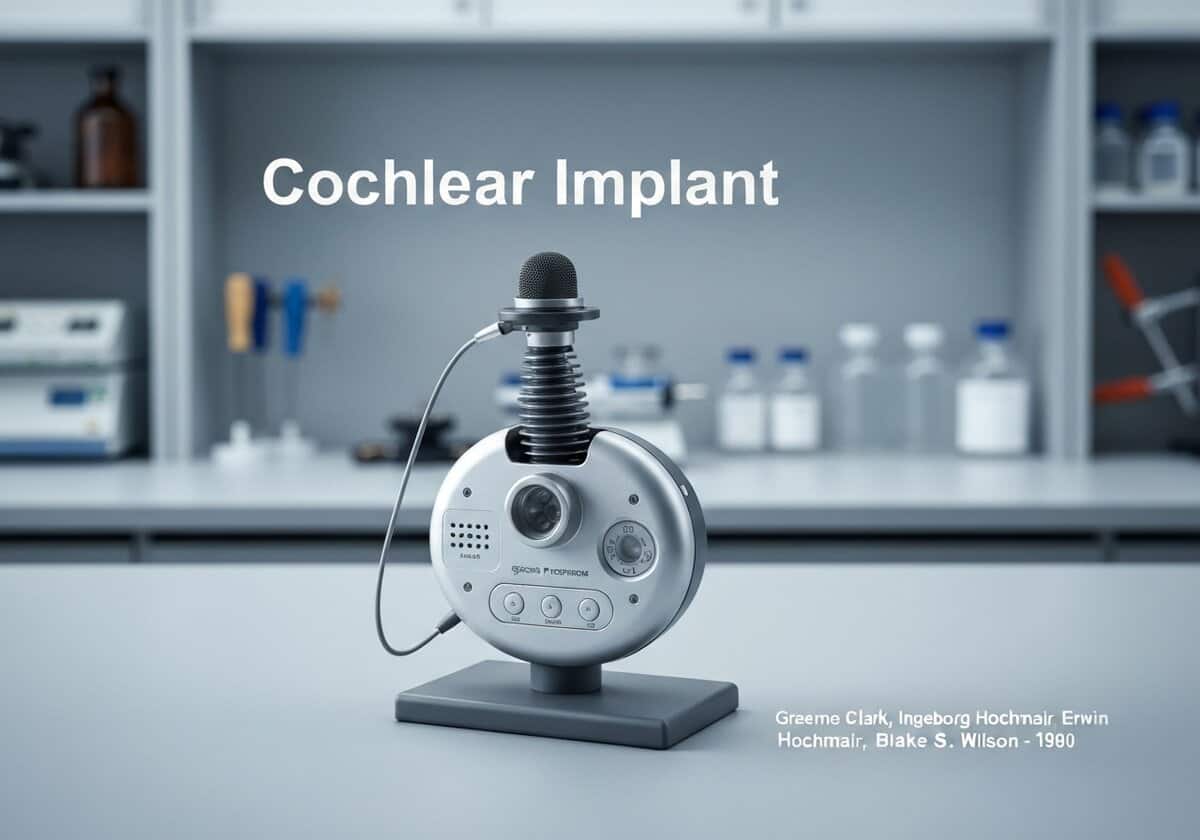
Cochlear implant device used in biomedical engineering for hearing restoration.

(generated image for illustration only)

A cochlear implant is a surgically implanted neuroprosthetic device that provides a sense of sound to a person with severe to profound sensorineural hearing loss. Unlike hearing aids, which amplify sound, cochlear implants bypass damaged portions of the ear (the hair cells) and directly stimulate the auditory nerve with electrical impulses, which the brain interprets as sound.

A cochlear implant system has two main parts. The external component includes a microphone, a speech processor, and a transmitter. The microphone picks up sounds from the environment, and the speech processor digitizes and codes them into electrical signals. The transmitter sends these signals wirelessly through the skin to the internal component. The internal component, which is surgically implanted, consists of a receiver and an electrode array. The receiver picks up the signals from the external transmitter and converts them into electrical impulses. These impulses are sent to the electrode array, a thin wire that is carefully threaded into the cochlea, the spiral-shaped part of the inner ear. Different electrodes along the array stimulate different parts of the auditory nerve. The nerve fibers at the base of the cochlea normally transmit high-frequency sound information, while those at the apex transmit low-frequency information. The implant’s speech processor is programmed to send high-frequency signals to the electrodes at the base and low-frequency signals to those at the apex, mimicking the natural tonotopic organization of the cochlea. The brain learns to interpret these patterns of electrical stimulation as meaningful sound, including speech.

UNESCO Nomenclature: 3201
– Biomedical engineering

Type

Physical Device

Disruption

Substantial

Usage

Widespread Use

Precursors

  • alessandro volta’s discovery of electrical stimulation of sensory nerves (1800)
  • development of the transistor and integrated circuits
  • understanding of the cochlea’s tonotopic organization by georg von békésy
  • early single-channel implant experiments by william f. house

Applications

  • restoration of hearing in post-lingually deafened adults
  • providing hearing to pre-lingually deaf children, enabling speech development
  • treatment for single-sided deafness (ssd)
  • improving tinnitus in some patients

Patents:

  • US4207441A
  • US4532930A

Potential Innovations Ideas

  • fully implantable cochlear implants with no external components
  • cochlear implants combined with acoustic hearing aids (electro-acoustic stimulation)
  • implants with directional microphones to improve hearing in noise
  • remote programming and adjustment of implants via telehealth
  • implants that can stream audio directly from smartphones
  • brainstem implants for patients without a functioning auditory nerve
  • implants using optical stimulation (optogenetics) instead of electrical for higher precision
  • ai-powered speech processors that adapt to different listening environments
  • cochlear implants integrated with balance restoration systems
  • biodegradable steroid-eluting electrodes to reduce inflammation during insertion
Related to: cochlear implant, neuroprosthetic, hearing loss, auditory nerve, electrode array, cochlea, sensorineural, speech processor, electrical stimulation, tonotopic organization.

Historical Context

Cochlear Implant

1960
1965
1970
1980
1980
1990
1960
1960
1969
1976-05-28
1980
1990

(if date is unknown or not relevant, e.g. "fluid mechanics", a rounded estimation of its notable emergence is provided)

10th year anniversary

Full size images and downloads are only available, 100% free, for registered members.

> Login <