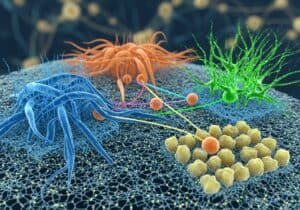
Regenerative medicine focuses on restoring or replacing damaged tissues and organs through the integration of stem cell biology, tissue engineering, and biomaterials science. This interdisciplinary field employs techniques such as scaffold fabrication, cellular reprogramming, and gene editing to promote tissue regeneration, enhance wound healing, and develop functional organ substitutes. Research addresses cellular differentiation, immunomodulation, vascularization, and extracellular matrix remodeling to optimize therapeutic outcomes. Our page compiles the latest peer-reviewed studies and patented technologies advancing regenerative strategies, biomaterial innovations, and clinical applications that redefine approaches to tissue repair and organ replacement.
This is our latest selection of worldwide publications and patents in english on Regenerative Medicine, between many scientific online journals, classified and focused on stem cell, tissue engineering, cell therapy, biomaterial, scaffold fabrication, induced pluripotent stem cell, regenerative scaffold, extracellular matrix, organ regeneration, 3D bioprinting, growth factor, mesenchymal stem cell, cell differentiat, gene editing, wound healing, regenerative biomaterial, cell transplantation, immunomodulat, tissue regenerat, cellular reprogram, bioactive molecule, vascularization, regenerat therap, autologous cell, allogeneic cell, regenerative implant, cell expansion, matrix remodeling and regenerative microenvironment.
Pharmaceutical composition for treating or preventing bone diseases comprising platelets
Patent published on the 2026-07-02 in WO under Ref WO2026142341 by DEWCELL INC [KR] (Shin Eung Kyun [kr], Kim Jung Hee [kr], Kim Chi Hwa [kr], Jeon Hyo Jin [kr])
Abstract: The present invention relates to a pharmaceutical composition for treating or preventing bone diseases, comprising platelets and, more specifically, to a pharmaceutical composition for treating or preventing bone diseases, comprising artificial platelets having an increased concentration of any one growth factor selected from the group consisting of PDGF-AA, PDGF-BB, EGF, TGF-β, bFGF, and VEGF, thereby promoting the synthesis of chondrocytes, inhibiting inflammatory responses, and reducing the [...]
Our summary: The invention involves a pharmaceutical composition for bone disease treatment using platelets. It includes artificial platelets with enhanced growth factor concentrations. This composition promotes chondrocyte synthesis and reduces inflammation and matrix degradation.
pharmaceutical composition, bone diseases, platelets, growth factors
Patent
Gpc3-targeted molecules and uses thereof
Patent published on the 2026-07-02 in WO under Ref WO2026143003 by ATARA BIOTHERAPEUTICS INC [US] (Harris Joel [us], Chen Xianhui [us], Yang Shuai [us])
Abstract: Various embodiments of the invention provide binding agents for glypican-3 (GPC3), including antibodies or antigen-binding fragments thereof that bind to GPC3 and antigen recognizing receptors (e.g., CARs) that target GPC3 including cells that express GPC3. Embodiments of the i n vention also provide cells comprising such binding agents such as CAR T-cells, therapeutic compositions comprising such cells and methods of using one or more of the binding agents, cells or therapeutic compositions for[...]
Our summary: The invention provides GPC3-targeted binding agents, including antibodies and CAR T-cells, for treating diseases like hepatocellular carcinoma. It includes therapeutic compositions and methods utilizing these agents for effective treatment. Additionally, it describes systems combining radiofrequency ablation with GPC3-targeted therapies and immune modulators to enhance treatment efficacy.
GPC3, CAR T-cells, antibodies, hepatocellular carcinoma
Patent
Use of a mechanical force in the implementation of a process of preparation of immunomodulatory drugs
Patent published on the 2026-07-01 in EP under Ref EP4768476 by UNIV MONTPELLIER [FR] (Solorzano-rodriguez Ruben [fr], Colacino Evelina [fr], Chatzigiannis Christos [fr], Bordier Corentin [fr])
Abstract: The invention relates to the use of a mechanical force to generate a mechanochemical reaction in the implementation of a process of preparation of immunomodulatory drugs of Formula (I) or a pharmaceutically acceptable salt thereof, and their process of preparation.[...]
Our summary: The invention utilizes mechanical force to induce a mechanochemical reaction. This process is aimed at preparing immunomodulatory drugs of Formula (I) or their pharmaceutically acceptable salts. The focus is on the innovative application of mechanical energy in drug preparation.
mechanical force, mechanochemical reaction, immunomodulatory drugs, pharmaceutical preparation
Patent
Microspheres comprising decellularized extracellular matrix, natural biopolymer and crosslinking agent and methods for making and using the same
Patent published on the 2026-07-01 in EP under Ref EP4768050 by FUNDACION TECNALIA RES & INNOVATION [ES] (Olalde Beatriz [es], Garcia Lizarribar Andrea Alicia [es])
Abstract: The present disclosure relates generally to microspheres comprising decellularized tissue extracellular matrix, at least a natural biopolymer, and at least a crosslinking agent. In some embodiments, the microsphere comprises biological cells and/or at least a biomolecule. Moreover, the present disclosure also relates to the method of generating said microspheres and the uses thereof.[...]
Our summary: The disclosure details microspheres made from decellularized extracellular matrix, natural biopolymers, and crosslinking agents. It includes methods for creating these microspheres and their potential applications. Some embodiments feature biological cells and biomolecules within the microspheres.
Microspheres, Decellularized ECM, Biopolymer, Crosslinking Agent
Patent
Use of n-terminal fragment of igfbp-4 in clinical assessment of heart failure and coronary heart disease
Patent published on the 2026-07-01 in EP under Ref EP4768919 by SHENZHEN MINDRAY BIOMEDICAL ELECTRONICS CO LTD [CN] (Liu Junjun [cn], Zhang Yi [cn], Wang Jing [cn], Li Ke [cn])
Abstract: The present disclosure relates to the technical field of biomedicine, in particular the use of an N-terminal fragment of insulin-like growth factor binding protein-4 in the clinical assessment of heart failure and coronary heart disease.[...]
Our summary: The N-terminal fragment of IGFBP-4 is utilized in the clinical assessment of heart failure and coronary heart disease. This fragment serves as a biomarker for evaluating these conditions. The research emphasizes its significance in biomedicine.
IGFBP-4, heart failure, coronary heart disease, biomarker
Patent
Improvement of artificial hair follicle germ
Patent published on the 2026-06-25 in WO under Ref WO2026134189 by ORGANTECH INC [JP] (Toyoshima Koh-ei [jp], Ogawa Miho [jp], Tsuji Takashi [jp])
Abstract: An artificial hair follicle germ 10 has a three-dimensional structure in which a first block 11 including hair follicle epithelial stem cells, a second block 12 including hair papilla cells, and a third block 13 including dermal-derived mesenchymal cells (DDMCs) are stacked in this order. A method for artificially preparing a hair follicle germ 10 includes three-dimensionally culturing a first block 11 including hair follicle epithelial stem cells, a second block 12 including hair papilla cells,[...]
Our summary: The artificial hair follicle germ consists of stacked blocks of epithelial stem cells, hair papilla cells, and dermal-derived mesenchymal cells. A method for its preparation involves three-dimensional culturing these components in a specific order. This innovation aims to improve hair follicle regeneration.
artificial hair follicle, three-dimensional culture, epithelial stem cells, dermal-derived mesenchymal cells
Patent
Kovacs-like memory effect in strain stiffening collagen networks
Published on 2026-06-10 by Abhishek Ghadai, Maitri Mandal and Sayantan Majumdar @IOP SCIENCE
Abstract: Materials driven far from equilibrium can encode memories of past deformations through long-lived structural reorganizations. Such memory effects-reflecting parameters such as deformation direction, magnitude, and duration have been widely explored in soft amorphous solids. Here, we report a Kovacs-like memory effect manifested as a non-monotonic stress relaxation in vitro biopolymer networks formed by type-I collagen, an essential component of the mammalian extracellular matrix. Using shear rhe[...]
Our summary: The study identifies a Kovacs-like memory effect in type-I collagen networks. This effect is linked to non-monotonic stress relaxation during nonlinear strain-stiffening. The findings reveal a correlation between memory response and negative normal stresses in biopolymer networks.
memory effect, strain stiffening, collagen networks, viscoelasticity
Publication
Joint material and shape optimization of a 3D printing nozzle by CFD and response surface methodology
Published on 2026-03-12 by @OXFORD
Abstract: AbstractThree-dimensional printing (3D printing) has emerged as a transformative technology in medicine, enabling the fabrication of complex structures with high precision. In bioprinting, optimization of nozzle design is essential to balance print resolution, mechanical strength, and biocompatibility. This study presents a computational framework for optimizing bioprinting performance by simultaneously accounting for nozzle geometry and biomaterial rheological properties. Using computational fl[...]
Our summary: This study presents a computational framework for optimizing bioprinting by integrating nozzle geometry and biomaterial properties. It utilizes CFD and response surface methodology to identify optimal nozzle configurations. Results show significant improvements in flow rate and reductions in wall shear stress, demonstrating the effectiveness of the approach.
3D printing, nozzle optimization, computational fluid dynamics, response surface methodology
Publication