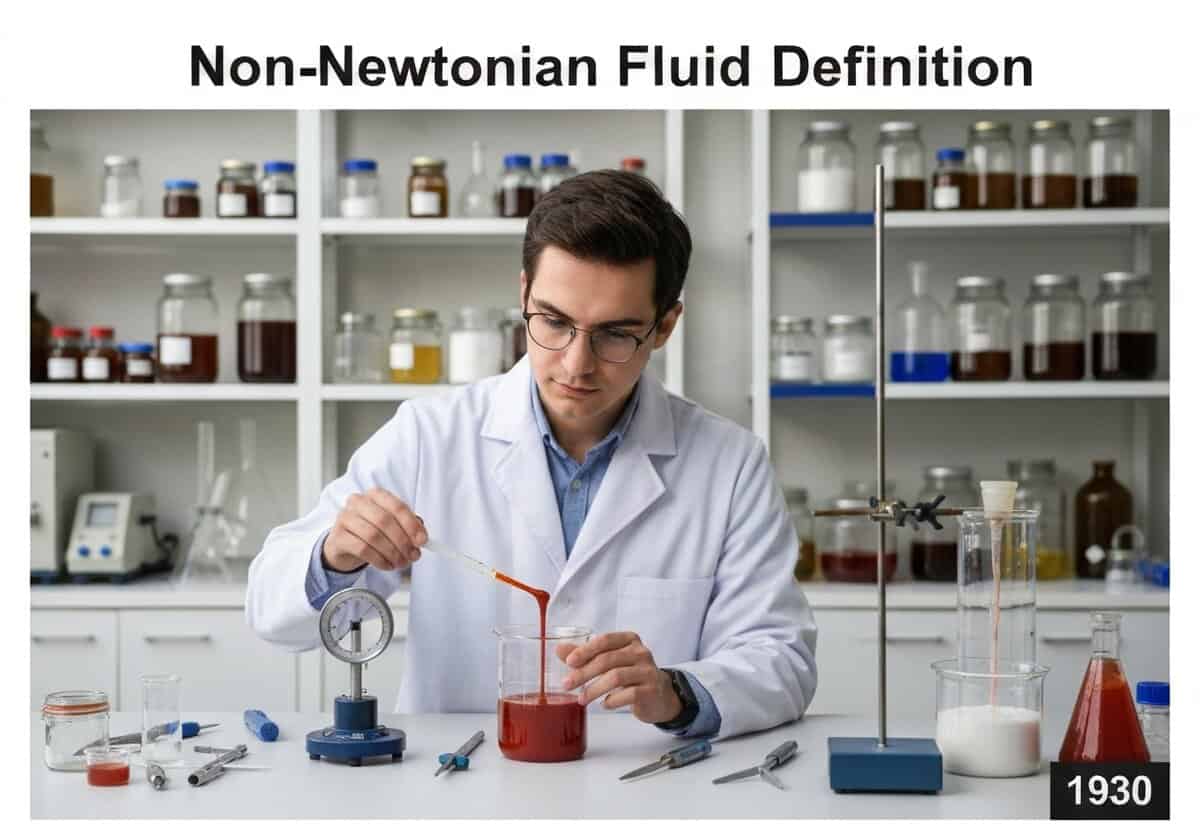
The fundamental difference between Newtonian and non-Newtonian fluids lies in their response to shear. For a Newtonian fluid, the relationship is linear, defined by Newton’s law of 粘度: [latex]\tau = \mu \dot{\gamma}[/latex], where [latex]\mu[/latex] is the constant coefficient of viscosity. For non-Newtonian fluids, this relationship is non-linear and can be time-dependent. The apparent viscosity, defined as [latex]\eta = \tau / \dot{\gamma}[/latex], is not a constant but a function of the shear rate itself, [latex]\eta(\dot{\gamma})[/latex].
This behavior arises from the fluid’s internal microstructure, such as long polymer chains, suspended particles, or emulsions. When a shear force is applied, these microstructures can align, deform, or rearrange, altering the fluid’s resistance to flow. For example, in a polymer solution (a せん断減粘性 fluid), the randomly coiled polymer chains untangle and align with the flow direction under high shear, reducing internal friction and thus viscosity. Conversely, in a concentrated suspension like cornstarch in water (a せん断増粘 fluid), the particles may jam together under high shear, drastically increasing viscosity.
The study of these complex flow behaviors is called rheology. Understanding a fluid’s non-Newtonian properties is critical in many industrial processes, from pumping and mixing to coating and molding, as the processing conditions directly influence the material’s behavior.
Related to: non-newtonian fluid, viscosity,
せん断応力, shear rate, rheology, fluid dynamics, shear-thinning, shear-thickening.