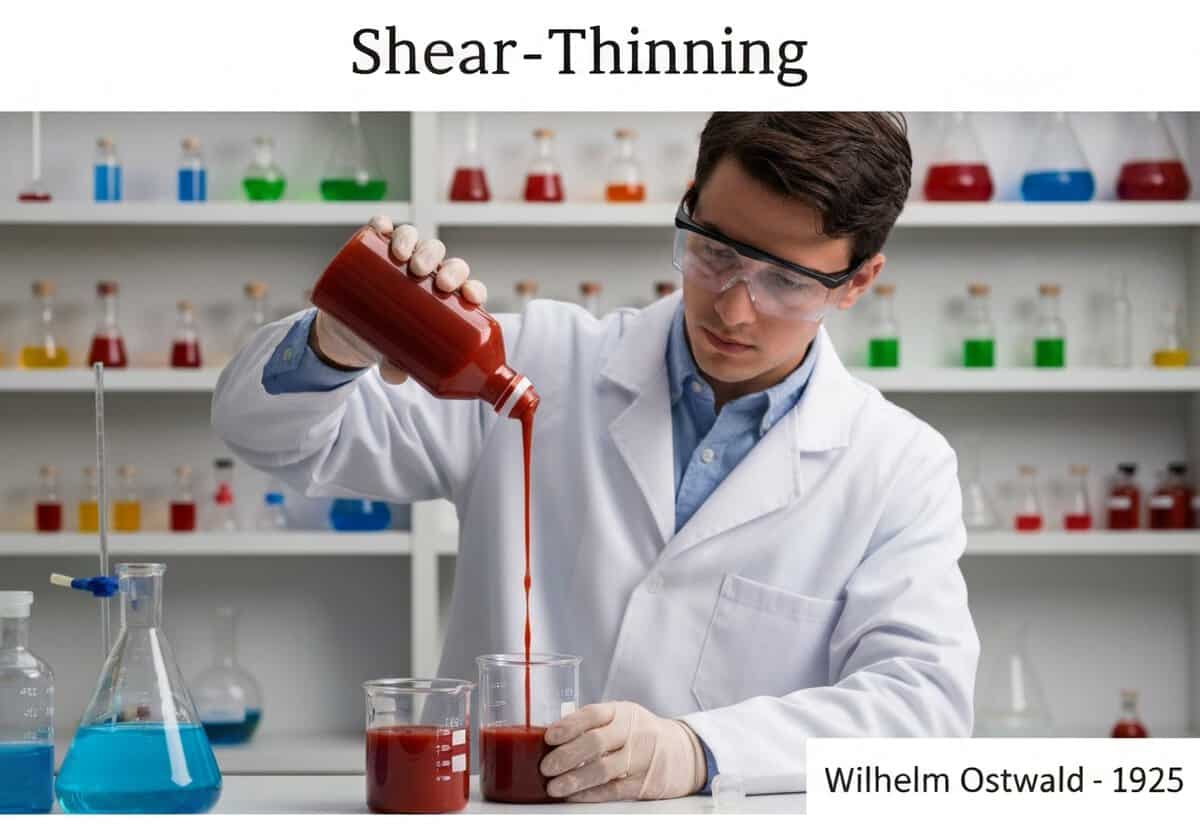
剪切稀化,或称假塑性,是一种 非牛顿流体 流体行为 粘度 随着剪切应力的增加,流动性降低。许多常见物质,例如番茄酱或油漆,都具有这种特性。静止时,它们粘稠,但摇晃、搅拌或涂抹时流动性会增强。这种特性通常可以用奥斯特瓦尔德-德瓦勒幂律关系来描述。

(图片仅供参考)
剪切稀化,或称假塑性,是一种 非牛顿流体 流体行为 粘度 随着剪切应力的增加,流动性降低。许多常见物质,例如番茄酱或油漆,都具有这种特性。静止时,它们粘稠,但摇晃、搅拌或涂抹时流动性会增强。这种特性通常可以用奥斯特瓦尔德-德瓦勒幂律关系来描述。
Shear-thinning behavior is typically caused by the alignment of the fluid’s internal structure under shear. In polymer solutions, for instance, long-chain molecules are randomly coiled and entangled at rest, leading to high 粘度. When shear is applied, these chains begin to untangle and align in the direction of flow. This alignment reduces the interactions and friction between the molecules, causing a decrease in the apparent viscosity. The more the fluid is sheared, the more aligned the molecules become, and the lower the viscosity gets, until it potentially reaches a lower plateau.
这种特性在许多应用中都非常理想。例如,油漆在罐中应该足够浓稠,以防止颜料沉淀和从刷子上滴落(低剪切力),但涂到表面上时又必须易于流动(高剪切力)。同样,印刷油墨需要从印刷机流到纸上,然后保持不动而不晕染。在食品工业中,酸奶和奶油等产品的设计使其入口浓稠(低剪切力),但易于吞咽(高剪切力)。剪切稀化的反义词是 剪切增稠其中粘度随剪切速率的增加而增加。
剪切稀化(假塑性)
(如果日期未知或不相关,例如“流体力学”,则提供其显著出现的近似估计)
只有注册会员才能免费获取完整尺寸的图片和下载内容。
> 登录 <