Product Design, Manufacturing & Innovation Resources
家 » 量子運動量演算子

量子運動量演算子

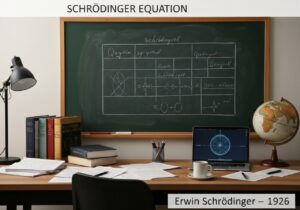
1926
  • Erwin Schrödinger
  • Werner Heisenberg
  • Paul Dirac
Quantum mechanics laboratory with physicist analyzing momentum operators.

(画像はイメージです)

In quantum mechanics, momentum is an observable represented by a vector operator. In the position basis, the momentum operator is given by [latex]\hat{\vec{p}} = -i\hbar\nabla[/latex], where [latex]\hbar[/latex] is the reduced Planck constant and [latex]\nabla[/latex] is the gradient operator. The 運動量保存の法則 corresponds to the fact that the ハミルトニアン operator commutes with the momentum operator, [latex][hat{H}, hat{vec{p}}] = 0[/latex], for a system with translational symmetry.


Quantum mechanics replaces classical observables with Hermitian operators acting on a ヒルベルト space of states. The momentum of a particle is no longer a simple number but an operator, [latex]\hat{\vec{p}}[/latex]. Its eigenvalues represent the possible outcomes of a momentum measurement. The famous expression [latex]\hat{\vec{p}} = -i\hbar\nabla[/latex] arises from the canonical commutation relation between the position operator [latex]\hat{\vec{x}}[/latex] and the momentum operator, [latex][\hat{x}_j, \hat{p}_k] = i\hbar\delta_{jk}[/latex], which is a fundamental postulate of quantum theory and the mathematical basis for the Heisenberg uncertainty principle.

The time evolution of the expectation value of an operator is governed by the Ehrenfest theorem. For momentum, it shows that the expectation value of momentum changes according to the expectation value of the force, mirroring Newton’s second law. A quantity is conserved if its operator commutes with the Hamiltonian [latex]hat{H}[/latex], the operator for total energy. If a system’s potential energy is independent of position (i.e., the system has translational symmetry), then [latex][hat{H}, hat{vec{p}}] = 0[/latex], and the expectation value of momentum is conserved. This re-establishes the connection between translational symmetry and momentum conservation, as seen via Noether’s theorem, within the quantum framework.

UNESCO Nomenclature: 2212
– Quantum physics

タイプ

抽象システム

混乱

革命的

使用法

広く普及している

前駆物質

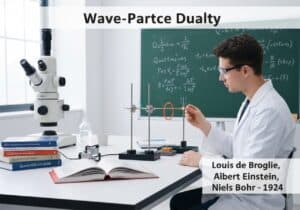
  • Louis de Broglie’s wave-particle duality hypothesis
  • Planck’s quantum hypothesis
  • Classical ハミルトニアン 力学
  • Noether’s theorem on symmetry and conservation

アプリケーション

  • quantum computing
  • scanning tunneling microscopy
  • semiconductor physics
  • 素粒子物理学 (feynman diagrams)
  • quantum chemistry (molecular orbitals)

特許:

NA

潜在的なイノベーションのアイデア

  • design of quantum well lasers
  • development of spintronic devices
  • creation of Bose-Einstein condensates
  • modeling of electron transport in グラフェン
  • design of quantum cryptographic systems
  • simulation of chemical reactions for drug discovery
  • development of new superconducting materials
  • control of qubits in quantum computers
  • analysis of neutron 散乱 data in materials science
  • engineering of atomic clocks with unprecedented accuracy
Related to: momentum operator, quantum mechanics, Schrödinger equation, Heisenberg uncertainty principle, commutation relation, Hamiltonian, observable, translational symmetry, Ehrenfest theorem, quantum state.

歴史的背景

量子運動量演算子

1924
1925
1926
1926
1927
1927
1930
1924
1924
1925
1926
1927
1927
1930
1930

(日付が不明または関連性がない場合、例えば「流体力学」などでは、その注目すべき出現時期の概算値が提示されます。)

10年目 周年

フルサイズの画像とダウンロードは、登録会員のみが100%無料で利用できます。