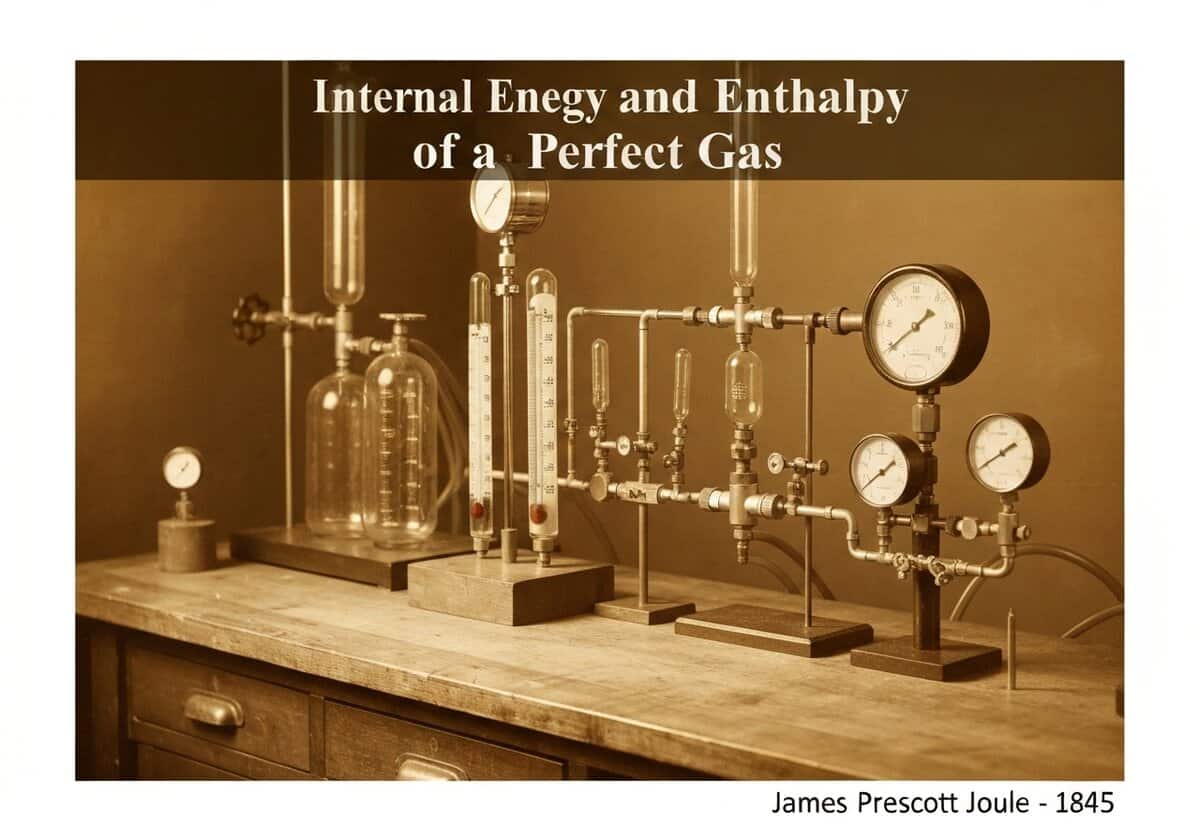
理想気体の場合、内部エネルギー ([latex]U[/latex]) とエンタルピー ([latex]H[/latex]) は温度のみの関数です。それらの変化は [latex]Delta U = m c_v Delta T[/latex] および [latex]Delta H = m c_p Delta T[/latex] で与えられます。ここで、[latex]c_v[/latex] と [latex]c_p[/latex] はそれぞれ定容比熱と定圧比熱であり、一定であると仮定されます。

(画像はイメージです)
理想気体の場合、内部エネルギー ([latex]U[/latex]) とエンタルピー ([latex]H[/latex]) は温度のみの関数です。それらの変化は [latex]Delta U = m c_v Delta T[/latex] および [latex]Delta H = m c_p Delta T[/latex] で与えられます。ここで、[latex]c_v[/latex] と [latex]c_p[/latex] はそれぞれ定容比熱と定圧比熱であり、一定であると仮定されます。

A cornerstone of the 完全気体 model is the principle that its internal energy depends solely on its temperature. This was experimentally demonstrated by James Prescott Joule in his expansion experiments. For an ideal gas, internal energy is the sum of the kinetic energies of its constituent molecules. Since temperature is a measure of the average kinetic energy, internal energy is a function of temperature. The perfect gas model simplifies this further by assuming a linear relationship through a constant specific heat at constant volume, [latex]c_v[/latex]. Thus, the change in specific internal energy is [latex]\Delta u = c_v \Delta T[/latex].
エンタルピー([latex]H[/latex])は 熱力学 ポテンシャルは[latex]H = U + PV[/latex]と定義される。理想気体の場合、 理想気体の法則 ([latex]PV = nRT[/latex]) の場合、エンタルピーは [latex]H = U(T) + nRT[/latex] となり、これも温度のみの関数となります。比エンタルピーの変化も同様に [latex]Delta h = c_p Delta T[/latex] で表され、[latex]c_p[/latex] は定圧比熱です。この簡略化は、複雑な表や状態方程式を必要とせずに圧縮、膨張、加熱などのプロセスにおけるエネルギー変化を簡単に計算できるため、工学において非常に強力であり、エンジン、冷蔵庫、発電所の解析の基礎となります。
理想気体の内部エネルギーとエンタルピー
(日付が不明または関連性がない場合、例えば「流体力学」などでは、その注目すべき出現時期の概算値が提示されます。)

フルサイズの画像とダウンロードは、登録会員のみが100%無料で利用できます。
> ログイン <