촉매 작용은 촉매라고 하는 물질을 첨가하여 화학 반응 속도를 증가시키는 과정입니다. 촉매는 반응에서 소모되지 않고 그대로 남아 있습니다. 촉매는 활성화 에너지([latex]E_a[/latex])가 더 낮은 대체 반응 경로를 제공함으로써 전체 열역학적 변화([latex]Delta H[/latex]) 없이 정반응과 역반응 모두를 가속화합니다.

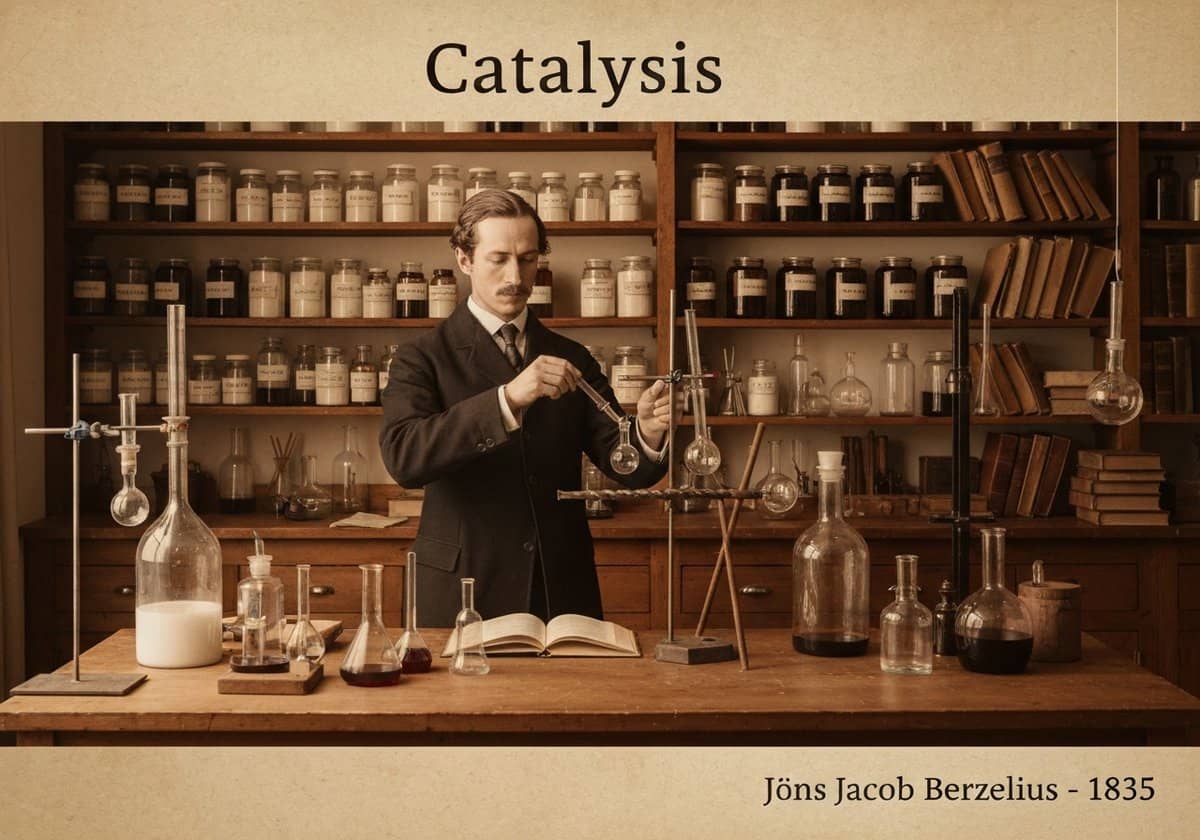
(설명을 위한 생성된 이미지입니다)
촉매 작용은 촉매라고 하는 물질을 첨가하여 화학 반응 속도를 증가시키는 과정입니다. 촉매는 반응에서 소모되지 않고 그대로 남아 있습니다. 촉매는 활성화 에너지([latex]E_a[/latex])가 더 낮은 대체 반응 경로를 제공함으로써 전체 열역학적 변화([latex]Delta H[/latex]) 없이 정반응과 역반응 모두를 가속화합니다.

The fundamental principle of catalysis lies in its ability to alter the kinetics of a chemical reaction without affecting its thermodynamics. A 촉매 introduces a new reaction mechanism, often involving one or more intermediate steps. For a reaction A + B → C, a catalyst C’ might participate as follows: A + C’ → AC’ and then AC’ + B → C + C’. The catalyst C’ is regenerated at the end of the process. This alternative pathway has a lower transition state energy compared to the uncatalyzed reaction. The Arrhenius equation, [latex]k = Ae^{-E_a/(RT)}[/latex], shows that a lower activation energy ([latex]E_a[/latex]) leads to an exponential increase in the reaction rate constant (k). Importantly, the catalyst does not change the Gibbs free energy change ([latex]\Delta G[/latex]) or the equilibrium constant ([latex]K_{eq}[/latex]) of the reaction. It only affects the speed at which equilibrium is reached. This concept was first formally described by Jöns Jacob Berzelius in 1835, who observed that certain substances could accelerate reactions without being consumed, coining the term “catalysis” from Greek words meaning “to dissolve” or “to break down”.
이 원리는 반응 좌표 다이어그램을 사용하여 시각화할 수 있는데, 촉매 반응 경로는 비촉매 반응 경로보다 낮은 에너지 피크(전이 상태)를 나타냅니다. 반응물과 생성물 사이의 전체 에너지 차이는 동일하게 유지되지만, 극복해야 할 에너지 장벽이 크게 감소합니다. 따라서 더 많은 반응물 분자가 충돌 시 반응에 필요한 충분한 에너지를 갖게 되어 주어진 온도에서 반응 속도가 빨라집니다.
촉매 작용
(날짜를 알 수 없거나 관련이 없는 경우, 예를 들어 "유체역학"의 경우, 주목할 만한 등장 시기를 대략적으로 추정하여 제공합니다.)

고화질 이미지 및 다운로드는 등록된 회원에게만 100% 무료로 제공됩니다.
> 로그인 <