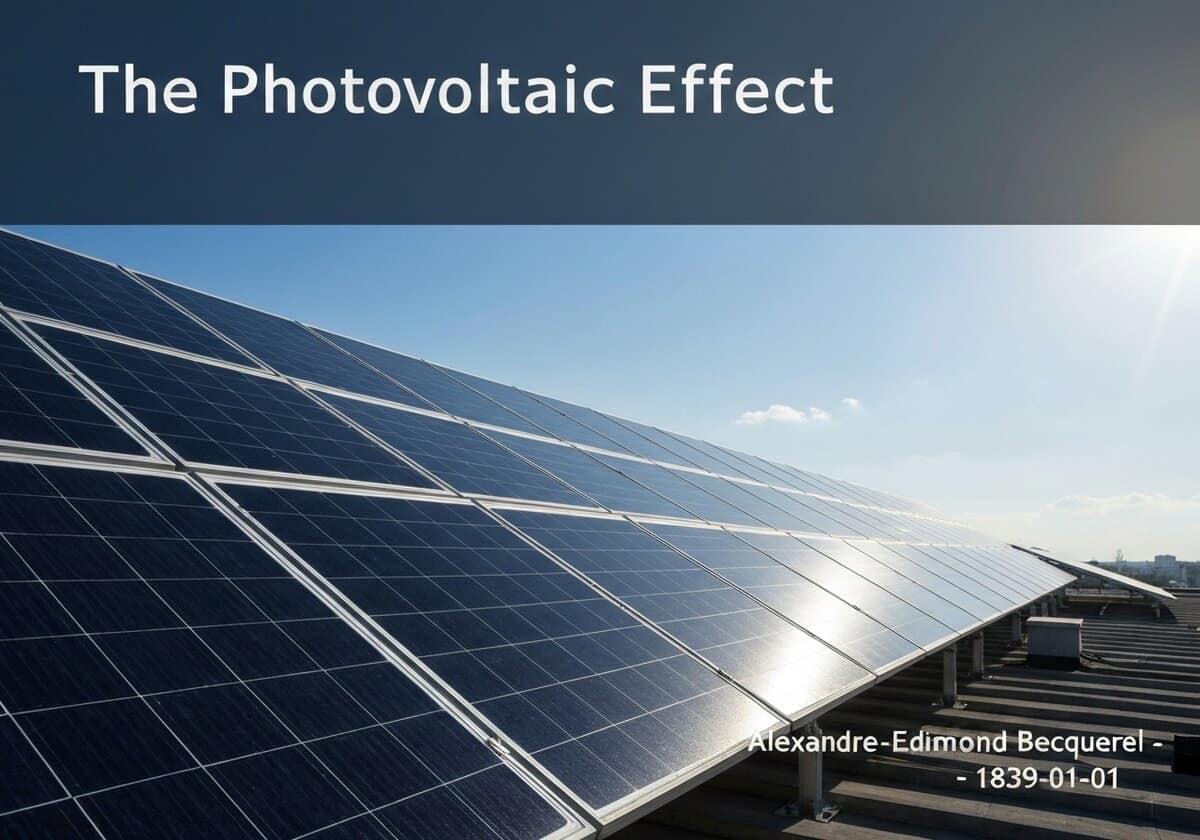
の 太陽光発電 effect was first observed by French physicist Alexandre-Edmond Becquerel in 1839. He discovered that a voltage developed when a silver chloride electrode in an acidic solution was illuminated. The effect remained a scientific curiosity for decades. The modern understanding is rooted in semiconductor physics. When a photon with sufficient energy strikes a semiconductor material, it can excite an electron, moving it from the valence band to the conduction band. This creates an electron-hole pair. In a photovoltaic device, an internal electric field, typically created by a p-n junction, separates these charge carriers. The electrons are swept to the n-side and the holes to the p-side. This separation of charge creates a voltage across the junction. If an external circuit is connected, the free electrons will flow through the circuit, creating a direct current (DC). The energy of the photon must be greater than the band gap of the semiconductor material for this process to occur. Photons with energy less than the band gap pass through the material without being absorbed, while photons with energy much greater than the band gap will have their excess energy converted into heat, reducing the overall efficiency of the cell.
The first solid-state photovoltaic cell was created by Charles Fritts in 1883, who coated selenium with a thin layer of gold. However, its efficiency was less than 1%. The breakthrough came in 1954 at Bell Labs, where Daryl Chapin, Calvin Fuller, and Gerald Pearson developed the first practical silicon ソーラー cell, achieving an efficiency of around 6%. This invention marked the beginning of the modern era of 太陽光発電 この技術は、当初は宇宙空間の衛星への電力供給といったニッチな用途に用いられていた。