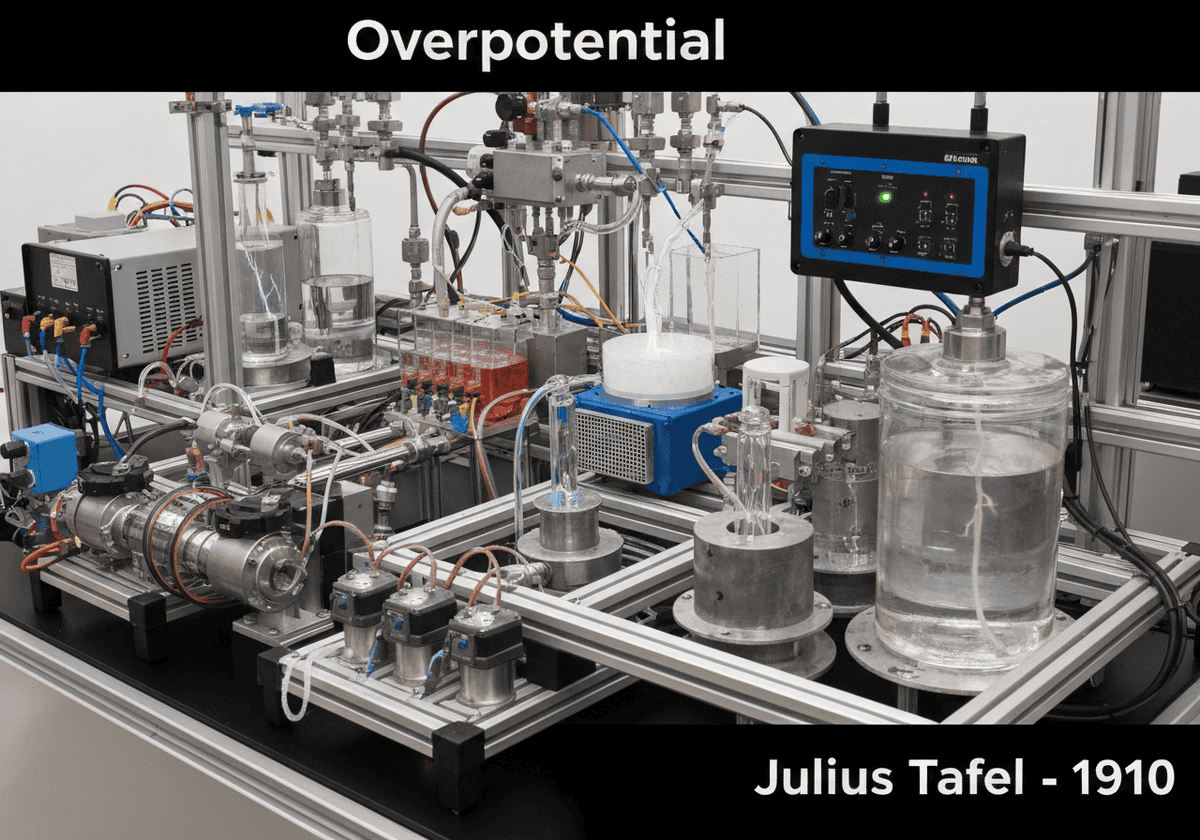
In an ideal electrolytic cell, the applied voltage needed to drive a reaction would be exactly equal to the cell’s standard electrode potential ([latex]E^0_{cell}[/latex]). However, in reality, a significantly higher voltage is almost always required. This excess voltage is the overpotential ([latex]\eta[/latex]). The total cell potential ([latex]E_{cell}[/latex]) is the sum of the equilibrium potential, the overpotentials at both electrodes, and the ohmic drop (IR drop) across the electrolyte: [latex]E_{cell} = E^0_{cell} + \eta_{anode} + \eta_{cathode} + IR_{drop}[/latex].
Overpotential arises from several sources. Activation overpotential is related to the kinetics of the electron transfer step at the electrode surface itself. Some reactions, like the evolution of hydrogen or oxygen gas, have inherently slow kinetics and require a large activation overpotential. Concentration overpotential occurs when the concentration of reactants at the electrode surface differs from the bulk concentration due to slow diffusion. Resistance overpotential is caused by the resistance of the electrolyte or films on the electrode surface.
電流密度 (j) と活性化過電圧の関係は、多くの場合、タフェル方程式 [latex]eta = a + b log(j)[/latex] で表されます。ここで、‘a’ と ‘b’ は、電極反応と材料に固有の定数 (タフェルパラメータ) です。この方程式は、より高い反応速度 (より高い電流密度) を得るには、より大きな過電圧が必要であることを示しています。効率的な電気化学システムを設計する際の主な目標は、過電圧を最小限に抑えることであり、これは通常、電極触媒 (活性化エネルギーを低下させる材料) を使用したり、動作温度を上げたり、物質輸送を促進するために電極構造を最適化したりすることによって達成されます。