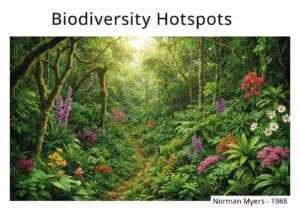
يشمل التنوع البيولوجي تنوع أشكال الحياة على ثلاثة مستويات: الجينات، والأنواع، والنظم البيئية. ويُقاس بمؤشرات تنوع الأنواع ووفرتها، وهو أساس خدمات النظام البيئي كالتلقيح، وتنقية المياه، وخصوبة التربة. وتُفسر الأنواع الرئيسية، والمستويات الغذائية، والمواطن البيئية كيفية تماسك المجتمعات الحيوية. وتُعد الأنواع الغازية وفقدان الموائل من الأسباب الرئيسية لتدهور التنوع البيولوجي.
Monitoring has become a technology field. Environmental DNA, صوتي أجهزة الاستشعار, camera traps and satellite remote sensing generate data at scale, and machine learning classifies it. Companies now face disclosure rules on nature-related risks. Biogeography and endemism guide conservation priorities. The papers and patents below follow methods, tools and policy-relevant findings.
يُعد التنوع البيولوجي أساساً للغذاء والدواء واستقرار المناخ. ويتزايد الضغط الناتج عن الاحتباس الحراري. تغير المناخ، ومراقبة الخرائط على نظم المعلومات الجغرافيةوتجارب الترميم على إعادة إحياء الأنواع المنقرضةالمقايضات الزراعية جارية الزراعة الدقيقة.
هذه هي أحدث مجموعة مختارة من المنشورات وبراءات الاختراع العالمية باللغة الإنجليزية حول التنوع البيولوجي، بين العديد من المجلات العلمية على الإنترنت، مصنفة ومركزة على التنوع البيولوجي، وتنوع الأنواع، وتنوع النظم الإيكولوجية، والتنوع الجيني، والتنوع الوراثي، والمستوى الغذائي، والأنواع الرئيسية، والجغرافيا الحيوية، والتوطن، والتنمية المستدامة، والأنواع الغازية، والمنطقة الحيوية، والعامل اللاأحيائي، والمكانة الإيكولوجية، والعامل الحيوي.
A method and system for generating personalized audio signals based on user-specific data and feedback
Patent published on the 2026-11-05 in WO under Ref WO2026229968 by LOUSKY DANIEL [IL] (Lousky Daniel [il])
Abstract: A computer-implemented method and system for generating personalized audio signals based on user-specific data and feedback. The system receives user questionnaire responses and an audio recording of a user pronouncing a predefined set of speech units. A base frequency is computed for each speech unit by calculating a greatest common divisor of the speech unit s frequency components and iteratively scaling it by half into a predefined frequency range. A dual-band personalized frequency profile i[...]
Our summary: The system generates personalized audio signals using user-specific data and feedback. It computes base frequencies from user speech units and classifies them as healthy or unhealthy. Audio signals are synthesized by incorporating healthy frequencies and adjusting based on user feedback or biometric data.
personalized audio, user feedback, frequency analysis, biometric data
Patent
Computer-implemented system and method for securing authentication of users
Patent published on the 2026-11-05 in US under Ref US20260352475 by HAWCX INC [US] (Shanmugam Sri Soundarya Kottur [us], Ramaraju Ravindraraj [us], Kumaraswamy Selvanathan [us])
Abstract: A computer-implemented method and system for securing authentication of users, is disclosed. The computer-implemented method includes: registering a user identity; for every subsequent login, authenticating user through zero-knowledge proof ceremony in which biometric check is performed within hardware security module of user device; upon detection of newly added biometric entry after registration of user identity, initiating cryptographic zeroization of credential material stored on user device[...]
Our summary: The system secures user authentication through a zero-knowledge proof ceremony and biometric checks. It initiates cryptographic zeroization of credentials upon new biometric entry detection. The method generates a single-use authorization token and requires signatures from both user and service provider.
authentication, biometric, cryptography, zero-knowledge proof
Patent
Rich engagement resource activation via cross-domain data aggregation and sentiment analysis
Patent published on the 2026-11-05 in US under Ref US20260350131 by SONY INTERACTIVE ENTERTAINMENT LLC [US] (Walsh Paul John [us], Smith Matthew [us], Gardner David [us])
Abstract: A computer-implemented method for activating rich engagement resources is described. The method includes receiving user data including media consumption data, biometric data, commerce behavior data, social data, or a combination thereof, processing the user data to generate one or more data signals comprising media signals, biometric signals, commerce signals, social signals, or a combination thereof, processing the one or more data signals using a classifier to generate a classification of the [...]
Our summary: The method activates engagement resources through cross-domain data aggregation. It processes user data to generate various data signals. A classifier is used to classify users based on their sentiment towards specific subjects.
data aggregation, sentiment analysis, user classification, engagement resources
Patent
Simulated quantum entropy fusion for cryptographic key generation without quantum hardware
Patent published on the 2026-11-05 in US under Ref US20260352456 by LUMINAREWARE LLC [US] (Diacont William Douglas [us])
Abstract: A method and system for generating high-entropy cryptographic keys by fusing heterogeneous entropy sources without requiring dedicated quantum hardware. The system, referred to as Simulated Quantum Entropy Fusion (SQEF), combines biometric inputs, environmental randomness, and device signals through a multi-stage process of entropy normalization, cryptographic hashing, and symbolic encoding. The resulting keys achieve entropy levels exceeding 7.95 bits per byte, suitable for post-quantum cryptog[...]
Our summary: Simulated Quantum Entropy Fusion (SQEF) generates high-entropy cryptographic keys without quantum hardware. It combines biometric, environmental, and device signals through a multi-stage process. The resulting keys exceed 7.95 bits per byte, ensuring advanced security for various applications.
Quantum Entropy Fusion, Cryptographic Key Generation, Biometric Inputs, Post-Quantum Security
Patent
System and method for multi-modal data processing and adaptive performance feedback
Patent published on the 2026-11-05 in US under Ref US20260350989 by DOACH INC [US] (Phelps Bryon [us], Sparrow Rory [us])
Abstract: [0000] A computing system is disclosed for multi-modal event detection, performance evaluation, and adaptive feedback delivery in a sports training environment. The system receives multi-modal input data from a plurality of sensors, including motion, video, biometric, and environmental sources, and synchronizes the data to generate a unified dataset. An event detection model is applied to identify candidate performance events. A temporal portion of the unified dataset corresponding to each candi[...]
Our summary: The system processes multi-modal data from various sensors to detect performance events. It evaluates pose data to compute performance metrics and generates adaptive feedback based on user profiles. Feedback instructions are prioritized and delivered through user device interfaces.
multi-modal data, event detection, performance evaluation, adaptive feedback
Patent
Hybrid nanoparticles for targeted delivery of senolytics for the treatment of osteoarthritis
Patent published on the 2026-11-05 in US under Ref US20260345491 by UNIV OF KENTUCKY RESEARCH FOUNDATION [US] (Annamalai Ramkumar Tiruvannamalai [us], Prajapati Sushant [us])
Abstract: [0000] A hybrid nanoparticle. The hybrid nanoparticle includes a synthetic lipid bilayer made of phosphatidylcholine, cholesterol, and a PEGylated phospholipid including a maleimide-functionalized PEG lipid and a biomembrane component derived from chondrocytes and incorporated into the synthetic lipid bilayer. The biomembrane component includes at least one SNARE protein configured to promote homotypic membrane fusion with chondrocytes and CD47 configured to inhibit phagocytic uptake. The hybrid[...]
Our summary: The hybrid nanoparticle consists of a synthetic lipid bilayer and a biomembrane component from chondrocytes. It is designed for targeted delivery of senolytics to treat osteoarthritis by promoting internalization into chondrocytes. The nanoparticle improves residence time in the joint compared to standard nanoparticles.
hybrid nanoparticles, targeted delivery, senolytics, osteoarthritis
Patent
Warm season variability and aquatic biodiversity assessment in the lower Los Angeles River (CA, USA) using environmental DNA
Published on 2026-10-29 by @OXFORD
Abstract: AbstractUrban ecology examines how biodiversity and ecological processes persist in human-modified environments. The Los Angeles River has been transformed by urbanization into a concrete flood control channel with altered flow regimes, degraded water quality, and reduced habitat quality. We used this site to assess how seasonal environmental variation influences aquatic biodiversity in a highly urbanized river. Monthly environmental DNA samples and corresponding water quality data were collecte[...]
Our summary: This study assessed the impact of seasonal environmental variation on aquatic biodiversity in the lower Los Angeles River. Monthly environmental DNA samples and water quality data were collected over six months, revealing shifts in community structure between warm and cool seasons. Findings indicate that environmental DNA is a valuable tool for monitoring biodiversity in urban river ecosystems.
environmental DNA, aquatic biodiversity, urban ecology, seasonal variability
Publication
Revisiting the Case for Sub-global, Democratic Ecosystem Governance
Published on 2026-10-28 by Sudhir Chella Rajan @NATURE npj
Abstract: npj Biodiversity, Published online: 28 October 2026; doi:10.1038/s44185-026-00162-5Global biodiversity loss is accelerating, with approximately one million species facing extinction and ecosystem degradation that compromises the welfare of over three billion people. While there is growing awareness and global consensus on biodiversity protection, nation-state governance alone cannot be counted on to address transborder species protection. This Comment revisits and updates the proposal for Biome [...]
Our summary: The article highlights the urgent need for sub-global governance to address biodiversity loss and ecosystem degradation. It proposes Biome Stewardship Councils as democratic, transboundary bodies to enhance species protection. Recent advancements in governance models and ecosystem monitoring support the feasibility of this approach.
biodiversity, ecosystem governance, Biome Stewardship Councils, transboundary protection
Publication