Product Design, Manufacturing & Innovation Resources
家 » 圧縮性流体における動圧

圧縮性流体における動圧

1930
  • Ernst Mach
  • Ludwig Prandtl
  • Theodore von Kármán
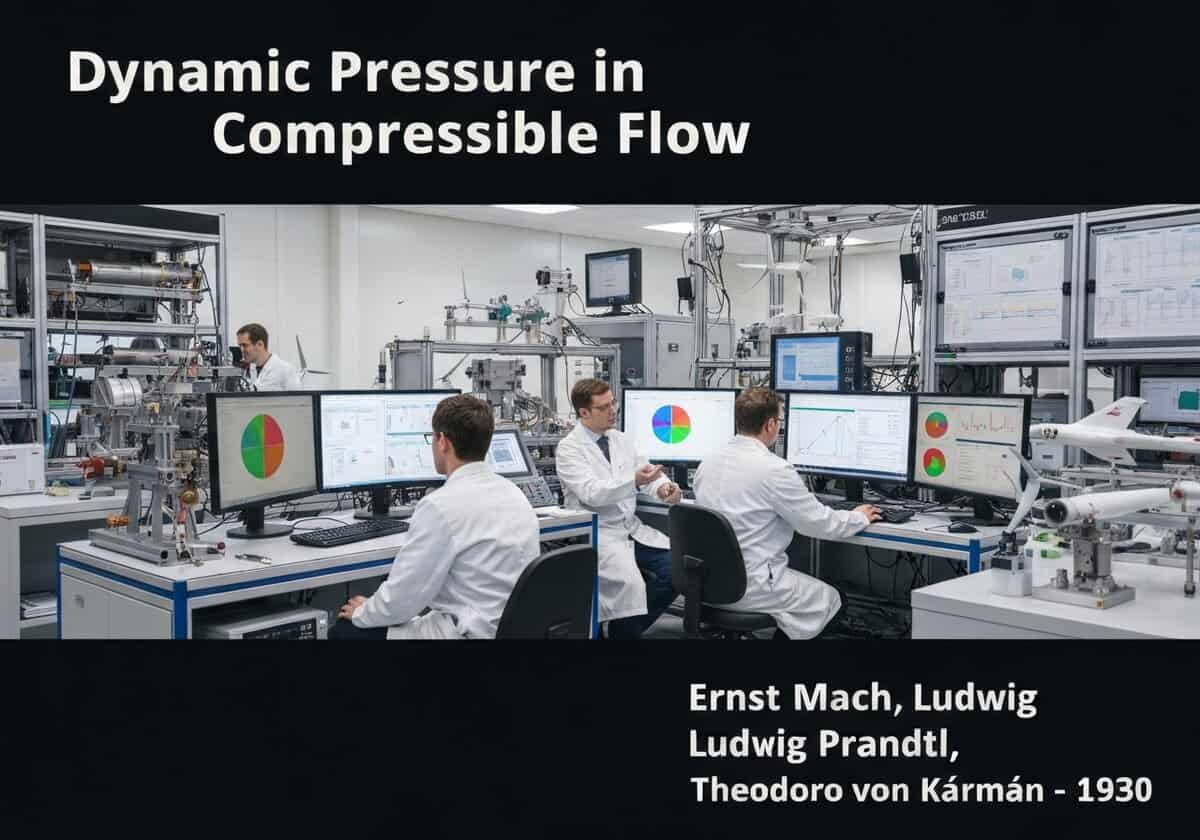
ハイテク実験室で動圧データを分析する航空宇宙エンジニアたち。.

(画像はイメージです)

圧縮性流体、特に高速流においては、動圧はマッハ数([latex]M[/latex])と静圧([latex]p[/latex])に関係します。理想気体の場合、その関係は[latex]q = frac{1}{2} gamma p M^2[/latex]で表され、ここで[latex]gamma[/latex]は比熱比です。この定式化は、流体密度が大きく変化する超音速および極超音速空力学において非常に重要です。


流体の速度が、 音速, the assumption of constant density (incompressibility) breaks down. Changes in pressure cause significant changes in density, and thermodynamic effects become important. This is the realm of compressible flow. The simple formula [latex]q = \frac{1}{2} \rho u^2[/latex] is still used as a formal definition, but its relationship to pressure changes is more complex. The formula [latex]q = \frac{1}{2} \gamma p M^2[/latex] provides a direct link between 動圧 and the key parameters of compressible flow: static pressure ([latex]p[/latex]), the ratio of specific heats ([latex]\gamma[/latex], which is a property of the gas, approximately 1.4 for air), and the マッハ数 ([latex]M = u/a[/latex], where [latex]a[/latex] is the local speed of sound).

This equation is derived from the definition of Mach number and the ideal gas equation of state. It is fundamental in high-speed aerodynamics. For instance, the pressure measured at a stagnation point ([latex]p_0[/latex]) in supersonic flow is not given by the simple Bernoulli equation. Instead, it is related to the static pressure by the isentropic flow relations or, if a shock wave is present, by the Rankine-Hugoniot relations. In these calculations, the term [latex]\frac{1}{2} \gamma p M^2[/latex] frequently appears, representing the kinetic energy component of the flow in a thermodynamically consistent way. This is crucial for accurately predicting the extreme pressures and temperatures experienced by supersonic aircraft, re-entry capsules, and meteorites entering the atmosphere. The concept is also sometimes referred to as “impact pressure” in this context, emphasizing the pressure rise due to the fluid’s momentum being brought to rest.

UNESCO Nomenclature: 3301
航空工学および技術

タイプ

抽象システム

混乱

実質的な

使用法

広く普及している

前駆物質

  • 理想気体の法則
  • 熱力学の原理
  • 非圧縮性流体に対するベルヌーイの原理
  • 音速とマッハ数の概念
  • 流体力学におけるオイラー方程式

アプリケーション

  • 超音速機および極超音速機の設計
  • 再突入機の熱防護システムの設計
  • ロケットノズルの設計と性能解析
  • スクラムジェットエンジンとラムジェットエンジンの開発
  • 高速風洞試験
  • 恒星風と天体ジェットのモデリング

特許:

NA

潜在的なイノベーションのアイデア

  • adaptive thermal protection systems for hypersonic vehicles that use real-time compressible flow analysis to actively cool leading edges
  • scramjet engines with dynamically adjusting inlet geometries to maintain optimal shock wave position and combustion efficiency across a range of mach numbers
  • advanced computational fluid dynamics (cfd) solvers for 天体物理学 that model 超新星 explosions and accretion disks using compressible dynamic pressure formulations
  • non-invasive medical diagnostic tools that use focused ultrasound (a compressible fluid phenomenon) to break up kidney stones
  • supersonic material processing techniques that use gas jets to cut or treat surfaces with high precision
  • next-generation wind tunnels that can simulate hypersonic flight conditions for testing re-entry vehicle models
  • active noise cancellation technology for supersonic aircraft that predicts and counteracts the formation of sonic booms
  • meteoroid impact warning systems for satellites that model the dynamic pressure exerted by small particle impacts
  • laser-induced plasma channels for directed energy weapons, where the channel’s stability is governed by compressible gas dynamics
  • advanced internal combustion engine models that treat the fuel-air explosion as a compressible flow phenomenon to optimize efficiency and reduce knock
関連キーワード:圧縮性流れ、超音速、極超音速、マッハ数、動圧、ガス力学、比熱比、衝撃波、空気力学、衝撃圧力。

歴史的背景

圧縮性流体における動圧

1925-01-01
1930
1930
1930
1930
1934
1940
1924
1927
1930
1930
1930
1930
1940
1940

(日付が不明または関連性がない場合、例えば「流体力学」などでは、その注目すべき出現時期の概算値が提示されます。)

10年目 周年

フルサイズの画像とダウンロードは、登録会員のみが100%無料で利用できます。