理想気体の法則(モル形式)
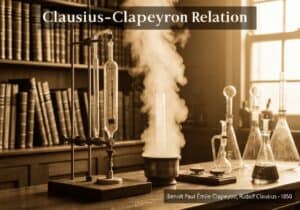
1850
- Benoît Paul Émile Clapeyron
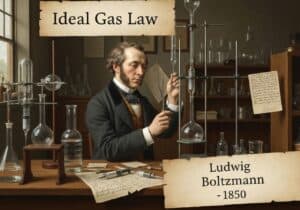
The ideal gas law is the equation of state for a hypothetical ideal gas, approximating the behavior of many gases under various conditions. The molar form relates プレッシャー ([latex]P[/latex]), volume ([latex]V[/latex]), amount of substance in moles ([latex]n[/latex]), and absolute temperature ([latex]T[/latex]) via the universal gas constant ([latex]R[/latex]): [latex]PV = nRT[/latex].
The ideal gas law, expressed as [latex]PV = nRT[/latex], is a cornerstone of thermodynamics and physical chemistry. It was first stated by Benoît Paul Émile Clapeyron in 1834 as a combination of the empirical laws of Boyle, Charles, ゲイ=リュサック、 そして アボガドロ. This equation of state provides a remarkably accurate approximation for the behavior of many gases under conditions of moderate temperature and low pressure. In the equation, [latex]P[/latex] represents the absolute pressure, [latex]V[/latex] is the volume, [latex]n[/latex] is the number of moles of the gas, and [latex]T[/latex] is the absolute temperature in Kelvin.
The constant of proportionality, [latex]R[/latex], is known as the universal gas constant. Its value is the same for all gases and is approximately 8.314 J/(mol·K). The law’s power lies in its ability to relate the four macroscopic state variables of a gas in a single, simple formula. This allows for the calculation of any one variable if the other three are known. The “ideal” nature of the gas described by this law stems from two key assumptions: the gas particles themselves have negligible volume, and there are no intermolecular attractive or repulsive forces between them. While no real gas is truly ideal, many common gases like nitrogen, oxygen, and argon behave nearly ideally under standard conditions, making the law extremely useful for practical applications.
UNESCO Nomenclature: 2210
熱力学
前駆物質
- Boyle’s Law (1662)
- Charles’s Law (1787)
- Gay-Lussac’s Law (1802)
- Avogadro’s Law (1811)
- Dalton’s Atomic Theory
- Concept of absolute temperature (Kelvin)
アプリケーション
- 化学工学プロセス設計
- meteorology and weather forecasting
- calculating gas density and molar mass
- 熱力学 cycle analysis (e.g., carnot cycle)
- scuba diving gas mixture calculations
潜在的なイノベーションのアイデア
- self-calibrating industrial gas sensors that use deviations from ideal behavior to identify contaminants
- smart food packaging that changes color based on internal pressure changes from spoilage gases
- ai-driven climate models with enhanced atmospheric strata simulation based on localized gas law calculations
- miniature, high-efficiency engines for drones that optimize fuel-air mixture based on real-time p, v, t readings
- advanced medical ventilators that precisely control gas delivery by dynamically modeling lung capacity
- geological survey tools that estimate underground gas reservoir size by analyzing pressure fluctuations
- next-generation fire suppression systems that calculate the optimal amount of inert gas to release based on room volume and temperature
- educational virtual reality labs for safely demonstrating gas properties under extreme conditions
- cryogenic storage systems that predict and prevent pressure build-up in liquefied gas containers
- inflatable habitat modules for space exploration with automated pressure regulation based on temperature and solar radiation
Related to: ideal gas, equation of state, pressure, volume, temperature, mole, gas constant, thermodynamics, clapeyron, physical chemistry.