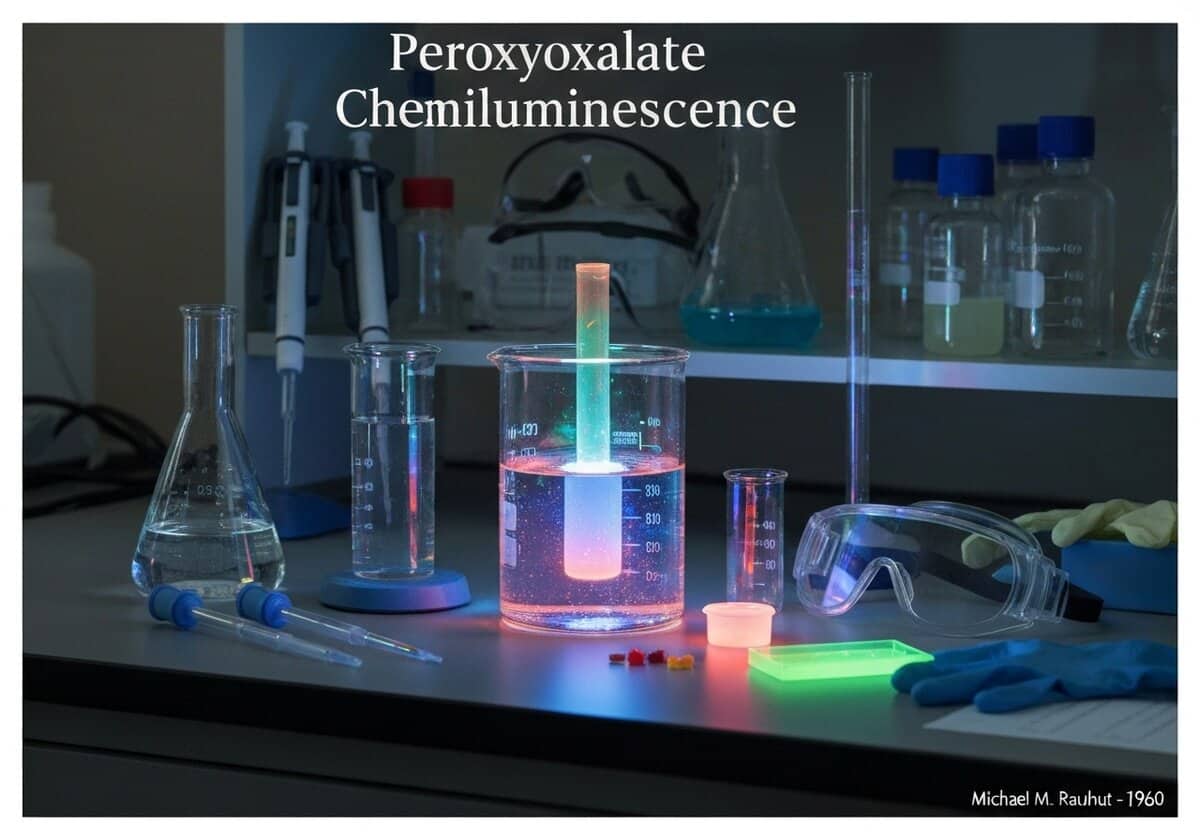
これは 化学プロセス グロースティックの発光に関与している。これは、ジフェニルオキサレートエステル(ジフェニルオキサレートなど)と過酸化水素が蛍光色素(蛍光体)の存在下で反応することを含む。この反応により、 高エネルギー 化学中間体が生成され、それがエネルギーを色素分子に伝達する。励起された色素分子はその後緩和し、特定の色の光子を放出する。
(画像はイメージです)
これは 化学プロセス グロースティックの発光に関与している。これは、ジフェニルオキサレートエステル(ジフェニルオキサレートなど)と過酸化水素が蛍光色素(蛍光体)の存在下で反応することを含む。この反応により、 高エネルギー 化学中間体が生成され、それがエネルギーを色素分子に伝達する。励起された色素分子はその後緩和し、特定の色の光子を放出する。
The peroxyoxalate reaction is one of the most efficient non-biological chemiluminescent processes known, with quantum yields reaching up to 23%. The mechanism is complex but is believed to involve the formation of a highly unstable, high-energy intermediate, often proposed to be 1,2-dioxetanedione ([latex]C_2O_4[/latex]). This intermediate is generated from the reaction between the oxalate ester and hydrogen peroxide. The key step is the chemically initiated electron exchange luminescence (CIEEL). The unstable intermediate transfers an electron to the nearby fluorophore, causing the intermediate to fragment (into two molecules of [latex]CO_2[/latex]) and the fluorophore to become a radical cation. An immediate back-electron transfer from the fragmented intermediate to the fluorophore radical cation generates the fluorophore in an electronically excited state. This excited fluorophore then emits light. The color of the light is determined entirely by the choice of fluorophore (e.g., 9,10-diphenylanthracene for blue, rhodamine B for red), not by the primary oxalate reaction. This allows for the production of a wide spectrum of colors simply by changing the dye additive.
ペルオキシオキサレート化学発光
(日付が不明または関連性がない場合、例えば「流体力学」などでは、その注目すべき出現時期の概算値が提示されます。)

フルサイズの画像とダウンロードは、登録会員のみが100%無料で利用できます。
> ログイン <