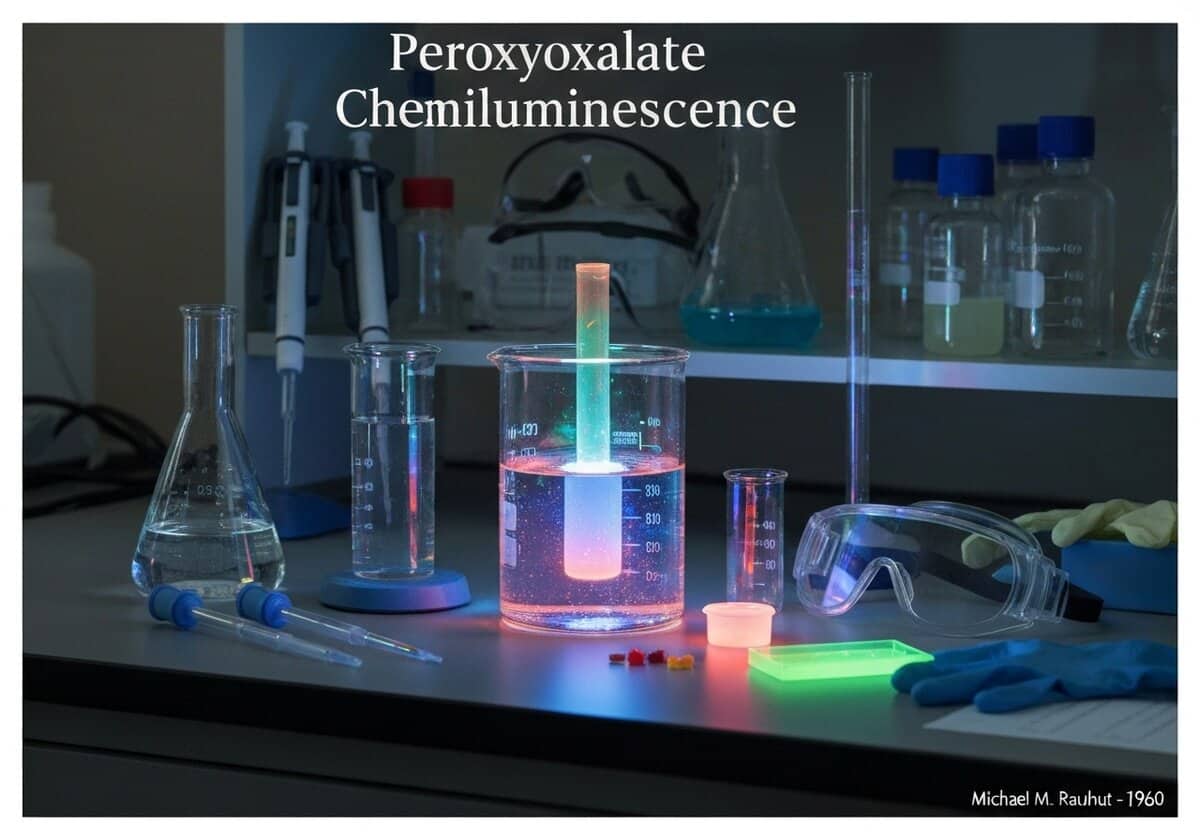
이것은 화학 공정 야광봉의 빛을 내는 원인 물질입니다. 이 반응은 다이아릴 옥살레이트 에스테르(예: 다이페닐 옥살레이트)가 형광 염료(형광체) 존재 하에 과산화수소와 반응하는 것을 포함합니다. 이 반응은 특정 물질을 생성합니다. 고에너지 화학적 중간체가 에너지를 염료 분자로 전달합니다. 들뜬 염료 분자는 다시 이완되면서 특정 색깔의 광자를 방출합니다.
(설명을 위한 생성된 이미지입니다)
이것은 화학 공정 야광봉의 빛을 내는 원인 물질입니다. 이 반응은 다이아릴 옥살레이트 에스테르(예: 다이페닐 옥살레이트)가 형광 염료(형광체) 존재 하에 과산화수소와 반응하는 것을 포함합니다. 이 반응은 특정 물질을 생성합니다. 고에너지 화학적 중간체가 에너지를 염료 분자로 전달합니다. 들뜬 염료 분자는 다시 이완되면서 특정 색깔의 광자를 방출합니다.
The peroxyoxalate reaction is one of the most efficient non-biological chemiluminescent processes known, with quantum yields reaching up to 23%. The mechanism is complex but is believed to involve the formation of a highly unstable, high-energy intermediate, often proposed to be 1,2-dioxetanedione ([latex]C_2O_4[/latex]). This intermediate is generated from the reaction between the oxalate ester and hydrogen peroxide. The key step is the chemically initiated electron exchange luminescence (CIEEL). The unstable intermediate transfers an electron to the nearby fluorophore, causing the intermediate to fragment (into two molecules of [latex]CO_2[/latex]) and the fluorophore to become a radical cation. An immediate back-electron transfer from the fragmented intermediate to the fluorophore radical cation generates the fluorophore in an electronically excited state. This excited fluorophore then emits light. The color of the light is determined entirely by the choice of fluorophore (e.g., 9,10-diphenylanthracene for blue, rhodamine B for red), not by the primary oxalate reaction. This allows for the production of a wide spectrum of colors simply by changing the dye additive.
과산화옥살산염 화학발광
(날짜를 알 수 없거나 관련이 없는 경우, 예를 들어 "유체역학"의 경우, 주목할 만한 등장 시기를 대략적으로 추정하여 제공합니다.)

고화질 이미지 및 다운로드는 등록된 회원에게만 100% 무료로 제공됩니다.
> 로그인 <