Product Design, Manufacturing & Innovation Resources
家 » ショックレー・クイサー限界

ショックレー・クイサー限界

1961
  • William Shockley
  • Hans-Joachim Queisser
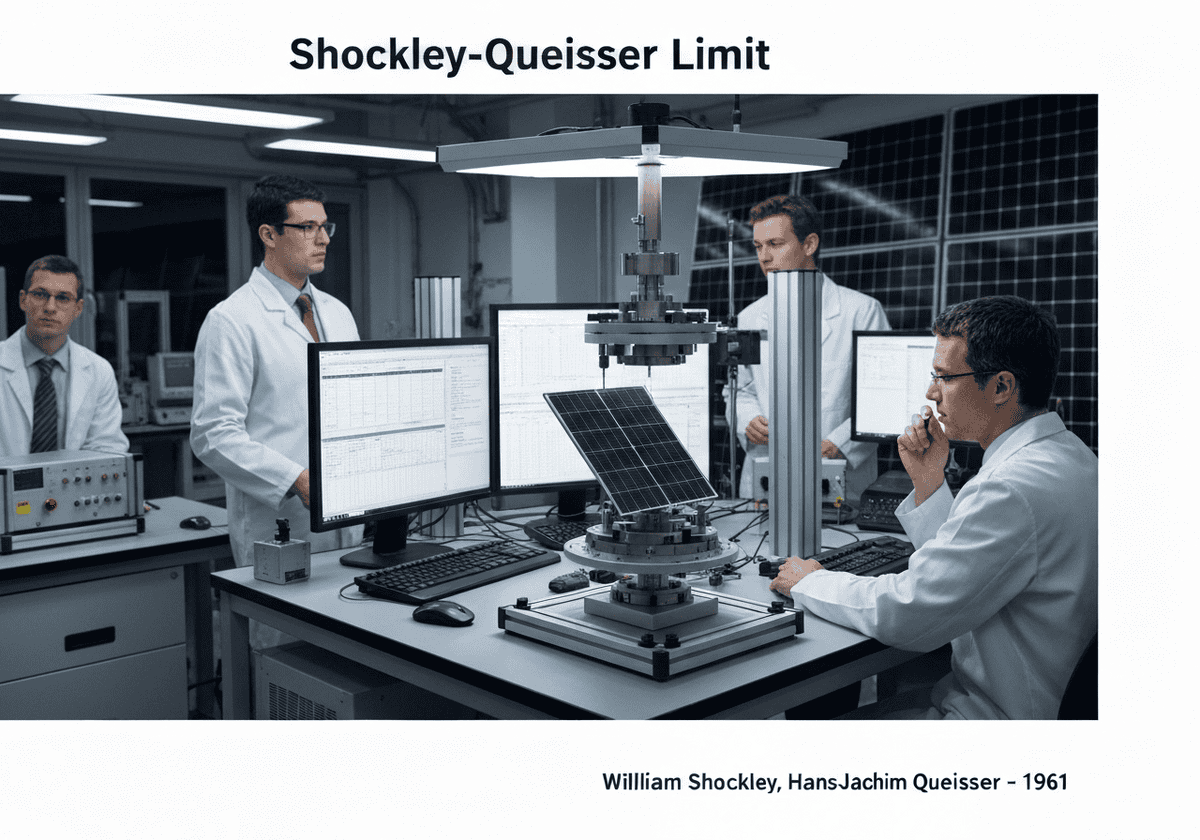
Research laboratory analyzing single p-n junction solar cell efficiency based on Shockley–Queisser Limit.

(画像はイメージです)

ショックレー・クイサー限界は、単一pn接合太陽電池の理論上の最大効率です。これは、放射再結合と黒体放射による損失のみを考慮しています。標準太陽光照射(AM1.5G)下で最適なバンドギャップ1.34 eVを持つ単一接合セルでは、最大効率は約33.7%です。この基本的な限界は、太陽電池の研究開発の指針となっています。

The Shockley–Queisser (SQ) limit, also known as the detailed balance limit, provides a foundational ceiling on the energy conversion efficiency of ソーラー cells. It is derived by analyzing the 熱力学 balance between the energy absorbed from the sun and the energy lost by the cell. The model makes several key assumptions: the cell is a single p-n junction, it operates at a standard temperature (300 K), and it is illuminated by unconcentrated sunlight (AM1.5G spectrum).

この計算では、いくつかの避けられない損失メカニズムを考慮しています。まず、半導体のバンドギャップ ([latex]E_g[/latex]) よりエネルギーの低い光子は、吸収されずにセルを通過し、電流に寄与しません。次に、バンドギャップより大きいエネルギーを持つ光子の場合、励起された電子が伝導帯の底に緩和するにつれて、余剰エネルギー ([latex]E_{photon} – E_g[/latex]) は熱化によって熱として急速に失われます。したがって、電圧は光子エネルギーではなく、バンドギャップによって制限されます。SQ 限界で考慮される最も重要な損失メカニズムは、放射再結合です。これは吸収の逆のプロセスであり、電子と正孔が再結合して光子を放出します。理想的なセルでは、これが唯一の再結合経路です。セルはゼロ以外の温度にあるため、黒体としてエネルギーを放射します。

ショックレーとクイサーは、太陽からの入射光子束と放射再結合および黒体放射からの出射光子束のバランスをとることで、理想的なセルの電流-電圧特性を導き出した。この曲線上の最大電力点が最大効率を定義する。効率はバンドギャップエネルギーに大きく依存し、バンドギャップが1.34 eVの場合に約33.7%でピークに達する。これはガリウムヒ素(GaAs)のバンドギャップに近い値である。シリコン([latex]E_g approx 1.12[/latex] eV)の場合、限界は約32%である。

UNESCO Nomenclature: 2210
物理学

タイプ

理論上の限界

混乱

基礎

使用法

広く普及している

前駆物質

  • プランクの黒体放射の法則
  • アインシュタインの光電効果と誘導放出に関する研究
  • 半導体pn接合理論
  • 熱力学の原理、特に 第二法則

アプリケーション

  • 単接合型太陽電池の性能ベンチマーク
  • 限界を克服するための多接合型太陽電池の設計
  • ホットキャリア型太陽電池およびアップコンバージョン/ダウンコンバージョン型太陽電池の研究
  • 太陽エネルギーコストの経済モデル

特許:

NA

潜在的なイノベーションのアイデア

  • solar cells using quantum dots with tunable bandgaps to perfectly match the sq peak
  • thermo-photovoltaic systems that convert waste heat back into narrow-band light for a matched solar cell
  • dynamic bandgap materials that adjust to changing solar spectrum throughout the day
  • luminescent solar concentrators that shift uv light to the optimal sq wavelength
  • フォトニック crystal designs that enhance absorption just above the bandgap while rejecting sub-bandgap photons
  • hybrid solar cells that use hot-carrier extraction for 高エネルギー photons and a standard p-n junction for lower-energy ones
  • metamaterials that angularly restrict cell emission to reduce radiative recombination losses
  • ai-driven discovery of new semiconductor alloys with ideal sq bandgaps and material properties
関連キーワード:ショックレー・クイサー限界、太陽電池効率、熱力学的限界、放射再結合、バンドギャップ、詳細平衡、単接合、黒体放射。

歴史的背景

ショックレー・クイサー限界

1960
1960
1960
1961
1962
1963
1965
1960
1960
1960
1960-05-16
1962
1963
1964
1968

(日付が不明または関連性がない場合、例えば「流体力学」などでは、その注目すべき出現時期の概算値が提示されます。)

10年目 周年

フルサイズの画像とダウンロードは、登録会員のみが100%無料で利用できます。