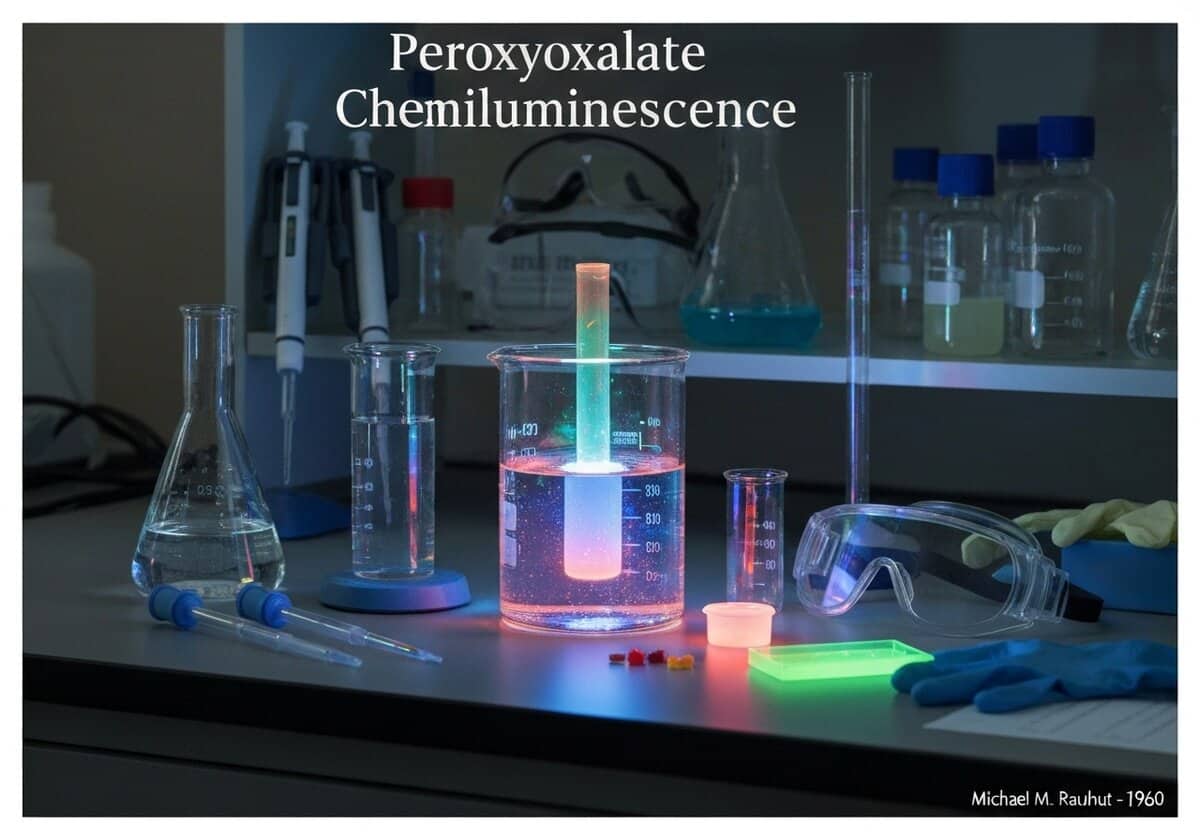
这是 chemical process 荧光棒发光的原理是:二芳基草酸酯(例如草酸二苯酯)在荧光染料(荧光团)存在下与过氧化氢发生反应。该反应生成一种 高能 化学中间体随后将其能量传递给染料分子。受激发的染料分子随后弛豫,并释放出特定颜色的光子。

(图片仅供参考)
这是 chemical process 荧光棒发光的原理是:二芳基草酸酯(例如草酸二苯酯)在荧光染料(荧光团)存在下与过氧化氢发生反应。该反应生成一种 高能 化学中间体随后将其能量传递给染料分子。受激发的染料分子随后弛豫,并释放出特定颜色的光子。
The peroxyoxalate reaction is one of the most efficient non-biological chemiluminescent processes known, with quantum yields reaching up to 23%. The mechanism is complex but is believed to involve the formation of a highly unstable, high-energy intermediate, often proposed to be 1,2-dioxetanedione ([latex]C_2O_4[/latex]). This intermediate is generated from the reaction between the oxalate ester and hydrogen peroxide. The key step is the chemically initiated electron exchange luminescence (CIEEL). The unstable intermediate transfers an electron to the nearby fluorophore, causing the intermediate to fragment (into two molecules of [latex]CO_2[/latex]) and the fluorophore to become a radical cation. An immediate back-electron transfer from the fragmented intermediate to the fluorophore radical cation generates the fluorophore in an electronically excited state. This excited fluorophore then emits light. The color of the light is determined entirely by the choice of fluorophore (e.g., 9,10-diphenylanthracene for blue, rhodamine B for red), not by the primary oxalate reaction. This allows for the production of a wide spectrum of colors simply by changing the dye additive.
过氧草酸化学发光
(如果日期未知或不相关,例如“流体力学”,则提供其显著出现的近似估计)
只有注册会员才能免费获取完整尺寸的图片和下载内容。
> 登录 <