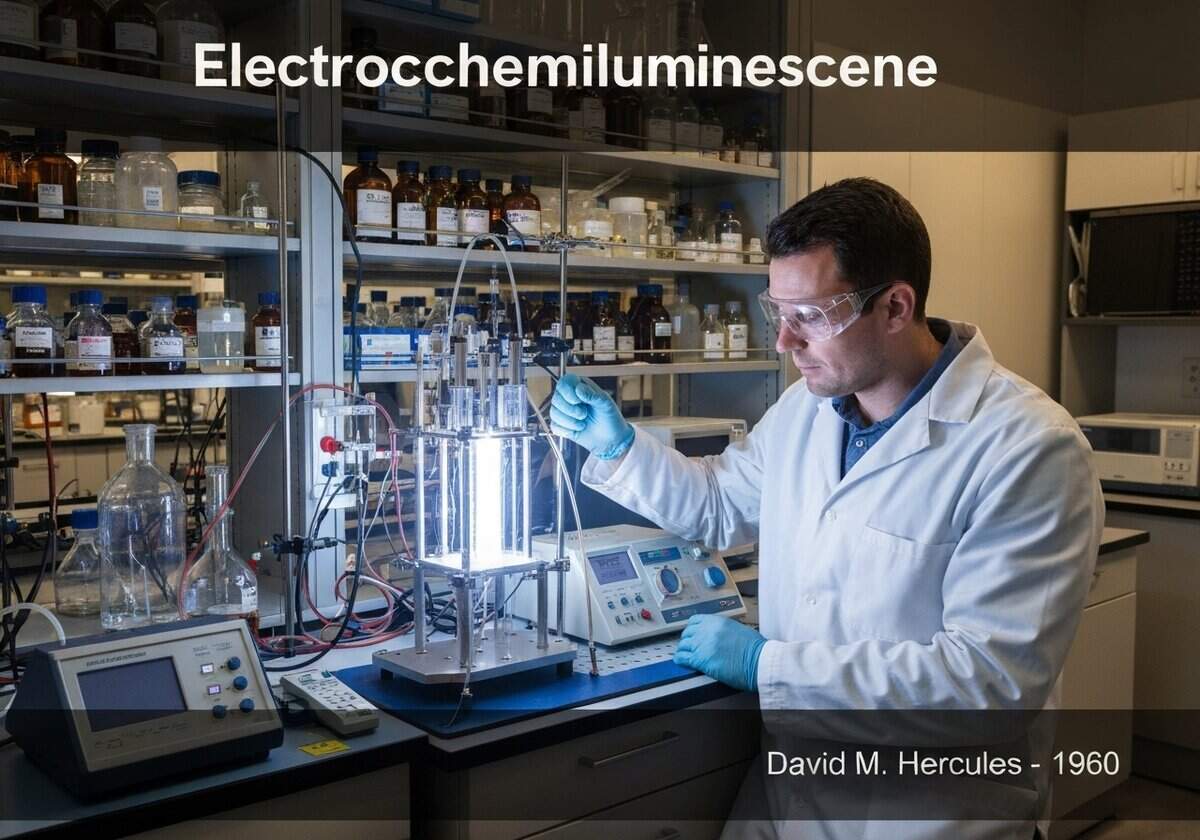
電気化学発光、または電気化学発光(ECL)とは、電極表面で開始される化学反応によって光が生成されるプロセスです。電気化学的に生成された物質は、高エネルギー電子移動反応を経て励起状態となり、緩和時に光を放出します。このプロセスは、化学発光の分析上の利点(低バックグラウンド、高感度)と、電気化学的トリガーの精密な制御を兼ね備えています。
(画像はイメージです)
電気化学発光、または電気化学発光(ECL)とは、電極表面で開始される化学反応によって光が生成されるプロセスです。電気化学的に生成された物質は、高エネルギー電子移動反応を経て励起状態となり、緩和時に光を放出します。このプロセスは、化学発光の分析上の利点(低バックグラウンド、高感度)と、電気化学的トリガーの精密な制御を兼ね備えています。
In a typical ECL system, a stable precursor molecule, such as a ruthenium(II) complex like [latex]Ru(bpy)_3^{2+}[/latex], is used. When a voltage is applied to an electrode in a solution containing this complex and a co-reactant (e.g., tripropylamine, TPA), both species are oxidized at the electrode surface. The oxidized TPA loses a proton and an electron to become a highly reducing radical intermediate. This radical then transfers an electron to the oxidized ruthenium complex, [latex]Ru(bpy)_3^{3+}[/latex], in a highly exothermic reaction. This 電子移動 is so energetic that it promotes the resulting [latex]Ru(bpy)_3^{2+}[/latex] to an electronically excited state, [latex][Ru(bpy)_3^{2+}]^*[/latex]. This excited state then relaxes to the ground state, emitting a photon of light at approximately 620 nm. The key advantage of ECL is its temporal and spatial control. The reaction only occurs when the voltage is applied and only at the electrode surface, which dramatically reduces background noise and allows for highly sensitive detection, often down to the attomolar level. This makes it a powerful tool in modern bioanalytical assays.
電気化学発光(ECL)
(日付が不明または関連性がない場合、例えば「流体力学」などでは、その注目すべき出現時期の概算値が提示されます。)

フルサイズの画像とダウンロードは、登録会員のみが100%無料で利用できます。
> ログイン <