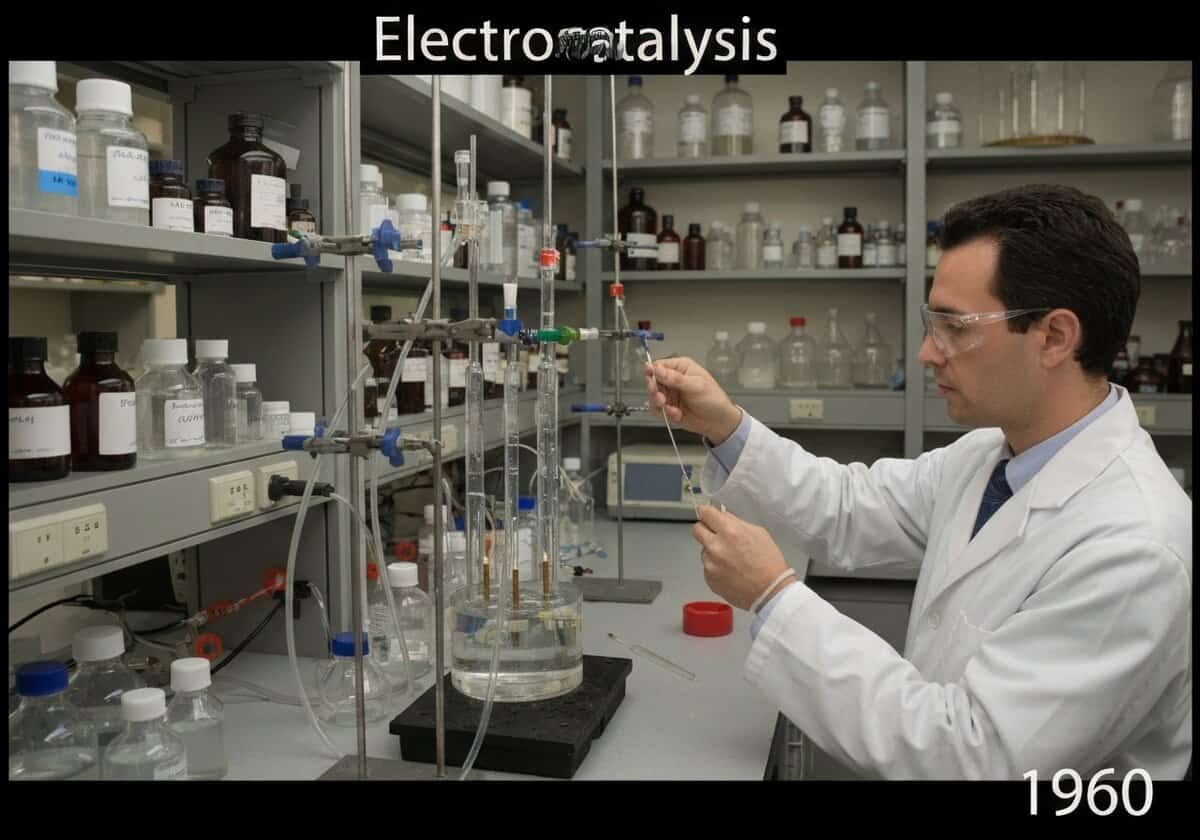
電気触媒作用は、電極表面で起こる電気化学反応の速度を加速させる触媒作用の一種です。これは触媒作用と電気化学の両方の分野にまたがるものです。電気触媒は、重要なエネルギー変換反応の効率を高め、過電圧(反応を適切な速度で進行させるために必要な余分な電圧)を低減する上で不可欠です。

(画像はイメージです)
電気触媒作用は、電極表面で起こる電気化学反応の速度を加速させる触媒作用の一種です。これは触媒作用と電気化学の両方の分野にまたがるものです。電気触媒は、重要なエネルギー変換反応の効率を高め、過電圧(反応を適切な速度で進行させるために必要な余分な電圧)を低減する上で不可欠です。
Electrocatalysis is fundamentally linked to heterogeneous catalysis but with the added dimension of an applied electrical potential controlling the reaction’s driving force. The 触媒 is the electrode material itself or a substance coated onto it. Its function is to lower the activation energy for 電子移動 steps. A key performance metric for an electrocatalyst is the overpotential ([latex]\eta[/latex]), defined as the difference between the thermodynamic potential and the actual potential required to achieve a certain current density. An efficient electrocatalyst minimizes [latex]\eta[/latex].
The performance is often analyzed using a Tafel plot, which shows a linear relationship between the logarithm of the current density ([latex]log(j)[/latex]) and the overpotential ([latex]eta[/latex]). The slope of this plot, the Tafel slope, provides insight into the reaction mechanism. For example, the oxygen evolution reaction (OER) and oxygen reduction reaction (ORR) are notoriously sluggish, requiring large overpotentials. Developing cheap, abundant, and efficient electrocatalysts (e.g., alternatives to platinum) for these reactions is a major goal in renewable energy research, as they are critical for technologies like water electrolyzers, fuel cells, and metal-air batteries. The Sabatier principle also applies here, stating that the ideal catalyst binds intermediates neither too strongly nor too weakly.
電極触媒作用
(日付が不明または関連性がない場合、例えば「流体力学」などでは、その注目すべき出現時期の概算値が提示されます。)
フルサイズの画像とダウンロードは、登録会員のみが100%無料で利用できます。
> ログイン <