Product Design, Manufacturing & Innovation Resources
Lar » Quimioluminescência do peroxioxalato

Quimioluminescência do peroxioxalato

1960
  • Michael M. Rauhut
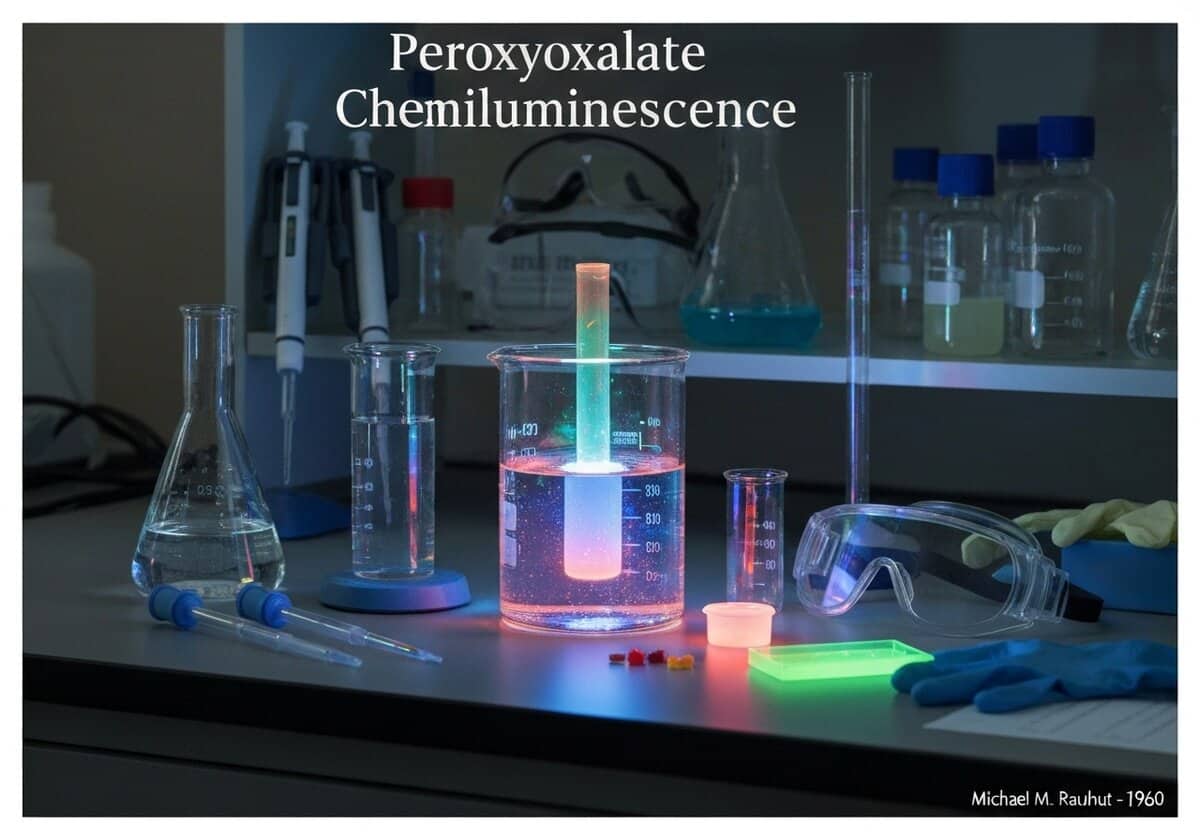
Configuração de laboratório para reação de quimioluminescência de peroxioxalato em química orgânica.

(Imagem gerada apenas para fins ilustrativos)

Este é o processo químico Responsável pela luz em bastões luminosos. Envolve a reação de um éster de oxalato de diarila (como o oxalato de difenila) com peróxido de hidrogênio na presença de um corante fluorescente (fluoróforo). A reação produz uma alta energia intermediário químico, que então transfere sua energia para a molécula do corante. A molécula do corante excitada então relaxa, emitindo um fóton de uma cor específica.
The peroxyoxalate reaction is one of the most efficient non-biological chemiluminescent processes known, with quantum yields reaching up to 23%. The mechanism is complex but is believed to involve the formation of a highly unstable, high-energy intermediate, often proposed to be 1,2-dioxetanedione ([latex]C_2O_4[/latex]). This intermediate is generated from the reaction between the oxalate ester and hydrogen peroxide. The key step is the chemically initiated electron exchange luminescence (CIEEL). The unstable intermediate transfers an electron to the nearby fluorophore, causing the intermediate to fragment (into two molecules of [latex]CO_2[/latex]) and the fluorophore to become a radical cation. An immediate back-electron transfer from the fragmented intermediate to the fluorophore radical cation generates the fluorophore in an electronically excited state. This excited fluorophore then emits light. The color of the light is determined entirely by the choice of fluorophore (e.g., 9,10-diphenylanthracene for blue, rhodamine B for red), not by the primary oxalate reaction. This allows for the production of a wide spectrum of colors simply by changing the dye additive.

UNESCO Nomenclature: 2203
Química orgânica

Tipo

Processo Químico

Interrupção

Substancial

Uso

Uso generalizado

Precursores

  • síntese de ésteres de oxalato
  • Descoberta e compreensão da fluorescência e dos fluoróforos
  • Pesquisa sobre mecanismos de reação envolvendo intermediários de alta energia
  • Desenvolvimento de química industrial para embalagens seguras de produtos químicos reativos.

Aplicações

  • iluminação de emergência (bastões luminosos)
  • Aplicações militares para marcação e iluminação
  • usos recreativos (festas, concertos)
  • iscas para pesca em alto mar
  • técnicas de química analítica

Patentes:

  • US3597362

Ideias de Inovação Potencial

  • long-duration chemiluminescent markers for infrastructure inspection in dark environments
  • self-illuminating medical tubing for better visibility during surgery
  • biodegradable glow sticks for reduced environmental impact
  • chemiluminescent films that activate upon mechanical stress to indicate material fatigue
  • multi-color, pattern-changing glow sticks controlled by sequential reaction initiation
  • emergency signage that activates automatically upon power failure
  • chemiluminescent threads woven into safety clothing
  • food products with edible, glowing components for novelty (e.g., cake frosting)
  • sprayable chemiluminescent foams for search and rescue marking
  • temperature-sensitive glow sticks whose color or intensity changes with ambient temperature
Related to: peroxyoxalate, quimioluminescência, glow stick, light stick, diphenyl oxalate, hydrogen peroxide, fluorophore, CIEEL, 1,2-dioxetanedione, quantum yield.

Contexto histórico

Quimioluminescência do peroxioxalato

1960
1960
1960
1960
1960
1960
1960-05-16
1960
1960
1960
1960
1960
1960
1960
1961

(Caso a data seja desconhecida ou irrelevante, por exemplo, "mecânica dos fluidos", é fornecida uma estimativa aproximada de seu surgimento notável)

10º ano aniversário

Imagens em tamanho real e downloads estão disponíveis apenas, 100% gratuitos, para membros registrados.