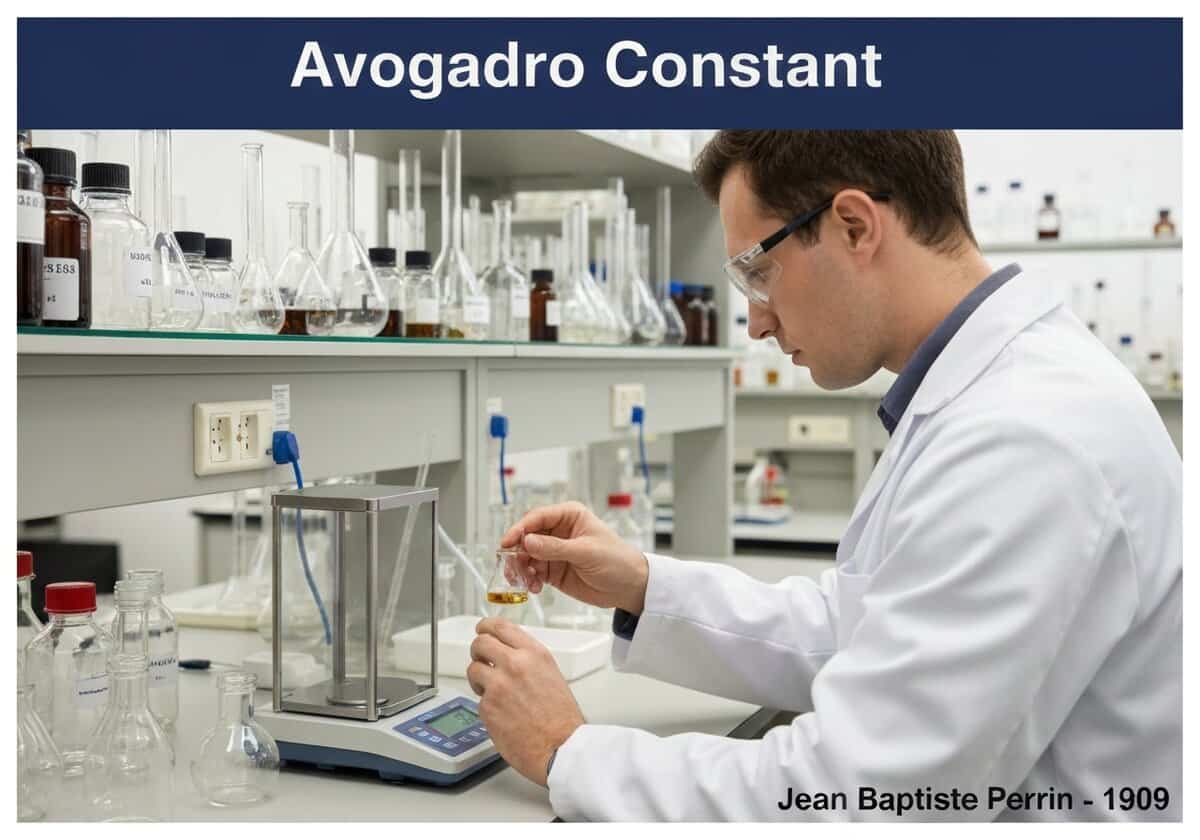
그만큼 아보가드로 상수 [latex]N_A[/latex]는 물질 1몰에 포함된 구성 입자(원자, 분자, 이온)의 수를 나타냅니다. 이는 [latex]6.02214076 times 10^{23} text{ mol}^{-1}[/latex]라는 정확한 값을 갖는 기본적인 물리 상수입니다. 이 상수는 몰이라는 거시적 규모와 개별 입자라는 미시적 세계를 연결하는 필수적인 고리 역할을 하며, 정량 화학의 기초를 이룹니다.

(설명을 위한 생성된 이미지입니다)
그만큼 아보가드로 상수 [latex]N_A[/latex]는 물질 1몰에 포함된 구성 입자(원자, 분자, 이온)의 수를 나타냅니다. 이는 [latex]6.02214076 times 10^{23} text{ mol}^{-1}[/latex]라는 정확한 값을 갖는 기본적인 물리 상수입니다. 이 상수는 몰이라는 거시적 규모와 개별 입자라는 미시적 세계를 연결하는 필수적인 고리 역할을 하며, 정량 화학의 기초를 이룹니다.
While Amedeo 아보가드로 proposed the principle that led to the mole concept, he never determined the value of the constant that bears his name. The first scientist to estimate the number of particles in a given volume of gas was Johann Josef Loschmidt in 1865, based on the kinetic theory of gases. For this reason, the constant is sometimes referred to as the Loschmidt constant in German-speaking countries, although that term now typically refers to the number of particles per unit volume.
The name ‘Avogadro’s number’ or ‘Avogadro constant’ was coined by French physicist Jean Perrin in 1909. Perrin’s experiments on Brownian motion—the random movement of particles suspended in a fluid—provided a more accurate determination of its value and earned him the 1926 Nobel Prize in Physics. For over a century, the value was refined through various experimental methods. However, on May 20, 2019, as part of the redefinition of SI base units, the Avogadro constant was assigned a fixed, exact numerical value. This act fundamentally changed the definition of the mole, which is now defined as containing exactly [latex]6.02214076 times 10^{23}[/latex] elementary entities, rather than being based on the number of atoms in 12 grams of carbon-12.
Avogadro Constant
(날짜를 알 수 없거나 관련이 없는 경우, 예를 들어 "유체역학"의 경우, 주목할 만한 등장 시기를 대략적으로 추정하여 제공합니다.)

고화질 이미지 및 다운로드는 등록된 회원에게만 100% 무료로 제공됩니다.
> 로그인 <