Product Design, Manufacturing & Innovation Resources
Maison » Constante d'Avogadro

Constante d'Avogadro

1909
  • Jean Baptiste Perrin
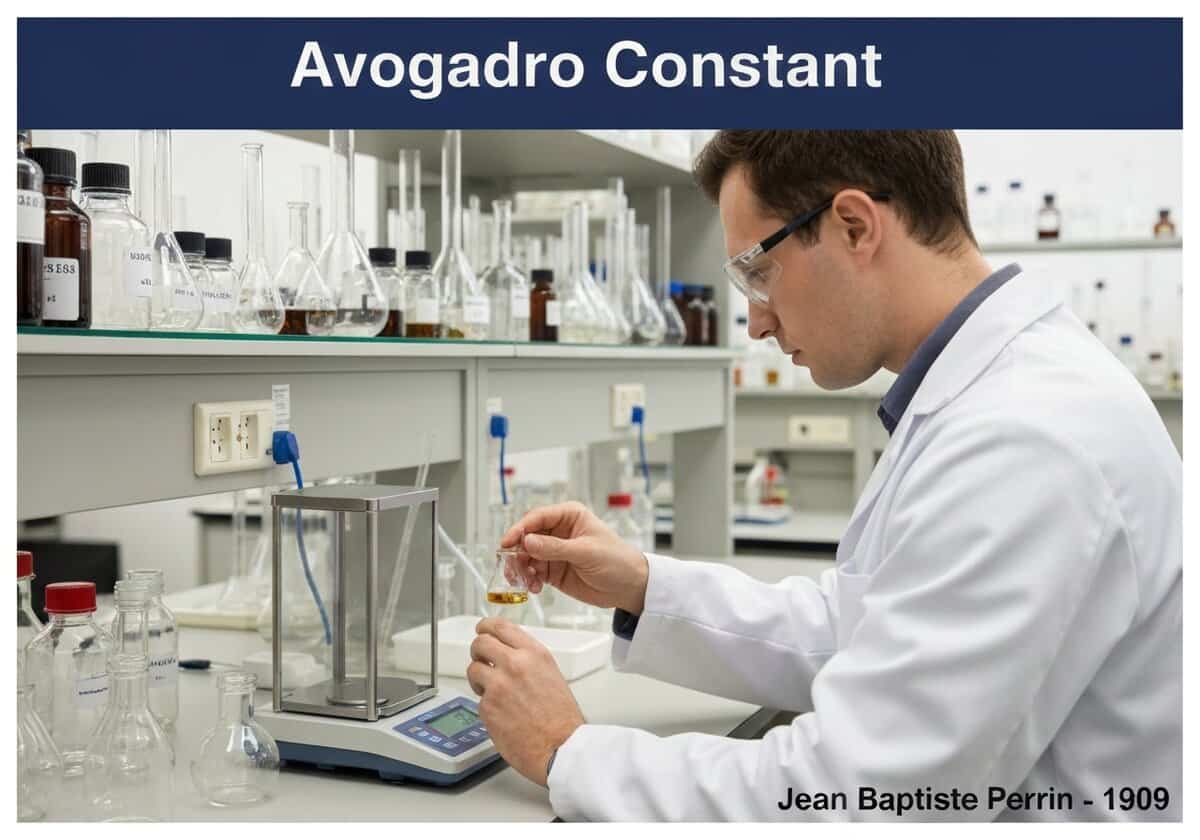
Un chimiste mesure la masse d'une substance en laboratoire pour des applications de chimie physique.

(Image générée à titre d'illustration uniquement)

Le Avogadro constant, [latex]N_A[/latex], represents the number of constituent particles (atoms, molecules, ions) in one mole of a substance. It is a fundamental physical constant with an exact, defined value of [latex]6.02214076 \times 10^{23} text{ mol}^{-1}[/latex]. This constant provides the essential link between the macroscopic scale of moles and the microscopic world of individual particles, underpinning quantitative chemistry.

While Amedeo Avogadro proposed the principle that led to the mole concept, he never determined the value of the constant that bears his name. The first scientist to estimate the number of particles in a given volume of gas was Johann Josef Loschmidt in 1865, based on the kinetic theory of gases. For this reason, the constant is sometimes referred to as the Loschmidt constant in German-speaking countries, although that term now typically refers to the number of particles per unit volume.

The name ‘Avogadro’s number’ or ‘Avogadro constant’ was coined by French physicist Jean Perrin in 1909. Perrin’s experiments on Brownian motion—the random movement of particles suspended in a fluid—provided a more accurate determination of its value and earned him the 1926 Nobel Prize in Physics. For over a century, the value was refined through various experimental methods. However, on May 20, 2019, as part of the redefinition of SI base units, the Avogadro constant was assigned a fixed, exact numerical value. This act fundamentally changed the definition of the mole, which is now defined as containing exactly [latex]6.02214076 times 10^{23}[/latex] elementary entities, rather than being based on the number of atoms in 12 grams of carbon-12.

UNESCO Nomenclature: 2209
- Chimie physique

Taper

Système abstrait

Perturbation

Fondamentaux

Usage

Utilisation généralisée

Précurseurs

  • loi d'avogadro (1811)
  • théorie cinétique des gaz
  • johann josef loschmidt’s work on estimating molecular size (1865)
  • albert einstein’s theoretical work on brownian motion (1905)

Applications

  • calculer la masse d'un seul atome ou d'une seule molécule
  • déterminer le nombre de particules dans une masse donnée d'une substance
  • calculs fondamentaux en chimie physique et en physique du solide
  • étalonnage en spectrométrie de masse
  • dosimétrie en physique des rayonnements

Brevets:

NA

Idées d'innovations potentielles

  • capteurs à molécule unique pour diagnostics médicaux ultra-sensibles
  • techniques de dépôt de couches atomiques (DLA) pour la fabrication de semi-conducteurs avec une précision de l'ordre de l'angström
  • algorithmes de calcul quantique qui simulent les interactions moléculaires
  • nanorobots conçus pour l'administration ciblée de médicaments à un nombre spécifique de cellules
  • biologie synthétique creating artificial cells with a precise count of functional proteins
  • sphères de silicium ultra-pur pour créer de nouveaux étalons de masse
  • matériaux avancés dont les propriétés sont définies par leur structure atomique exacte
  • modèles cosmologiques qui calculent l'abondance des éléments dans l'univers primitif
  • systèmes de stockage de données ADN codant les informations en fonction du nombre de paires de bases
  • highly efficient catalyseurs designed by calculating the optimal number of active sites
Related to: Avogadro constant, Avogadro’s number, mole, NA, jean perrin, si units, fundamental constant, physical chemistry, loschmidt constant, particle count.

Contexte historique

Constante d'Avogadro

1902
1902
1907
1909
1910
1911-04-08
1913
1900-12-14
1902
1904
1907
1909
1910
1912
1915

(si la date est inconnue ou non pertinente, par exemple « mécanique des fluides », une estimation arrondie de son émergence notable est fournie)

10e année anniversaire

Les images en pleine résolution et les téléchargements sont uniquement disponibles, et 100% gratuits, pour les membres inscrits.