Product Design, Manufacturing & Innovation Resources
Lar » Constante de Avogadro

Constante de Avogadro

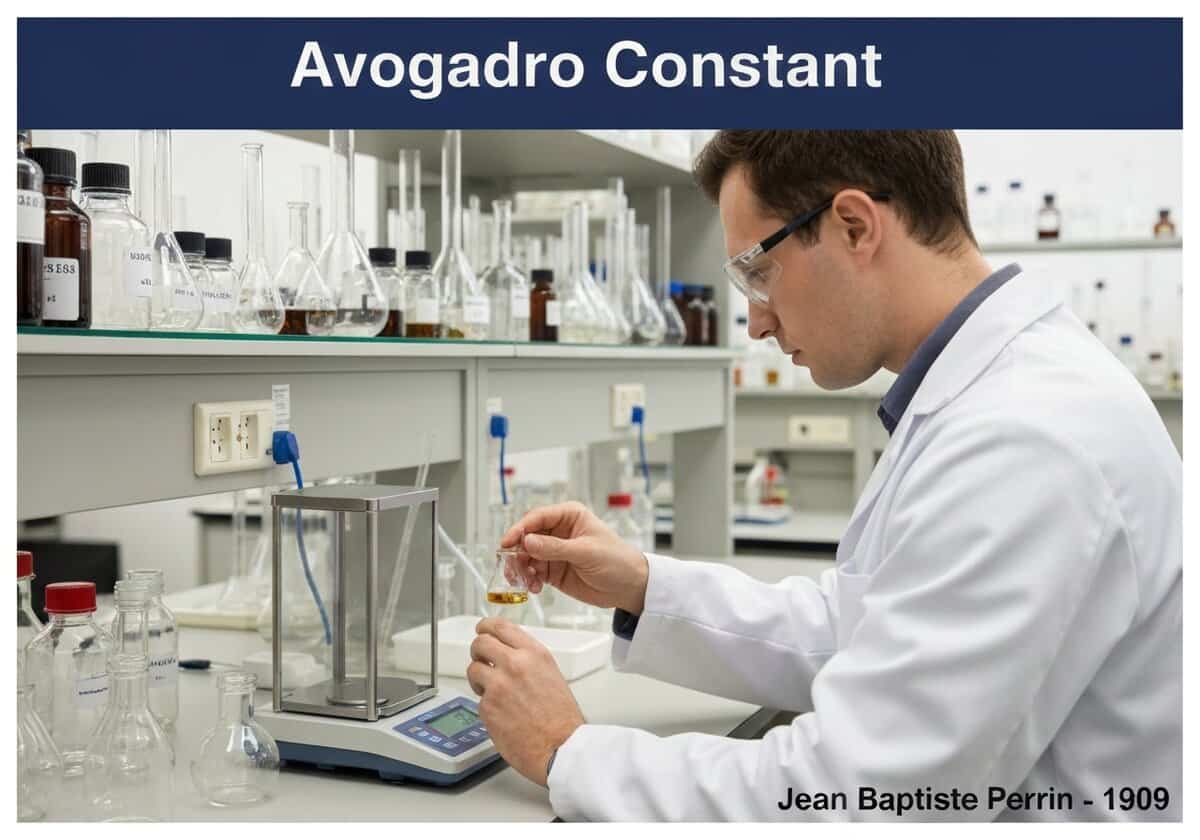
1909
  • Jean Baptiste Perrin
Químico que mede a massa de uma substância em laboratório para aplicações em físico-química.

(Imagem gerada apenas para fins ilustrativos)

O Avogadro A constante [latex]N_A[/latex] representa o número de partículas constituintes (átomos, moléculas, íons) em um mol de uma substância. É uma constante física fundamental com um valor exato e definido de [latex]6,02214076 × 10^{23} mol^{-1}[/latex]. Essa constante fornece a ligação essencial entre a escala macroscópica de moles e o mundo microscópico de partículas individuais, fundamentando a química quantitativa.

While Amedeo Avogadro proposed the principle that led to the mole concept, he never determined the value of the constant that bears his name. The first scientist to estimate the number of particles in a given volume of gas was Johann Josef Loschmidt in 1865, based on the kinetic theory of gases. For this reason, the constant is sometimes referred to as the Loschmidt constant in German-speaking countries, although that term now typically refers to the number of particles per unit volume.

The name ‘Avogadro’s number’ or ‘Avogadro constant’ was coined by French physicist Jean Perrin in 1909. Perrin’s experiments on Brownian motion—the random movement of particles suspended in a fluid—provided a more accurate determination of its value and earned him the 1926 Nobel Prize in Physics. For over a century, the value was refined through various experimental methods. However, on May 20, 2019, as part of the redefinition of SI base units, the Avogadro constant was assigned a fixed, exact numerical value. This act fundamentally changed the definition of the mole, which is now defined as containing exactly [latex]6.02214076 times 10^{23}[/latex] elementary entities, rather than being based on the number of atoms in 12 grams of carbon-12.

UNESCO Nomenclature: 2209
Química física

Tipo

Sistema abstrato

Interrupção

Fundamentais

Uso

Uso generalizado

Precursores

  • Lei de Avogadro (1811)
  • teoria cinética dos gases
  • O trabalho de Johann Josef Loschmidt sobre a estimativa do tamanho molecular (1865)
  • O trabalho teórico de Albert Einstein sobre o movimento browniano (1905)

Aplicações

  • Calcular a massa de um único átomo ou molécula.
  • Determinar o número de partículas em uma determinada massa de uma substância.
  • cálculos fundamentais em físico-química e física do estado sólido
  • calibração em espectrometria de massa
  • dosimetria em física da radiação

Patentes:

NA

Ideias de Inovação Potencial

  • single-molecule sensors for ultra-sensitive medical diagnostics
  • atomic-layer deposition (ald) techniques for manufacturing semiconductors with angstrom-level precision
  • quantum computing algorithms that simulate molecular interactions
  • nanobots designed for targeted drug delivery to a specific number of cells
  • biologia sintética creating artificial cells with a precise count of functional proteins
  • ultra-pure silicon spheres for creating new mass standards
  • advanced materials with properties defined by their exact atomic structure
  • cosmological models that calculate the abundance of elements in the early universe
  • dna data storage systems encoding information based on the number of base pairs
  • highly efficient catalisadores designed by calculating the optimal number of active sites
Relacionado a: constante de Avogadro, número de Avogadro, mol, NA, Jean Perrin, unidades SI, constante fundamental, físico-química, constante de Loschmidt, contagem de partículas.

Contexto histórico

Constante de Avogadro

1902
1902
1907
1909
1910
1911-04-08
1913
1900-12-14
1902
1904
1907
1909
1910
1912
1915

(Caso a data seja desconhecida ou irrelevante, por exemplo, "mecânica dos fluidos", é fornecida uma estimativa aproximada de seu surgimento notável)

10º ano aniversário

Imagens em tamanho real e downloads estão disponíveis apenas, 100% gratuitos, para membros registrados.