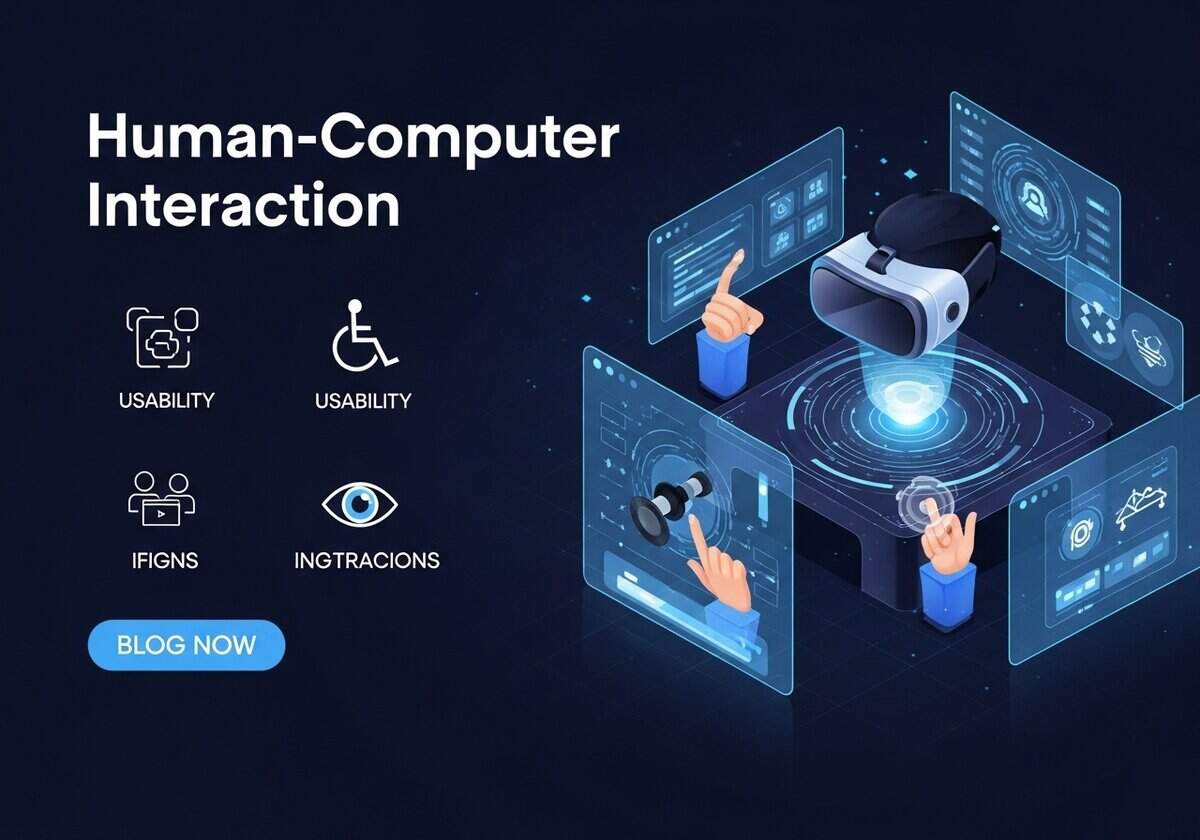

Human-Computer Interaction (HCI) investigates the design, evaluation, and implementation of interactive computing systems for human use, emphasizing the optimization of user interfaces and experiences. This multidisciplinary field integrates principles from computer science, cognitive psychology, design, and ergonomics to enhance the efficiency, effectiveness, and satisfaction of user interactions with technology. Research and innovation in HCI address diverse topics including 使いやすさ, accessibility, input/output modalities, adaptive systems, and emerging technologies such as virtual and augmented reality. Our following compilation presents the latest scholarly articles and patented inventions that advance theoretical frameworks, 方法論, and practical applications within HCI.
This is our latest selection of worldwide publications and patents in english on Human-Computer Interaction (HCI), between many scientific online journals, classified and focused on usability, user experience, interaction design, user interface, affordance, cognitive load, human factor, ergonomic, input device, output device, multimodal interaction, gesture recognition, eye tracking, touchscreen interaction, virtual reality, 拡張現実, user-centered design, heuristic evaluation, accessibility, task analys, information visual, speech recognition, adaptive interface, context-aware comput, human error, feedback mechanism, mental model and situated interaction.
Evidence for hierarchical representations of written and spoken words from an open-science human neuroimaging dataset
Published on 2026-10-15 by @MIT
Abstract: AbstractReading and speech recognition rely on multi-level processing that builds from basic visual or sound features to complete word representations, yet details of these processing hierarchies (in particular those for spoken words) are still poorly understood. We re-analyzed the functional magnetic resonance imaging (fMRI) data provided in the Mother Of all Unification Studies (MOUS) open-science dataset by using parametric regressions of word frequency and sublexical unit (bigram or syllable[...]
Our summary: This study re-analyzes fMRI data to explore processing hierarchies for written and spoken words. It identifies significant correlations in brain regions associated with lexical and sublexical processing during reading and listening tasks. Findings suggest a hierarchical organization in visual and auditory streams, with modality-specific representations converging in higher-order language areas.
neuroimaging, hierarchical representations, word frequency, auditory processing
Publication
Natural language access control configuration
Patent published on the 2026-10-15 in WO under Ref WO2026214869 by DORMAKABA DEUTSCHLAND GMBH [DE] (FiÉvet Alexis [de], Appl Dominik [de], Schwarz Dieter [de], Kanstein Volker [de])
Abstract: A computer-implemented method manages an access control platform by receiving a natural language request from a user via a user interface. The request, formulated in natural language and describing a configuration operation relating to the access control platform, is processed by a language model that determines the intended configuration operation to be performed on the platform. The method causes the performing of the determined configuration operation on the access control platform. This enab[...]
Our summary: This method allows users to configure an access control platform using natural language requests. A language model processes these requests to determine the intended configuration operations. This approach simplifies management and automates configuration tasks, making it accessible to non-technical users.
natural language processing, access control, configuration management, user interface
Patent
Virtual reality walking balance assessment system using firm and foam surfaces for sensory contributions to walking balance
Patent published on the 2026-10-15 in US under Ref US20260314991 by CLARKSON UNIV [US] (Appiah-kubi Kwadwo [us])
Abstract: A virtual reality walking balance assessment system includes a head-mounted display configured to present an interactive virtual environment to a participant during over-ground walking and to generate head-tracking data representing motion of the head-mounted display during the over-ground walking. A walking test protocol specifies a plurality of visual scene conditions and specifies a first walking surface condition and a second walking surface condition that is more compliant than the first wa[...]
Our summary: A virtual reality walking balance assessment system uses a head-mounted display to create an interactive environment for participants. It evaluates walking balance by analyzing head-tracking data and computing gait balance metrics. The system incorporates various visual scenes and surface conditions to assess sensory contributions to balance.
virtual reality, balance assessment, gait metrics, sensory contributions
Patent
Controlling virtual content display based on environment
Patent published on the 2026-10-15 in WO under Ref WO2026217097 by MAGIC LEAP INC [US] (Singh Vikramjit [us], Miller Michael Nevin [us], Ong Ryan Jason [us])
Abstract: Techniques are described for controlling the presentation of virtual image content through a wearable display system, such as an augmented reality and/or mixed reality display system, based on the environment in proximity to the display system. In some embodiments, the virtual image content being presented through such a system may be modified to enable the user of the display system to have a better view of the physical world, for example by changing one or more of a position, a depth, a resolu[...]
Our summary: Techniques for controlling virtual content display adapt to the surrounding environment. Modifications to virtual images enhance user interaction with the physical world. Changes can be triggered by the presence of nearby individuals, adjusting visibility accordingly.
augmented reality, mixed reality, wearable display, environmental interaction
Patent
A system and method for facilitating english reading and pronunciation
Patent published on the 2026-10-15 in WO under Ref WO2026215912 by HARATHI PAVANKUMAR [IN] (Karumunga Rudra Pradeepta [in], Karumunga Shree Durga Sharvani [in], Karumunga Shreeram Mahadev [in], Harathi Pavankumar [in])
Abstract: The invention relates to a method for facilitating reading English and pronunciation of words, and is aimed at learners comprising children, adults, and those with learning disabilities. English, being predominantly non-phonetic, presents significant challenges for learners due to its irregular vowels, homonyms, homophones, homographs, and foreign words. Current methods, such as phonic-based and sight-word-based programs, provide some benefit but are often burdened with numerous rules, exception[...]
Our summary: The invention simplifies English reading and pronunciation by transforming it into a structured phonetic system. It utilizes forty distinct sounds represented by unique phonetic symbols. This approach enhances reading fluency and accessibility for all learners, including those with learning disabilities.
phonetic system, reading facilitation, language learning, accessibility
Patent
Machine learning system with asynchronous communication
Patent published on the 2026-10-15 in US under Ref US20260320475 by MICROSOFT TECH LICENSING LLC [US] (Goodner Marc A [us], Krabach Brian Scott [us])
Abstract: [0000] A computing system including one or more processing devices configured to receive a first user input at a user interface of a machine learning (ML) system. In response to receiving the first user input, the one or more processing devices initiate a first model call to a first ML model. During execution of the first model call, the one or more processing devices receive one or more second user inputs and perform one or more second model calls to a second ML model to compute one or more sec[...]
Our summary: The system processes user inputs through asynchronous communication. It initiates model calls to different ML models based on user interactions. Outputs are provided to the user interface after processing inputs and model computations.
asynchronous communication, machine learning, model calls, user interface
Patent
System and method for use of spreadsheets integrated with web services, including support for creation of child rows
Patent published on the 2026-10-15 in US under Ref US20260320288 by ORACLE INT CORPORATION [US] (Chen Xiameng [us], Davis Edmund Alex [us])
Abstract: [0000] A system and method for use of spreadsheets integrated with web services, including support for creation of child rows in child spreadsheets. A client device can interrogate one or more web services to obtain web service metadata that determines one or more capabilities of those web services. This metadata can be used to automatically configure an editable table component in a spreadsheet. The table component can be used to retrieve data, edit that data in a spreadsheet, and upload change[...]
Our summary: The system integrates spreadsheets with web services to support child row creation. It retrieves web service metadata to configure an editable table component. Users can create child layouts with hierarchical relationships and manage data efficiently.
spreadsheets, web services, child rows, metadata
Patent
Deep learning-based speller system for decoding user intentions from pupillary light reflex signals using time-division flickering visual stimuli
Published on 2026-09-16 by @OXFORD
Abstract: AbstractDespite extensive studies on brain–computer interface (BCI)-based speller systems for individuals with motor disabilities as communication aids and, more recently, for healthy users as hands-free input devices, these systems continue to face practical limitations, including calibration and training requirements, high costs, and limited portability. This study proposes a keyboard-type 40-class pupillary light reflex (PLR)-based speller system to interpret user intentions through changes[...]
Our summary: This study presents a deep learning-based speller system that decodes user intentions from pupillary light reflex signals. The system uses time-division flickering visual stimuli and achieves high accuracy across various evaluation methods. It offers intuitive interaction without the need for calibration, making it a practical alternative to traditional BCI systems.
deep learning, brain-computer interface, pupillary light reflex, speller system
Publication