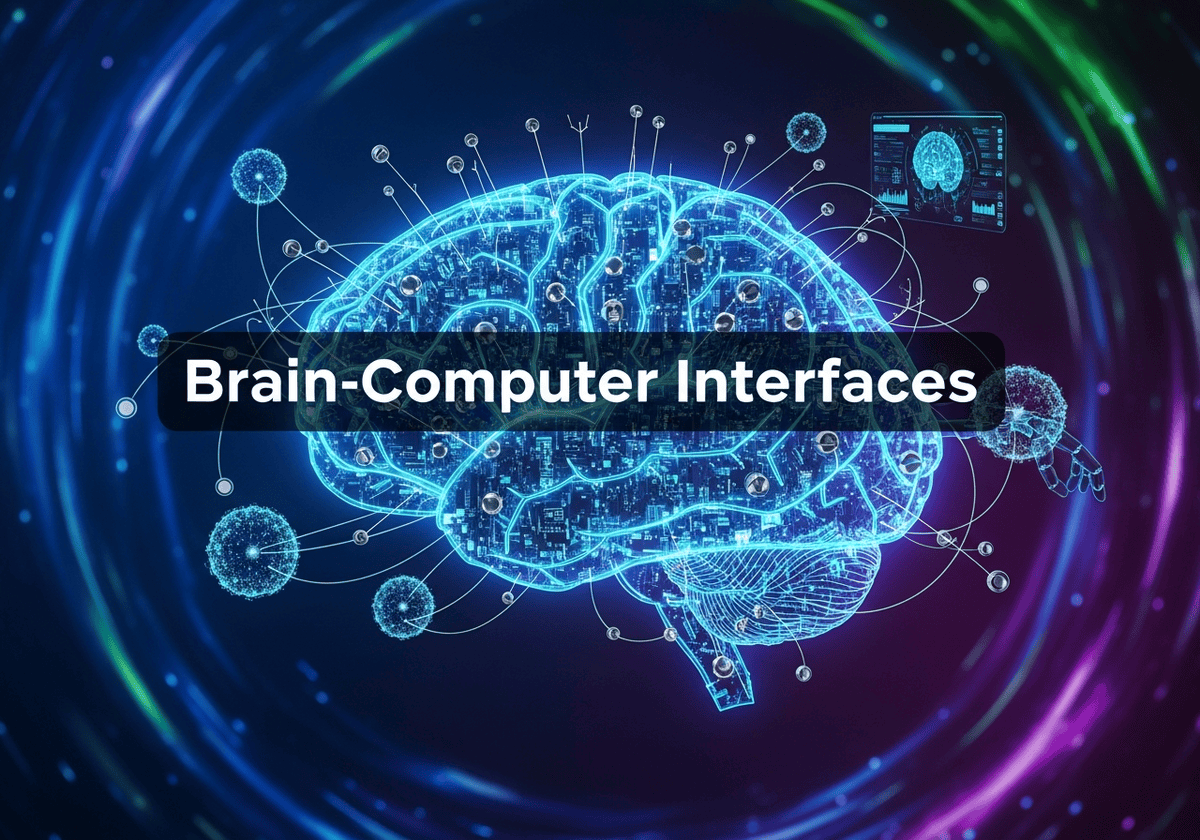
ब्रेन-कंप्यूटर इंटरफेस तंत्रिका ऊतक और एक बाहरी कम्प्यूटेशनल प्रणाली के बीच एक सीधा संचार मार्ग है, जो रिकॉर्ड की गई मस्तिष्क गतिविधि को डिवाइस कमांड, संश्लेषित भाषण, या वास्तविक समय में बहाल संवेदी प्रतिक्रिया में अनुवाद करने के लिए पारंपरिक न्यूरोमस्कुलर आउटपुट चैनलों को बायपास करता है।
इस क्षेत्र को आक्रामकता के आधार पर विभाजित किया गया है: गैर-आक्रामक विधियाँ — स्कैल्प ईईजी, कार्यात्मक निकट-अवरक्त स्पेक्ट्रोस्कोपी — शल्य चिकित्सा के जोखिम के बिना सिग्नल अधिग्रहण प्रदान करती हैं, लेकिन इनकी स्थानिक रिज़ॉल्यूशन और सिग्नल-टू-शोर अनुपात बेहद सीमित होता है; कॉर्टिकल सतह पर रखे गए इलेक्ट्रोकॉर्टिकोग्राफी ग्रिड मध्य स्तर पर आते हैं; और पूरी तरह से इंट्राकॉर्टिकल दृष्टिकोण, जैसे कि यूटा ऐरे और न्यूरालिंक की लचीली थ्रेड इलेक्ट्रोड प्रणाली, शल्य चिकित्सा प्रत्यारोपण, विदेशी शरीर प्रतिक्रिया और दीर्घकालिक इलेक्ट्रोड स्थिरता में गिरावट की कीमत पर सैकड़ों से हजारों न्यूरॉन्स से एकल-इकाई स्पाइक्स को एक साथ रिकॉर्ड करते हैं।
सिग्नल प्रोसेसिंग पाइपलाइनें — स्पाइक सॉर्टिंग, लोकल फील्ड पोटेंशियल डीकंपोजिशन, और न्यूरल पॉपुलेशन डायनेमिक्स पर प्रशिक्षित डीप लर्निंग डिकोडर — कच्चे इलेक्ट्रोफिजियोलॉजी को उच्च-आयामी नियंत्रण संकेतों में परिवर्तित करती हैं। कर्सर नियंत्रण और रोबोटिक अंगों की क्रिया के लिए मोटर कॉर्टेक्स डिकोडिंग और काल्पनिक या प्रयासित वाक् संश्लेषण के लिए वाक् क्षेत्र डिकोडिंग दो सबसे उन्नत नैदानिक अनुप्रयोग क्षेत्र हैं। सटीक समय पर कॉर्टिकल या परिधीय न्यूरोस्टिमुलेशन के साथ न्यूरल रिकॉर्डिंग को संयोजित करने वाली क्लोज्ड-लूप संरचनाएं स्ट्रोक पुनर्वास, उपचार-प्रतिरोधी अवसाद और मिर्गी प्रबंधन को एक साथ आगे बढ़ा रही हैं।
नीचे सूचीबद्ध प्रकाशन और पेटेंट इलेक्ट्रोड सामग्री विज्ञान, एएसआईसी फ्रंट-एंड एम्पलीफायर डिजाइन, डिकोडर एल्गोरिदम, वायरलेस न्यूरल टेलीमेट्री, जैव अनुकूलता अध्ययन और नैदानिक परीक्षण परिणामों को शामिल करते हैं, जो आक्रामक प्रक्रिया के संपूर्ण स्पेक्ट्रम को कवर करते हैं:
बीसीआई तंत्रिका गतिविधि को पढ़ते या लिखते हैं, इसलिए वे इंजीनियरिंग और चिकित्सा के बीच स्थित होते हैं। हार्डवेयर और नैदानिक संदर्भ एक दूसरे के ऊपर होते हैं। चिकित्सा उपकरणइंटरफ़ेस डिज़ाइन पर ह्यूमन कंप्यूटर इंटरेक्शनऔर डिकोडिंग एल्गोरिदम पर तंत्रिका - तंत्रअपग्रेड की नैतिकता पर चर्चा जारी है। मानव संवर्धनइवेंट-ड्रिवन चिप्स चालू हैं। न्यूरोमॉर्फिक कम्प्यूटिंग.
यह ब्रेन-कंप्यूटर इंटरफेस (बीसीआई) पर अंग्रेजी में प्रकाशित विश्वव्यापी प्रकाशनों और पेटेंटों का हमारा नवीनतम संकलन है, जिसमें कई वैज्ञानिक ऑनलाइन जर्नल शामिल हैं, जिन्हें बीसीआई, ब्रेन-कंप्यूटर इंटरफेस, न्यूरल इंटरफेस, इलेक्ट्रोकॉर्टिकोग्राफी, इंट्राकोर्टिकल इलेक्ट्रोड ऐरे, यूटा ऐरे, न्यूरालिंक इम्प्लांट, स्टेंट्रोड बीसीआई, ईईजी-आधारित बीसीआई, मोटर कॉर्टेक्स डिकोडिंग, न्यूरल स्पाइक सॉर्टिंग, लोकल फील्ड पोटेंशियल बीसीआई, स्पाइकिंग न्यूरल नेटवर्क डिकोडर, न्यूरल सिग्नल एम्पलीफायर, क्लोज्ड-लूप न्यूरोस्टिम्यूलेशन, बीसीआई मोटर न्यूरोप्रोस्थेसिस, स्पीच बीसीआई, इमेजिन्ड स्पीच डिकोडिंग, बीसीआई कर्सर कंट्रोल, बीसीआई कम्युनिकेशन डिवाइस, न्यूरल डिकोडर एल्गोरिदम, बीसीआई आर्टिफैक्ट रिजेक्शन, फ्लेक्सिबल न्यूरल प्रोब, बायोकम्पैटिबल न्यूरल इलेक्ट्रोड और बीसीआई दीर्घकालिक स्थिरता पर वर्गीकृत और केंद्रित किया गया है।
Systems for controlling one or more devices using a signal control unit
Patent published on the 2026-11-19 in US under Ref US20260370352 by SYNCHRON AUSTRALIA PTY LTD [AU] (Schnell Evan [us], Dohle Marthe Esmee [us], Hardy Nicholas F [us], Prastakou Katerina [us])
Abstract: Interface systems for directing communication between an individual and a plurality of external devices using an external processing system, where the individual has a neural interface device having an electrode component electrically coupled with a receiver and transmitter unit (RTU). The RTU is configured to locally decode a user intent from a bounded fallback vocabulary and perform a fallback action when the external processing system is unavailable. The RTU is further operable in an active m[...]
Our summary: The system controls devices via a signal control unit and interfaces between users and external devices. It includes a neural interface with an RTU that decodes user intent and performs fallback actions when necessary. Routing logic prioritizes caregiver-output routes based on the external processing system s availability.
Neural interface, Signal control unit, External processing system, Fallback action
Patent
Power switch system and control method therefor
Patent published on the 2026-11-12 in US under Ref US20260361295 by DELTA ELECTRONICS INC [TW] (Zhang Chi [us], Wang Ruxi [us], Barbosa Peter Mantovanelli [tw], Wang Dakai [us])
Abstract: A power switch system and a control method are provided. The power switch system includes a subcircuit module including N serial-half-bridge subcircuits connected in cascade. Each serial-half-bridge subcircuit includes a first switch, a second switch, a third switch, a fourth switch, a first capacitor and a second capacitor. The first switch, the second switch, the third switch and the fourth switch are connected in series. The first capacitor is coupled to the first switch and the second switch[...]
Our summary: The power switch system comprises N serial-half-bridge subcircuits in cascade. Each subcircuit includes four switches and two capacitors. Control signals adjust timing parameters based on voltages across the capacitors.
power switch, control method, half-bridge, subcircuit module
Patent
Polyimide liquid metal particle electronic ink, and preparation method therefor and use thereof
Patent published on the 2026-11-12 in WO under Ref WO2026233453 by UNIV JIANGNAN [CN] (Dong Jiancheng [cn], Zhu Haijun [cn], Liu Tianxi [cn], Tian Qingyuan [cn], Wei Xinyue [cn], Zhang Yuduo [cn], Zhou Chang [cn], Xiao Yiyi [cn])
Abstract: Disclosed in the present invention are polyimide liquid metal particle electronic ink, and a preparation method therefor and the use thereof. The liquid metal ink prepared in the present invention is printed into circuits, and conductive paths can be formed by means of a high-temperature sintering method without the need for time-consuming activation methods such as pressing or scratching, which reduces damage to the circuit patterns, greatly saves on preparation time, and allows for printing of[...]
Our summary: The invention discloses a polyimide liquid metal particle electronic ink and its preparation method. This ink enables the printing of circuits with high-temperature sintering, eliminating the need for activation methods. It is suitable for flexible electronics, offering good tensile properties and cost-effective production of complex patterns.
Polyimide, liquid metal, electronic ink, flexible circuits
Patent
Brain-Computer Interface With High-Speed Eye Tracking Features
Patent published on the 2026-11-12 in US under Ref US20260358890 by NEURABLE INC [US] (Alcaide Ramses Eduardo [us], Padden Dereck [us], Jantz Jay [us], Hamet James [us], Morris Jr Jeffrey [us], Pereira Arnaldo [us])
Abstract: Embodiments described herein relate to systems, devices, and methods for use in the implementation of a brain-computer interface that integrates real-time eye-movement tracking with brain activity tracking to present and update a user interface that is strategically designed for high speed and accuracy of human—machine interaction. Embodiments described herein also relate to the implementation of a hardware agnostic brain-computer interface that uses real-time eye tracking and online analysis [...]
Our summary: This document discusses a brain-computer interface that combines eye movement tracking with brain activity monitoring. It emphasizes high-speed and accurate user interface updates for efficient human-machine interaction. The system is hardware agnostic and facilitates real-time analysis of neural signals to enhance user control.
Brain-Computer Interface, Eye Tracking, Neural Signals, Human-Machine Interaction
Patent
Power switch system and control method therefor
Patent published on the 2026-11-11 in EP under Ref EP4838776 by DELTA ELECTRONICS INC [TW] (Zhang Chi [us], Wang Ruxi [us], Barbosa Peter Mantovanelli [tw], Wang Dakai [us])
Abstract: A power switch system (1, 1a, 1b, 1c, 1d) and a control method are provided. The power switch system (1, 1a, 1b, 1c, 1d) includes a subcircuit module including N serial-half-bridge subcircuits (31, 32, 33) connected in cascade. Each serial-half-bridge subcircuit (31, 32, 33) includes a first switch (S1), a second switch (S2), a third switch (S3), a fourth switch (S4), a first capacitor (C1) and a second capacitor (C2). The first switch (S1), the second switch (S2), the third switch (S3) and the [...]
Our summary: The power switch system includes a subcircuit module with N serial-half-bridge subcircuits. Each subcircuit contains four switches and two capacitors configured in series. Control signals are generated based on voltages across the capacitors to adjust timing parameters of the switches.
power switch system, control method, subcircuit module, timing parameters
Patent
A system for improving cognitive capabilities in an individual
Patent published on the 2026-11-05 in WO under Ref WO2026229994 by TATA IND LTD [IN] (Jamwal Kanwar Rameshwar Singh [in], Jain Abhishek [in], D’souza Ruth [in])
Abstract: A SYSTEM FOR IMPROVING COGNITIVE CAPABILITIES IN AN INDIVIDUAL A system for improving cognitive capabilities in an individual comprises a monitoring component configured to detect brain activity and generate brain activity data, a stimulation component configured to non-invasively apply neurostimulation, a user-input component configured to receive user-generated inputs during a session comprising at least one of performance data from an active cognitive task or subjective state reports, and a p[...]
Our summary: The system enhances cognitive capabilities through a closed-loop neurostimulation approach. It monitors brain activity and adjusts stimulation parameters based on user inputs. The integration of fNIRS and tPBM technologies supports effective cognitive assessments and personalized stimulation responses.
cognitive enhancement, neurostimulation, closed-loop system, brain activity monitoring
Patent
In conversation with Edward Chang
Published on 2026-10-01 by Henrietta Howells @NATURE
Abstract: Nature Neuroscience, Published online: 01 October 2026; doi:10.1038/s41593-026-02453-3As part of our special issue on neurotechnology, we spoke with Edward Chang, Margaret Liu Collins and Edward B. Collins distinguished Professor and Chair of neurosurgery at the University of California, San Francisco, about the evolution of speech brain–computer interfaces (BCIs). He discusses how advances in AI are accelerating the translation of BCIs into the clinic, the challenge of restoring natural commu[...]
Our summary: Edward Chang discusses the evolution of speech brain-computer interfaces (BCIs). He highlights how AI advancements are facilitating clinical applications of BCIs. Chang emphasizes the importance of large-scale neural datasets for developing computational models of the human brain.
neurotechnology, brain-computer interfaces, artificial intelligence, neural datasets
Publication
In conversation with Miguel Nicolelis
Published on 2026-10-01 by Henrietta Howells @NATURE
Abstract: Nature Neuroscience, Published online: 01 October 2026; doi:10.1038/s41593-026-02467-xAs part of our special issue on neurotechnology, we spoke with Miguel Nicolelis, Professor Emeritus at Duke University and founder of the Edmond and Lily Safra International Neuroscience Institute, about the bold ideas that have defined his career, from helping to pioneer brain–machine interfaces to establishing a neuroscience institute in northeastern Brazil with the goal of driving social transformation. He[...]
Our summary: Miguel Nicolelis discusses his pioneering work in brain-machine interfaces and their impact on neuroscience. He emphasizes the importance of addressing ethical questions in neurotechnology. Nicolelis also highlights his efforts to drive social transformation through neuroscience in Brazil.
neurotechnology, brain-machine interfaces, neural interfaces, neurorehabilitation
Publication