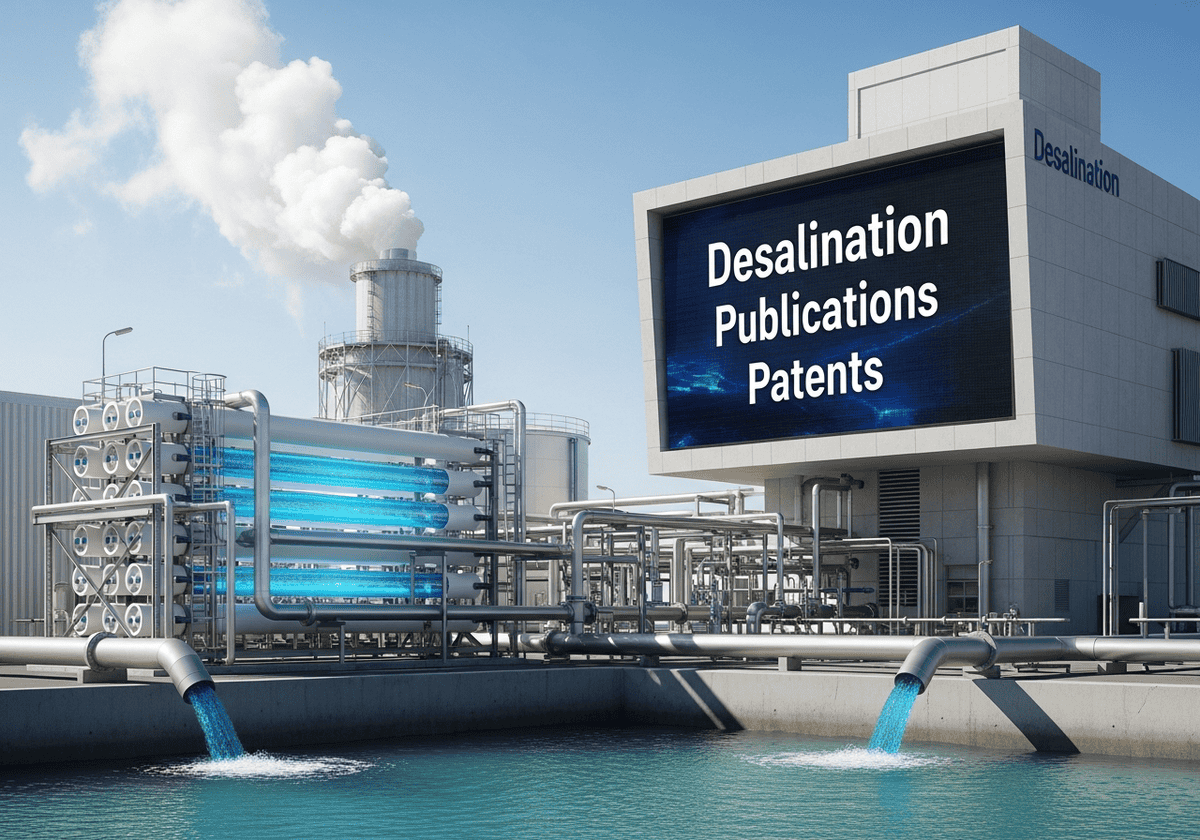
Bei der Entsalzung handelt es sich um die industrielle und ingenieurtechnische Disziplin der Entfernung gelöster Salze und Mineralien aus Meerwasser oder brackigem Grundwasser zur Gewinnung von Trinkwasser oder Süßwasser in Bewässerungsqualität. Mittlerweile werden über 100 Millionen Menschen in wasserarmen Regionen im Nahen Osten, Nordafrika, Küstenasien und zunehmend auch in Südeuropa und Amerika mit Wasser versorgt.
Die Umkehrosmose (RO) dominiert derzeit die installierte Kapazität. Dabei wird salzhaltiges Speisewasser unter hohem Druck durch Dünnschicht-Polyamid-Verbundmembranen gepresst, deren Selektivität, Foulingresistenz und Bor-Rückhalterate weiterhin Gegenstand intensiver materialwissenschaftlicher Forschung sind. Thermische Verfahren – mehrstufige Entspannungsverdampfung und Mehrfacheffektverdampfung – behalten ihre Relevanz, wenn Abwärme aus der Stromerzeugung als kostenlose Energiequelle zur Verfügung steht. Die zentrale technische Herausforderung in diesem Bereich ist der spezifische Energieverbrauch: Moderne RO-Anlagen mit druckwärmetauscherbasierter Energierückgewinnung erreichen mittlerweile das thermodynamische Minimum für die Meerwasserentsalzung. Dadurch verlagert sich der Wettbewerbsvorteil hin zur Membranlebensdauer, zur Gestaltung des Wassereinlaufs und zum Management des Solekonzentrats, wobei die Toxizität der Abwässer und die Auswirkungen auf marine Ökosysteme zunehmend strengeren regulatorischen Kontrollen unterliegen.
Neue Prozessarchitekturen – Vorwärtsosmose, Membrandestillation, kapazitive Deionisierung und Membranen auf Graphenoxid- oder Aquaporinbasis – zielen auf spezielle Speisewasserzusammensetzungen oder netzunabhängige, mit erneuerbarer Energie betriebene Konfigurationen ab, bei denen die Wirtschaftlichkeit der herkömmlichen Umkehrosmose nicht mehr gegeben ist.
Die unten aufgeführten Veröffentlichungen und Patente decken das gesamte Spektrum ab, von der Membransynthese und Modulentwicklung über die Systemthermodynamik, die Soleverwertung, die Kopplung erneuerbarer Energien bis hin zu den hydrogeologischen Standortbewertungen, die die Rentabilität von Anlagen bestimmen:
Süßwasser aus dem Meer benötigt Membranen, Energie und ausgeklügelte Chemie. Die Membranphysik ist Gegenstand aktueller Forschung. Osmoseund poröse Sorptionsmittel auf ZeolithenZuverlässige Energie kommt von Solarmodule oder kleine modulare ReaktorenRegulierte Schadstoffe werden verfolgt unter PFAS.
Dies ist unsere neueste Auswahl weltweiter englischsprachiger Publikationen und Patente zum Thema Entsalzung, die aus zahlreichen wissenschaftlichen Online-Zeitschriften stammen und sich auf Umkehrosmose, Entsalzung, Meerwasserentsalzung, Brackwasserentsalzung, Membranverschmutzung bei Umkehrosmose, Dünnschicht-Verbundmembranen, Energierückgewinnungsgeräte für Umkehrosmose, Druckaustauscher-Entsalzung, mehrstufige Entspannungsverdampfung, Mehrfacheffektverdampfung, Elektrodialyse-Entsalzung, Vorwärtsosmose, Membrandestillation, kapazitive Deionisierung, Entsorgung von Entsalzungssole, Sole-Konzentrat-Management, solarbetriebene Umkehrosmose, windbetriebene Entsalzung, nukleare Entsalzung, Energieverbrauch bei der Entsalzung, spezifischer Energieverbrauch bei Umkehrosmose, Bor-Rückhaltung von Umkehrosmosemembranen und Permeat-Rückgewinnungsrate bei Umkehrosmose konzentrieren.
Water purification apparatus and flushing method for water purification apparatus
Patent published on the 2026-11-19 in WO under Ref WO2026238134 by QINGDAO HAIER STRAUSS WATER CO LTD [CN] (Zhang Penghui [cn], Liu Jie [cn], Tan Jun [cn], Sheng Xunning [cn])
Abstract: A water purification apparatus and a flushing method for the water purification apparatus. The water purification apparatus comprises a filter assembly, a pressure tank, and a flushing water path assembly. The filter assembly comprises a reverse osmosis membrane element and a filtrate outlet. The pressure tank is configured to store pure water. The flushing water path assembly comprises a water flow channel and a flushing flow channel, wherein the water flow channel is capable of communicating t[...]
Our summary: The water purification apparatus includes a filter assembly with a reverse osmosis membrane and a pressure tank for storing pure water. It features a flushing water path assembly that allows for selective communication between the filtrate outlet and the reverse osmosis membrane. The flushing method enhances the cleaning of the membrane element to maintain efficiency.
water purification, reverse osmosis, flushing method, pressure tank
Patent
Lithium recovery from rechargeable batteries
Patent published on the 2026-11-19 in WO under Ref WO2026241702 by LIEN LARRY [US] (Lien Larry [us])
Abstract: Methods of recovering lithium from a lithium containing material, such as a lithium battery, using water leaching to recover lithium hydroxide in an alkaline solution, concentrating the lithium hydroxide using one or more of a semipermeable membrane, an optional ion-exchange membrane, and/or a reverse osmosis membrane to form a concentrated lithium solution, and then exposing the concentrated lithium solution to carbon dioxide to form lithium carbonate.[...]
Our summary: This process involves recovering lithium from batteries using water leaching to extract lithium hydroxide. The lithium hydroxide is concentrated through membrane techniques, including semipermeable and reverse osmosis membranes. Finally, carbon dioxide is introduced to convert the concentrated lithium solution into lithium carbonate.
Lithium recovery, water leaching, membrane filtration, lithium carbonate
Patent
Purification of evaporator condensate
Patent published on the 2026-11-19 in US under Ref US20260365555 by LUCASE3 L C [US] (Lucas Scott A [us])
Abstract: Systems, methods, and devices for purifying evaporator condensate from one or more evaporators, such as evaporators of an ethanol distillation process. The evaporator condensate is fed to one or more separators to remove at least a portion of contaminants from the evaporator condensate. The one or more separators include at least one reverse osmosis system for removing at least a portion of the contaminants from the evaporator condensate to form a clean water stream. The clean water stream is th[...]
Our summary: Systems and methods are designed to purify evaporator condensate from ethanol distillation processes. Contaminants are removed using separators, including reverse osmosis systems. The resulting clean water stream is recycled for use in the distillation process.
evaporator condensate, purification, reverse osmosis, ethanol distillation
Patent
Gravity motor
Patent published on the 2026-11-19 in WO under Ref WO2026240710 by JMAI KAIES [TN] (Jmai Kaies [tn])
Abstract: The application relates to a gravity motor which is easy to manufacture industrially or in terms of cost and transforms the available sustainable energy coming from the Earth s gravity into consistent and continuous kinetic energy of rotation via the effect of the pressure and counter-pressure caused by the rotating weights, resulting from a function of injection on one side and suction on the other side causing a displacement of the liquid, providing a difference in weight between the two sides[...]
Our summary: The gravity motor converts Earth s gravity into continuous rotational kinetic energy using pressure differences. It is cost-effective, sustainable, and environmentally friendly, producing no waste or pollution. Potential applications include powering electric generators, illuminating cities, and desalinating seawater.
gravity motor, sustainable energy, kinetic energy, environmental impact
Patent
Membrane separation system and method for operating same
Patent published on the 2026-11-19 in WO under Ref WO2026239714 by KURITA WATER IND LTD [JP] (Kawakatsu Takahiro [jp], Gotou Hideki [jp])
Abstract: The disclosure provides a membrane separation system comprising: a membrane separation device having a nanofiltration membrane or a reverse osmosis membrane; and a pressure recovery device for pressurizing raw water to be supplied to the membrane separation device by means of pressure from concentrated water from the membrane separation device, said system being characterized in that, on the basis of the following formula, the quantity of concentrated water received by the pressure recovery devi[...]
Our summary: The membrane separation system includes a nanofiltration or reverse osmosis membrane and a pressure recovery device. The system operates by pressurizing raw water using concentrated water from the membrane device. The quantity of concentrated water received is determined by a specific formula based on operating pressure and recovery efficiency.
membrane separation, nanofiltration, reverse osmosis, pressure recovery
Patent
Subsea desalination systems and methods using fluid displacement
Patent published on the 2026-11-19 in US under Ref US20260365550 by INNOVATOR ENERGY LLC [US] (Novek Ethan [us])
Abstract: The present application pertains to systems and methods for desalination. In one embodiment the system employs a first storage reservoir configured to be near the surface of a body of water and configured to store a low density fluid. A second storage reservoir is configured to be located below the surface of the body of water. A desalination system is operably connected to the second reservoir. Desalinated water is produced by allowing desalination permeate to displace low density fluid in the [...]
Our summary: The system utilizes a first storage reservoir near the surface and a second reservoir below water. Desalination occurs by displacing low density fluid in the second reservoir. Desalinated water is exported by transferring fluid between the reservoirs.
Desalination, Subsea systems, Fluid displacement, Reservoirs
Patent
Carbon dioxide emissions elimination for reverse osmosis desalination units of remote islands via photovoltaic and battery solution. The case of Karpathos Island
Published on 2026-06-06 by @OXFORD
Abstract: AbstractRecently, the imperative water demand problem of small islands in the South-East Mediterranean area is being faced with the development and operation of new reverse osmosis (RO) desalination plants at high operational and environmental cost. One of the most serious RO desalination unit’s problems is their high-energy demand. This water demand coincides with the electricity demand, both peaked during the summer imposing the existing local electrical power stations to operate near their [...]
Our summary: This study explores the integration of photovoltaic systems and battery storage to power reverse osmosis desalination units on Karpathos Island. It addresses high energy demands and carbon emissions associated with traditional diesel power. The proposed solution aims to enhance clean energy autonomy while minimizing operational costs and environmental impact.
photovoltaic, desalination, carbon emissions, battery storage
Publication
PSS composite sponge for solar-driven water purification and dye removal for environmental sustainability
Published on 2026-05-21 by Chung-Wei Huang, Wei-Cheng Jhao, Yu-Jen Liang, Meng-Fang Lin, Yu-Sheng Hsiao @NATURE
Abstract: Polymer Journal, Published online: 21 May 2026; doi:10.1038/s41428-026-01188-zA 3D macroporous MWCNT/PEDOT: PSS composite sponge, fabricated via freeze-drying, enables efficient solar-driven interfacial water evaporation (SIWE) through optimized light absorption, wettability, and water transport. The engineered porous architecture enhances solar–thermal management while facilitating rapid water uptake. Simultaneously, the sponge exhibits high adsorption capacities for organic dyes and strong a[...]
Our summary: A 3D macroporous MWCNT/PEDOT: PSS composite sponge enables efficient solar-driven interfacial water evaporation. It enhances solar–thermal management and facilitates rapid water uptake. The sponge also demonstrates high dye adsorption capacities and strong antifouling properties for sustainable water purification.
PSS, composite sponge, solar-driven purification, environmental sustainability
Publication