Product Design, Manufacturing & Innovation Resources
Home » Net Positive Suction Head (NPSH)

Net Positive Suction Head (NPSH)

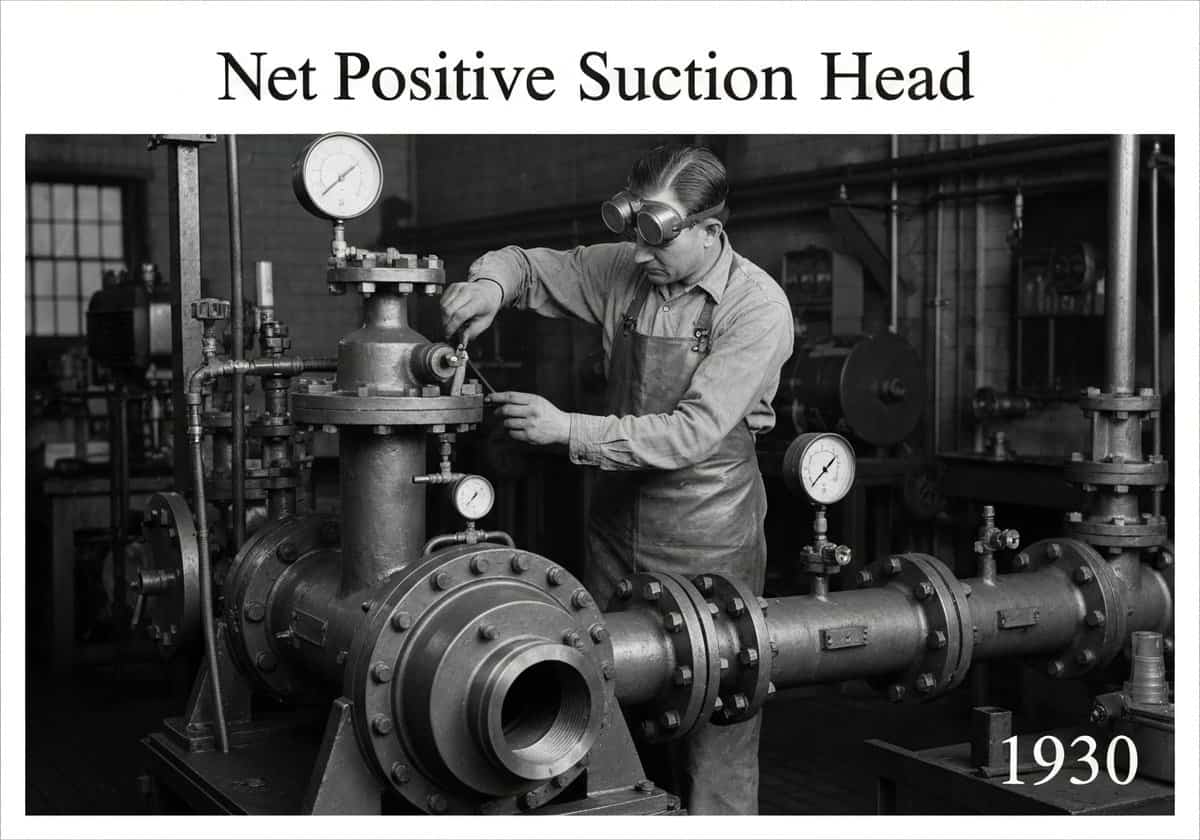
1930
Mechanical engineer assessing centrifugal pump for Net Positive Suction Head in 1930s industrial setting.

(generated image for illustration only)

Net Positive Suction Head (NPSH) is a critical parameter in pump engineering that measures the fluid pressure at the pump’s suction inlet relative to its vapor pressure. To prevent cavitation—the damaging formation and collapse of vapor bubbles—the available NPSH (NPSHa) of the system must always be greater than the required NPSH (NPSHr) specified by the pump manufacturer.


Cavitation is a phenomenon that occurs when the static pressure of a liquid drops below its vapor pressure, causing the liquid to boil and form small vapor-filled cavities or ‘bubbles’. In a pump, this pressure drop is most pronounced at the eye of the impeller, where the fluid velocity is highest. These bubbles are then swept into regions of higher pressure as they move along the impeller vanes, where they violently collapse or implode. This collapse generates intense shockwaves and microjets that can erode and pit the impeller material, leading to severe damage, reduced efficiency, and eventual pump failure.

To prevent this, engineers analyze the pump system using the NPSH parameter. The NPSH Available (NPSHa) is a property of the system and is calculated as the total head at the pump suction nozzle minus the liquid’s vapor pressure head. The formula is \(NPSHa = H_{a} + H_{z} – H_{f} – H_{vp}\), where \(H_{a}\) is the absolute pressure on the liquid surface, \(H_{z}\) is the static head, \(H_{f}\) is the friction loss in the suction piping, and \(H_{vp}\) is the liquid’s vapor pressure. The NPSH Required (NPSHr) is an intrinsic property of the pump, determined by its design and provided by the manufacturer. It represents the minimum pressure required at the suction port to keep the liquid from cavitating. The fundamental rule of pump system design is to ensure a sufficient margin where NPSHa > NPSHr at all operating conditions.

UNESCO Nomenclature: 3308
– Fluid mechanics

Type

Abstract System

Disruption

Substantial

Usage

Widespread Use

Precursors

  • understanding of fluid vapor pressure and boiling points (Clausius-Clapeyron relation)
  • Bernoulli’s equation for fluid energy analysis
  • Darcy-Weisbach equation for calculating friction losses in pipes
  • development of high-speed centrifugal pumps which made cavitation a common problem

Applications

  • design of industrial piping systems to ensure proper pump operation
  • selection of pumps for high-altitude or high-temperature applications
  • troubleshooting pump performance issues like noise, vibration, and damage
  • preventive maintenance scheduling for pumps in critical services
  • chemical process engineering where liquids are pumped near their boiling point

Patents:

NA

Potential Innovations Ideas

Due to scrapping bot traffic, currently more than 40k per day, this content is reserved to community members.
> Login < or > Register < (100% free) to access this, so as all other restricted content and tools.

Related to: NPSH, cavitation, pump suction, fluid mechanics, hydraulics, vapor pressure, pump performance, engineering design, suction head, pump failure.

Historical Context

Net Positive Suction Head (NPSH)

1930
1930
1930
1930
1934
1940
1940
1927
1930
1930
1930
1930
1940
1940
1940

(if date is unknown or not relevant, e.g. "fluid mechanics", a rounded estimation of its notable emergence is provided)

Related Invention, Innovation & Technical Principles

Full size images and downloads are only available, 100% free, for registered members.

> Login <