Pulse-Echo Ultrasonic Testing
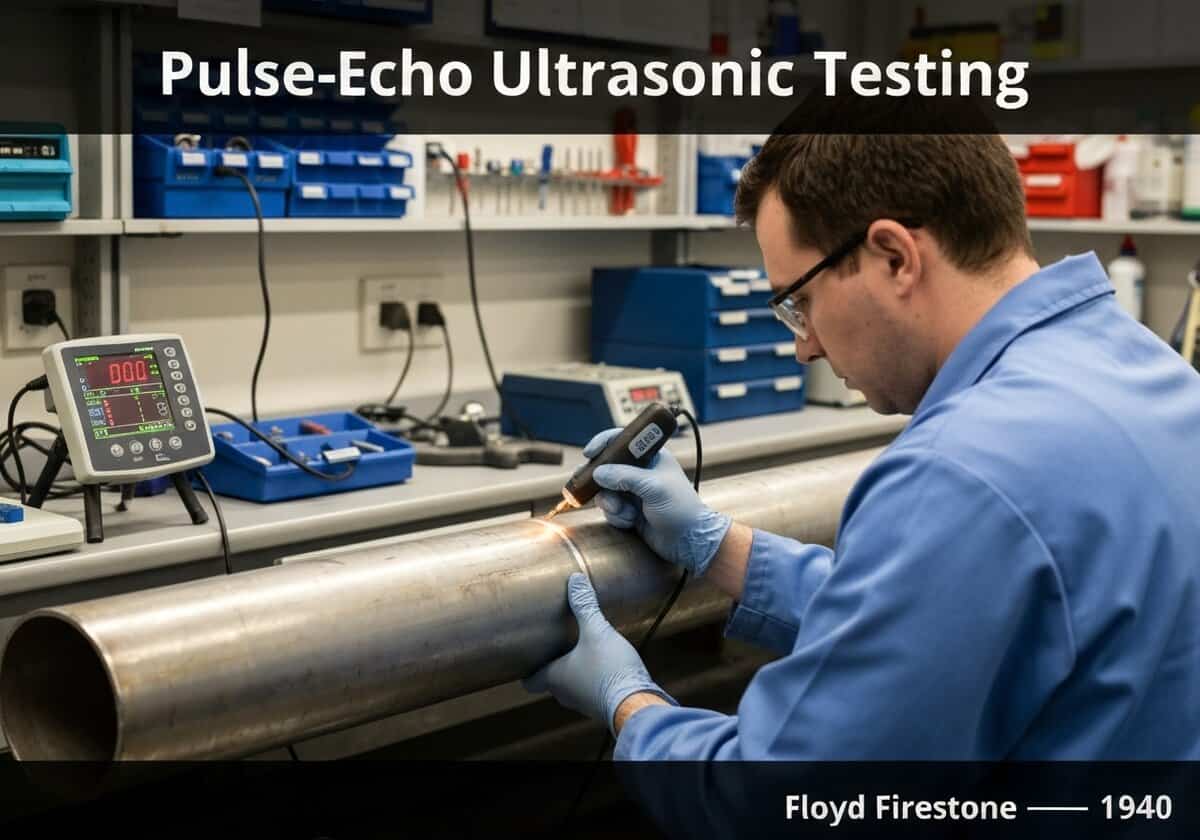
The pulse-echo method is the foundation of most ultrasonic testing. A transducer emits a short, high-frequency sound pulse into a material. This pulse travels until it hits a boundary or flaw, reflecting some energy back as an echo. The same transducer detects this echo, and the time-of-flight is used to calculate the reflector’s depth, enabling flaw detection and thickness measurement.
The pulse-echo technique operates on a simple principle of timing sound waves. A specialized device called a pulser-receiver generates a high-voltage electrical pulse. This pulse is sent to a transducer, which contains a piezoelectric element that vibrates in response, creating a high-frequency ultrasonic wave. This wave propagates through the test material. When it encounters an interface with a different acoustic impedance, such as a crack, void, or the back wall of the material, a portion of the wave’s energy is reflected.
The reflected wave, or echo, travels back to the transducer. The piezoelectric element converts this returning acoustic energy back into an electrical signal. The receiver component of the pulser-receiver amplifies this weak signal. The system’s internal clock measures the precise time elapsed between the initial pulse transmission and the reception of the echo. This is known as the ‘time-of-flight’ (ToF).
Knowing the velocity of sound in the specific material being tested (\(c\)), the distance (\(d\)) to the reflector can be calculated using the formula \(d = (c times ToF) / 2\). The division by two is necessary because the measured time accounts for the sound traveling to the reflector and back again. The results are typically displayed on a screen as an A-scan, which plots signal amplitude versus time, allowing a trained operator to identify the location, size, and orientation of internal flaws.
UNESCO Nomenclature: 3322
– Materials science
Precursors
- sonar development for underwater detection
- discovery of the piezoelectric effect by Jacques and Pierre Curie
- fundamental understanding of sound wave propagation in solids
- industrial need for internal flaw detection in manufacturing and infrastructure
Applications
- weld inspection in critical structures
- thickness gauging of pipes and tanks
- medical ultrasonography for imaging organs
- aerospace composite material inspection for delamination
- corrosion mapping in the oil and gas industry
Potential Innovations Ideas
Due to scrapping bot traffic, currently more than 40k per day, this content is reserved to community members.
> Login < or > Register < (100% free) to access this, so as all other restricted content and tools.
Related to: pulse-echo, ultrasonic testing, NDT, flaw detection, time-of-flight, transducer, reflection, inspection, materials testing, Floyd Firestone.