Product Design, Manufacturing & Innovation Resources
Heim » Netto-Saugdruckhöhe (NPSH)

Netto-Saugdruckhöhe (NPSH)

1930
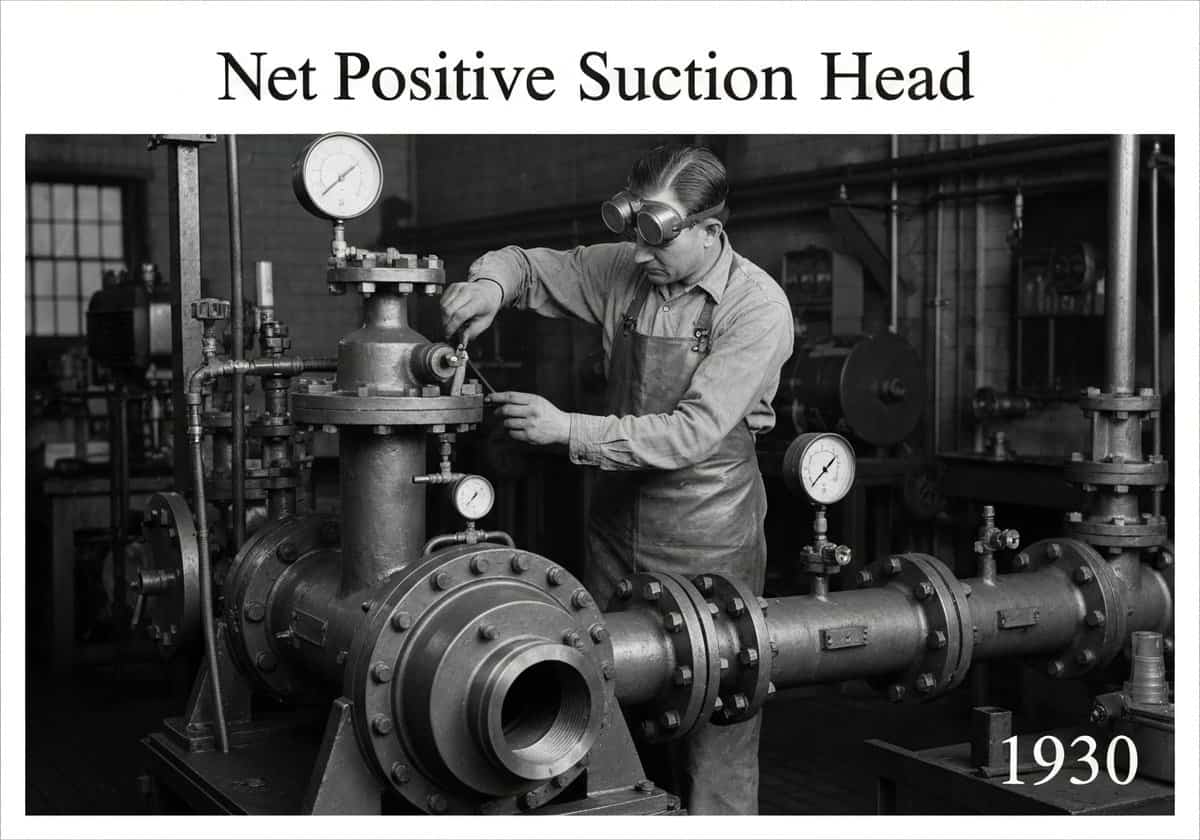
Maschinenbauingenieur, der eine Kreiselpumpe für eine positive Netto-Saughöhe in der Industrie von 1930 bewertet.

(Abbildung dient nur zur Veranschaulichung)

Net Positive Suction Head (NPSH) is a critical parameter in Pumpe engineering that measures the fluid Druck at the pump’s suction inlet relative to its Dampfdruck. To prevent cavitation—the damaging formation and collapse of vapor bubbles—the available NPSH (NPSHa) of the system must always be greater than the required NPSH (NPSHr) specified by the pump manufacturer.


Cavitation is a phenomenon that occurs when the static pressure of a liquid drops below its vapor pressure, causing the liquid to boil and form small vapor-filled cavities or ‘bubbles’. In a pump, this pressure drop is most pronounced at the eye of the impeller, where the fluid velocity is highest. These bubbles are then swept into regions of higher pressure as they move along the impeller vanes, where they violently collapse or implode. This collapse generates intense shockwaves and microjets that can erode and pit the impeller material, leading to severe damage, reduced efficiency, and eventual pump failure.

To prevent this, engineers analyze the pump system using the NPSH parameter. The NPSH Available (NPSHa) is a property of the system and is calculated as the total head at the pump suction nozzle minus the liquid’s vapor pressure head. The formula is [latex]NPSHa = H_{a} + H_{z} – H_{f} – H_{vp}[/latex], where [latex]H_{a}[/latex] is the absolute pressure on the liquid surface, [latex]H_{z}[/latex] is the static head, [latex]H_{f}[/latex] is the friction loss in the suction piping, and [latex]H_{vp}[/latex] is the liquid’s vapor pressure. The NPSH Required (NPSHr) is an intrinsic property of the pump, determined by its design and provided by the manufacturer. It represents the minimum pressure required at the suction port to keep the liquid from cavitating. The fundamental rule of pump system design is to ensure a sufficient margin where NPSHa > NPSHr at all operating conditions.

UNESCO Nomenclature: 3308
– Strömungsmechanik

Typ

Abstraktes System

Störung

Wesentliche

Verwendung

Weitverbreitete Verwendung

Vorläufer

  • Verständnis des Dampfdrucks und der Siedepunkte von Flüssigkeiten (Clausius-Clapeyron-Beziehung)
  • Bernoulli’s equation for fluid energy analysis
  • Darcy-Weisbach-Gleichung zur Berechnung von Reibungsverlusten in Rohrleitungen
  • Entwicklung von Hochgeschwindigkeits-Kreiselpumpen, die Kavitation zu einem häufigen Problem machten

Anwendungen

  • Entwurf industrieller Rohrleitungssysteme, um einen ordnungsgemäßen Pumpenbetrieb sicherzustellen
  • Auswahl an Pumpen für Anwendungen in großen Höhen oder bei hohen Temperaturen
  • Behebung von Problemen mit der Pumpenleistung wie Lärm, Vibrationen und Schäden
  • Planung der vorbeugenden Wartung von Pumpen in kritischen Bereichen
  • Chemische Verfahrenstechnik, bei der Flüssigkeiten nahe ihrem Siedepunkt gepumpt werden

Patente:

NA

Potenzielle Innovationsideen

Aufgrund des hohen Datenverkehrs durch Web-Scraping-Bots, der derzeit mehr als 40.000 Anfragen pro Tag umfasst, ist dieser Inhalt ausschließlich Community-Mitgliedern vorbehalten.
> Anmelden < oder > Registrieren < (100% kostenlos) Zugriff darauf sowie auf alle anderen eingeschränkten Inhalte und Tools.

Related to: NPSH, cavitation, pump suction, fluid mechanics, hydraulics, vapor pressure, pump performance, engineering design, suction head, pump failure.

Historischer Kontext

Netto-Saugdruckhöhe (NPSH)

1930
1930
1930
1930
1934
1940
1940
1927
1930
1930
1930
1930
1940
1940
1940

(wenn das Datum unbekannt oder nicht relevant ist, z. B. „Strömungsmechanik“, wird eine gerundete Schätzung seines bemerkenswerten Auftretens bereitgestellt)

Verwandte Erfindungen, Innovationen und technische Prinzipien

Bilder in voller Größe und Downloads sind nur für registrierte Mitglieder 100% kostenlos verfügbar.

> Login <