Product Design, Manufacturing & Innovation Resources
Home » Kelvin (Thomson) Relations

Kelvin (Thomson) Relations

1854
  • William Thomson (Lord Kelvin)
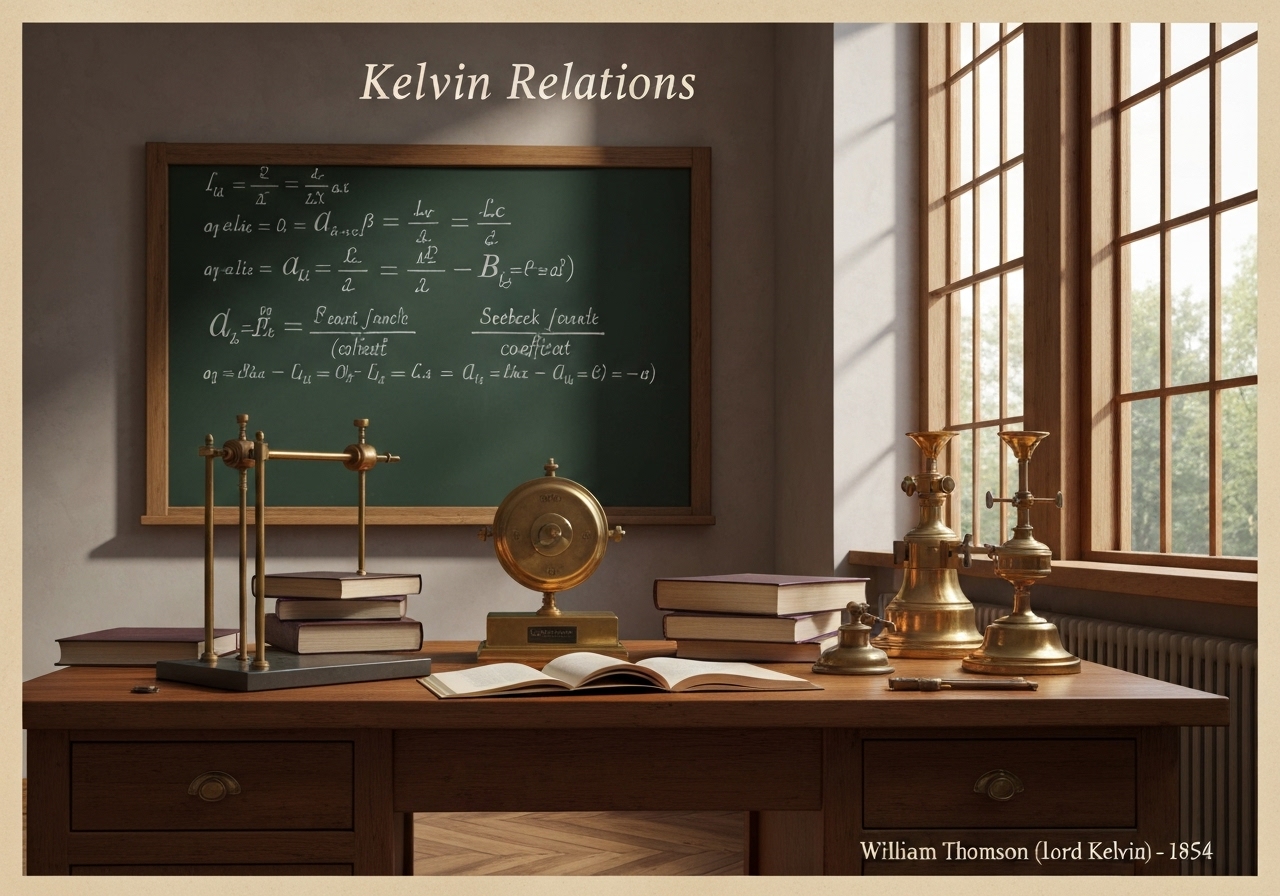
Thermodynamic laboratory with Peltier and Seebeck apparatus illustrating Kelvin relations.

(generated image for illustration only)

The Kelvin relations are two equations that thermodynamically link the three thermoelectric coefficients: the first relation connects the Peltier coefficient (\(\Pi\)) to the Seebeck coefficient (\(S\)) via absolute temperature (\(T\)): \(Pi = S \cdot T\). The second relates the Thomson coefficient (\(\mathcal{K}\)) to the temperature derivative of the Seebeck coefficient: \(\mathcal{K} = T \frac{dS}{dT}\).


The Kelvin relations are a cornerstone of thermoelectric theory, demonstrating that the Seebeck, Peltier, and Thomson effects are not independent phenomena but are deeply interconnected aspects of the same underlying transport process. Lord Kelvin derived these relationships by applying the laws of thermodynamics to a thermoelectric circuit, treating it as a reversible heat engine. His derivation, while insightful, predated the more rigorous framework of irreversible thermodynamics.

Later, Lars Onsager’s work on reciprocal relations for irreversible processes provided a more general and solid foundation for the Kelvin relations. The Onsager reciprocal relations, based on the principle of microscopic reversibility, confirm Kelvin’s results. The relations are immensely practical. For instance, it is often easier to measure the Seebeck coefficient (S) and its temperature dependence than it is to directly measure the Peltier (\(Pi\)) or Thomson (\(mathcal{K}\)) coefficients. Using the Kelvin relations, one can calculate \(Pi\) and \(mathcal{K}\) from measurements of S, which is critical for characterizing new materials and designing efficient devices.

UNESCO Nomenclature: 2203
– Thermodynamics

Type

Abstract System

Disruption

Foundational

Usage

Widespread Use

Precursors

  • Sadi Carnot’s theory of heat engines
  • Rudolf Clausius’s formulation of the second law of thermodynamics
  • the individual discoveries of the Seebeck and Peltier effects
  • the development of differential calculus for describing physical processes

Applications

  • provides a self-consistent theoretical framework for thermoelectricity
  • allows for the experimental determination of one coefficient by measuring another
  • essential for the accurate modeling and simulation of thermoelectric devices
  • validates the application of reversible thermodynamics to thermoelectric processes

Patents:

NA

Potential Innovations Ideas

Due to scrapping bot traffic, currently more than 40k per day, this content is reserved to community members.
> Login < or > Register < (100% free) to access this, so as all other restricted content and tools.

Related to: Kelvin relations, Thomson relations, Onsager reciprocal relations, thermodynamics, Seebeck coefficient, Peltier coefficient, Thomson coefficient, irreversible thermodynamics, transport phenomena, solid-state physics.

Historical Context

Kelvin (Thomson) Relations

1850
1850
1851
1854
1859
1861
1865
1850
1850
1851
1852
1859
1860
1861
1865

(if date is unknown or not relevant, e.g. "fluid mechanics", a rounded estimation of its notable emergence is provided)

Related Invention, Innovation & Technical Principles

Full size images and downloads are only available, 100% free, for registered members.

> Login <