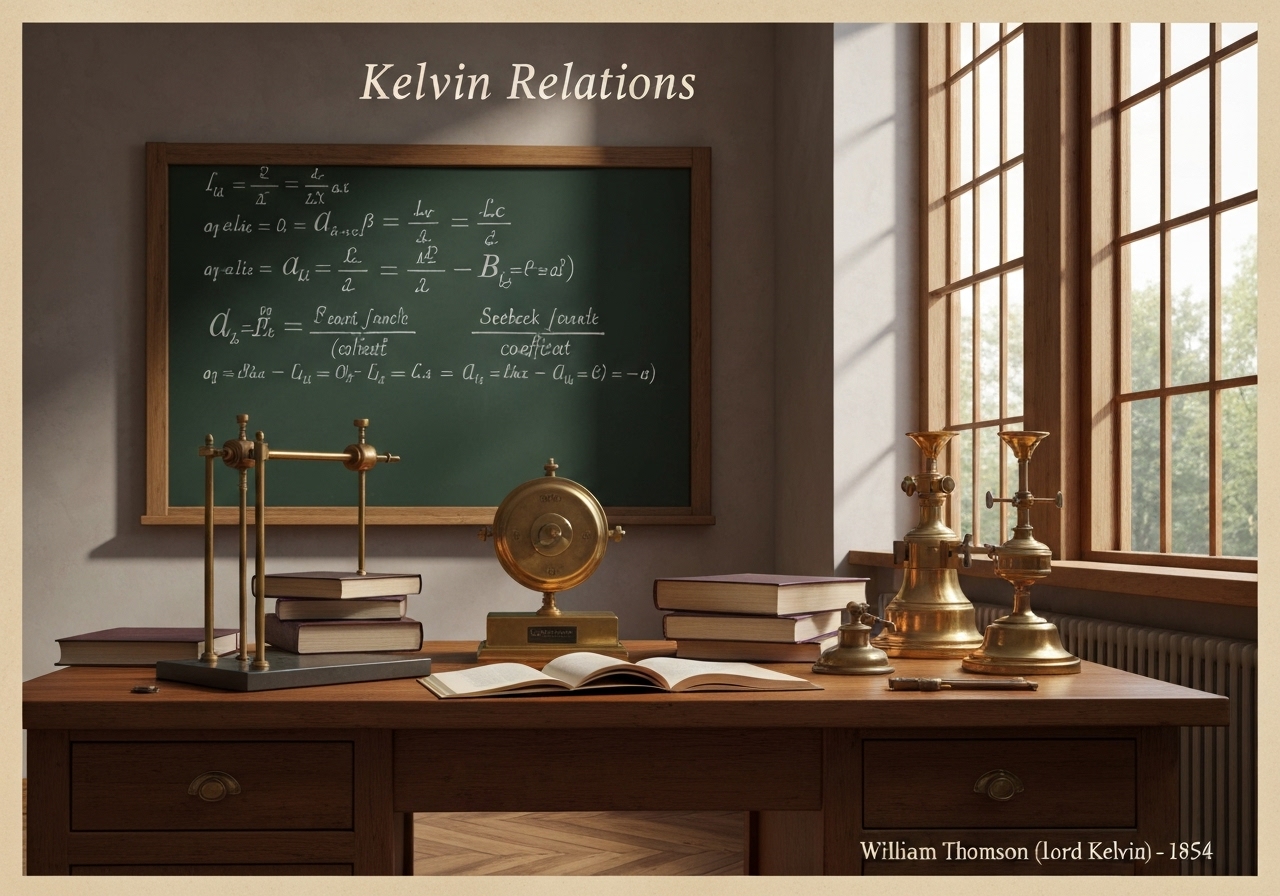
开尔文关系式是热力学上连接三个热电系数的两个方程:第一个关系式通过绝对温度 ([latex]T[/latex]) 连接珀尔帖系数 ([latex]\Pi[/latex]) 和塞贝克系数 ([latex]S[/latex]):[latex]Pi = S \cdot T[/latex]。第二种方法将汤姆逊系数([latex]/mathcal{K}[/latex])与塞贝克系数的温度导数联系起来:[latex]/mathcal{K} = T \frac{dS}{dT}[/latex]。.


(图片仅供参考)
开尔文关系式是热力学上连接三个热电系数的两个方程:第一个关系式通过绝对温度 ([latex]T[/latex]) 连接珀尔帖系数 ([latex]\Pi[/latex]) 和塞贝克系数 ([latex]S[/latex]):[latex]Pi = S \cdot T[/latex]。第二种方法将汤姆逊系数([latex]/mathcal{K}[/latex])与塞贝克系数的温度导数联系起来:[latex]/mathcal{K} = T \frac{dS}{dT}[/latex]。.

The Kelvin relations are a cornerstone of thermoelectric theory, demonstrating that the 塞贝克, 佩尔蒂埃, and Thomson effects are not independent phenomena but are deeply interconnected aspects of the same underlying transport process. Lord Kelvin derived these relationships by applying the laws of thermodynamics to a thermoelectric circuit, treating it as a reversible heat engine. His derivation, while insightful, predated the more rigorous framework of irreversible thermodynamics.
后来,拉尔斯·昂萨格关于不可逆过程互易关系的研究为开尔文关系提供了更普遍、更坚实的基础。 昂萨格 基于微观可逆性原理的互易关系证实了开尔文的结果。这些关系具有极高的实用价值。例如,测量塞贝克系数 (S) 及其温度依赖性通常比直接测量珀尔帖系数 (Pi) 或汤姆逊系数 (K) 更容易。利用开尔文关系,可以根据 S 的测量值计算出 Pi 和 K,这对于表征新材料和设计高效器件至关重要。
开尔文(汤姆森)关系公司
(如果日期未知或不相关,例如“流体力学”,则提供其显著出现的近似估计)

只有注册会员才能免费获取完整尺寸的图片和下载内容。
> 登录 <