Product Design, Manufacturing & Innovation Resources
Home » GUM Framework for Measurement Uncertainty

GUM Framework for Measurement Uncertainty

1993-01-01
  • Joint Committee for Guides in Metrology (JCGM)
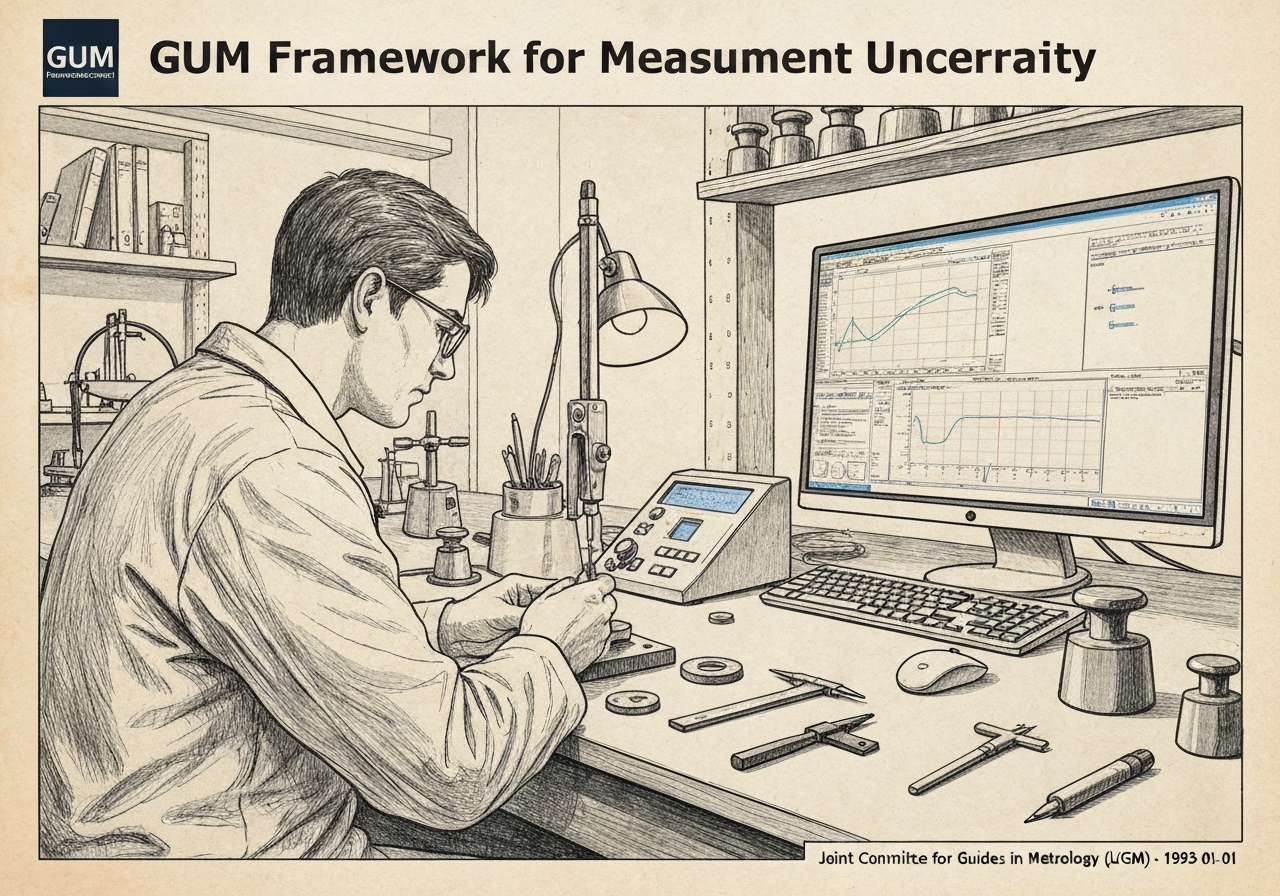
Calibration laboratory with technician measuring standard reference material in metrology.

(generated image for illustration only)

The ‘Guide to the Expression of Uncertainty in Measurement’ (GUM) establishes the international standard for evaluating and expressing measurement uncertainty. It defines uncertainty as a non-negative parameter characterizing the dispersion of values attributable to a measurand, based on the information used. This framework shifts focus from the unknowable ‘error’ to a quantifiable, probabilistic expression of doubt about a measurement result.


The GUM framework, first published in 1993 by the BIPM on behalf of seven international organizations, revolutionized the field of metrology. Before its introduction, different fields and countries used varied and often incompatible methods to express measurement quality. The GUM introduced a unified, philosophically consistent approach. Its core novelty was to abandon the concept of ‘true value’ and ‘error’ (the difference between a measurement and the true value), as the true value is inherently unknowable. Instead, it focuses on the ‘measurand’ (the quantity intended to be measured) and the uncertainty associated with its estimated value.

The framework is built upon a probabilistic foundation, treating all input quantities as having probability distributions. The result of a measurement is then not a single value but a best estimate accompanied by an uncertainty that defines an interval within which the value of the measurand is believed to lie with a certain level of confidence. This approach requires identifying all sources of uncertainty, quantifying them as standard uncertainties (analogous to standard deviations), and then combining them according to a specific procedure to obtain a total combined standard uncertainty. This process provides a universal, transferable, and quantitative basis for comparing measurement results worldwide.

UNESCO Nomenclature: 2209
– Instrumentation

Type

Abstract System

Disruption

Foundational

Usage

Widespread Use

Precursors

  • probability theory (Laplace, Bayes)
  • method of least squares (Gauss, Legendre)
  • statistical concepts of standard deviation and variance
  • early error analysis in astronomy and geodesy
  • international efforts for standardization in science and trade (e.g., treaty of the metre)

Applications

  • calibration laboratory accreditation (iso/iec 17025)
  • quality control in manufacturing
  • scientific research and publication standards
  • legal metrology and trade
  • medical diagnostics and testing
  • environmental monitoring

Patents:

NA

Potential Innovations Ideas

Due to scrapping bot traffic, currently more than 40k per day, this content is reserved to community members.
> Login < or > Register < (100% free) to access this, so as all other restricted content and tools.

Related to: GUM, JCGM, metrology, measurement uncertainty, calibration, standard uncertainty, measurand, iso 17025, BIPM, quality assurance.

Historical Context

GUM Framework for Measurement Uncertainty

1985
1986
1990
1993-01-01
1995
2000
2004
1984
1986
1986
1991
1994
1997
2002
2015-09-14

(if date is unknown or not relevant, e.g. "fluid mechanics", a rounded estimation of its notable emergence is provided)

Full size images and downloads are only available, 100% free, for registered members.

> Login <