Product Design, Manufacturing & Innovation Resources
Home » Free-Piston Stirling Engine (FPSE)

Free-Piston Stirling Engine (FPSE)

1964
  • William Beale
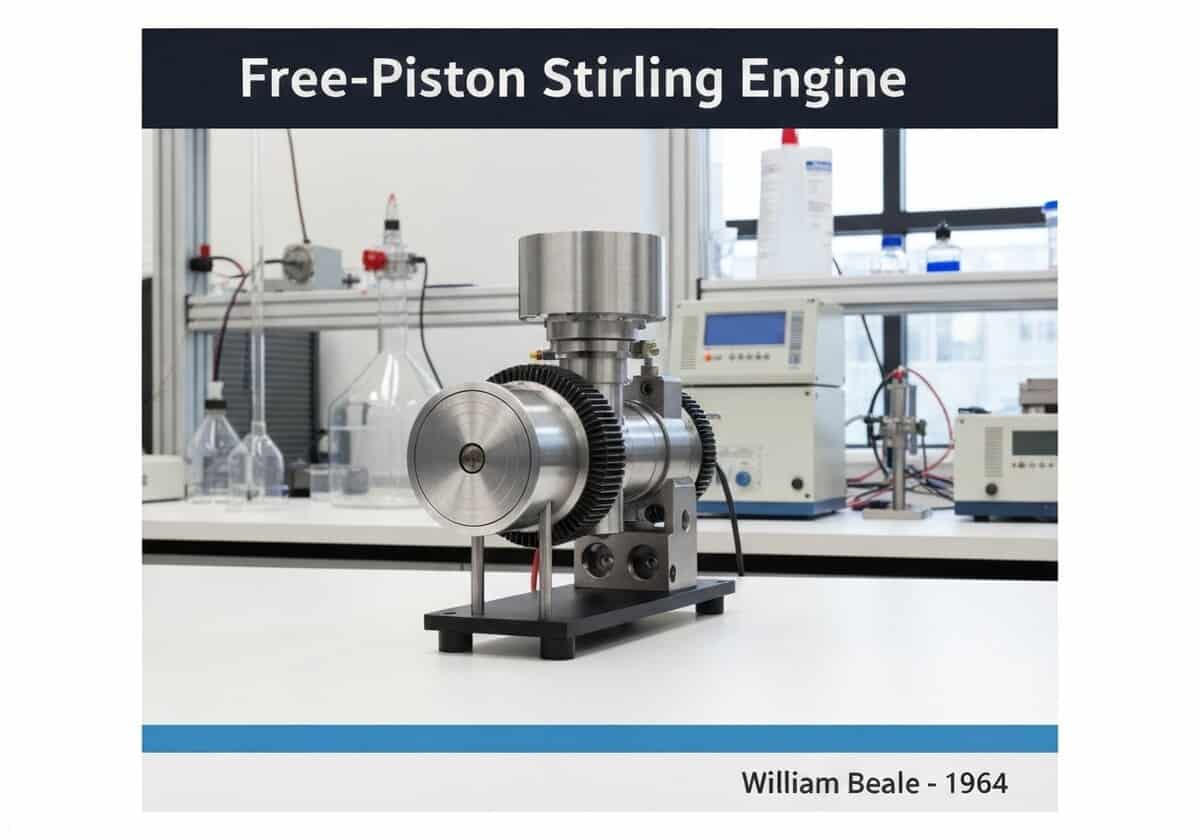
Free-Piston Stirling Engine in a mechanical engineering laboratory.

(generated image for illustration only)

A Free-Piston Stirling Engine (FPSE) eliminates the crankshaft and all mechanical linkages. The piston and displacer oscillate freely, their motion governed by the interplay of gas pressure forces from the thermodynamic cycle and spring forces. This design enables hermetic sealing of the working gas, requires no lubrication, and offers extremely high reliability and long operational life, making it ideal for maintenance-free applications.
The operation of an FPSE relies on creating a dynamically stable resonant system. The displacer and power piston are not mechanically connected but are designed as a coupled mass-spring system. The ‘springs’ can be mechanical (flexure bearings) or, more commonly, volumes of trapped gas that act as gas springs. The engine is designed so that the natural resonant frequency of this system matches the desired operating frequency. The thermodynamic cycle provides the driving force, and the phase lag between the displacer’s motion and the power piston’s motion is naturally established by the system’s dynamics, allowing the cycle to be self-sustaining.

Power is typically extracted not with a rotating shaft, but with a linear alternator. The power piston is attached to magnets that oscillate within a coil of wire, inducing an electric current directly. This complete absence of rotating parts, bearings, and sliding seals that require lubrication is the FPSE’s greatest advantage. It eliminates major sources of wear and failure, allowing for operational lifetimes exceeding tens of thousands of hours without maintenance. This makes them exceptionally well-suited for applications where reliability is paramount and physical access is difficult or impossible, such as in deep space or within a sealed power unit.

UNESCO Nomenclature: 3313
– Mechanical engineering

Type

Physical Device

Disruption

Substantial

Usage

Niche/Specialized

Precursors

  • The conventional kinematic stirling engine (beta and gamma types)
  • Theory of mechanical resonance and harmonic oscillators
  • Development of linear electric motors and alternators
  • The concept of gas springs and flexure bearings

Applications

  • long-life power systems for space probes (e.g., nasa’s advanced stirling radioisotope generator)
  • cryocoolers for cooling infrared sensors on satellites and military hardware
  • micro combined heat and power (mchp) systems for residential use
  • solar thermal power generation
  • experimental artificial hearts
  • portable power generation

Patents:

  • US3552120A

Potential Innovations Ideas

Due to scrapping bot traffic, currently more than 40k per day, this content is reserved to community members.
> Login < or > Register < (100% free) to access this, so as all other restricted content and tools.

Related to: free-piston, Stirling engine, FPSE, linear alternator, gas spring, hermetic seal, cryocooler, high reliability, no lubrication, William Beale.

Historical Context

Free-Piston Stirling Engine (FPSE)

1960
1960
1962
1964
1970
1970
1970
1960
1960
1960
1963
1965-12-21
1970
1970
1970

(if date is unknown or not relevant, e.g. "fluid mechanics", a rounded estimation of its notable emergence is provided)

Full size images and downloads are only available, 100% free, for registered members.

> Login <