Product Design, Manufacturing & Innovation Resources
Maison » Moteur Stirling à piston libre (FPSE)

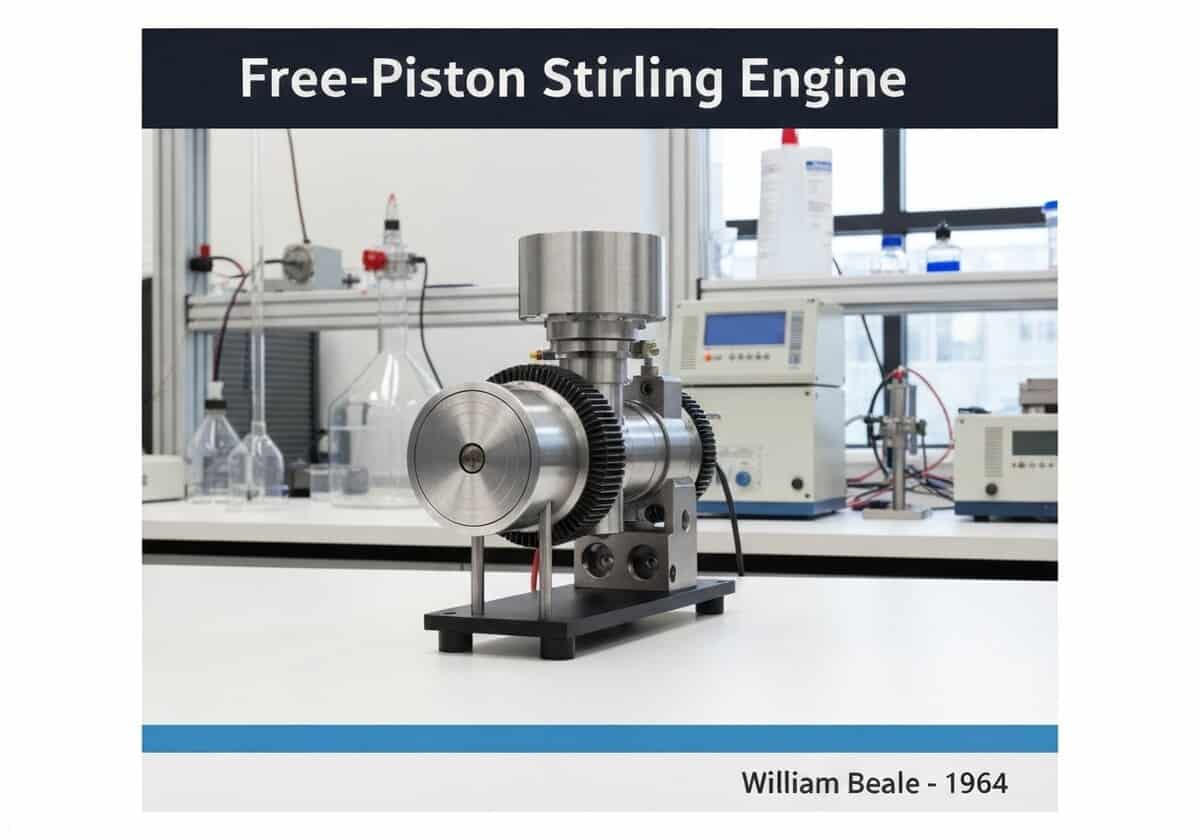
Moteur Stirling à piston libre (FPSE)

1964
  • William Beale
Moteur Stirling à piston libre dans un laboratoire de génie mécanique.

(Image générée à titre d'illustration uniquement)

A Free-Piston Stirling Engine (FPSE) eliminates the crankshaft and all mechanical linkages. The piston and displacer oscillate freely, their motion governed by the interplay of gas pression forces from the thermodynamique cycle and spring forces. This design enables hermetic sealing of the working gas, requires no lubrication, and offers extremely high reliability and long operational life, making it ideal for maintenance-free applications.

The operation of an FPSE relies on creating a dynamically stable resonant system. The displacer and power piston are not mechanically connected but are designed as a coupled mass-spring system. The ‘springs’ can be mechanical (flexure bearings) or, more commonly, volumes of trapped gas that act as gas springs. The engine is designed so that the natural resonant frequency of this system matches the desired operating frequency. The thermodynamic cycle provides the driving force, and the phase lag between the displacer’s motion and the power piston’s motion is naturally established by the system’s dynamics, allowing the cycle to be self-sustaining.

Power is typically extracted not with a rotating shaft, but with a linear alternator. The power piston is attached to magnets that oscillate within a coil of wire, inducing an electric current directly. This complete absence of rotating parts, bearings, and sliding seals that require lubrication is the FPSE’s greatest advantage. It eliminates major sources of wear and failure, allowing for operational lifetimes exceeding tens of thousands of hours without maintenance. This makes them exceptionally well-suited for applications where reliability is paramount and physical access is difficult or impossible, such as in deep space or within a sealed power unit.

UNESCO Nomenclature: 3313
- Ingénierie mécanique

Taper

Dispositif physique

Perturbation

Substantiel

Usage

Créneau/spécialité

Précurseurs

  • Le moteur Stirling cinématique conventionnel (types bêta et gamma)
  • Théorie de la résonance mécanique et des oscillateurs harmoniques
  • Développement des moteurs et alternateurs électriques linéaires
  • Le concept des ressorts à gaz et des paliers flexibles

Applications

  • long-life power systems for space probes (e.g., nasa’s advanced stirling radioisotope generator)
  • cryorefroidisseurs pour le refroidissement des capteurs infrarouges sur les satellites et le matériel militaire
  • systèmes de micro-cogénération (MCHP) pour usage résidentiel
  • production d'énergie solaire thermique
  • cœurs artificiels expérimentaux
  • production d'énergie portable

Brevets:

  • US3552120A

Idées d'innovations potentielles

En raison du trafic généré par les robots de scraping, actuellement supérieur à 40 000 par jour, ce contenu est réservé aux membres de la communauté.
> Connexion < ou > Registre < (100% gratuit) pour y accéder, ainsi qu'à tous les autres contenus et outils à accès restreint.

Related to: free-piston, Stirling engine, FPSE, linear alternator, gas spring, hermetic seal, cryocooler, high reliability, no lubrication, William Beale.

Contexte historique

Moteur Stirling à piston libre (FPSE)

1960
1960
1962
1964
1970
1970
1970
1960
1960
1960
1963
1965-12-21
1970
1970
1970

(si la date est inconnue ou non pertinente, par exemple « mécanique des fluides », une estimation arrondie de son émergence notable est fournie)

Les images en pleine résolution et les téléchargements sont uniquement disponibles, et 100% gratuits, pour les membres inscrits.