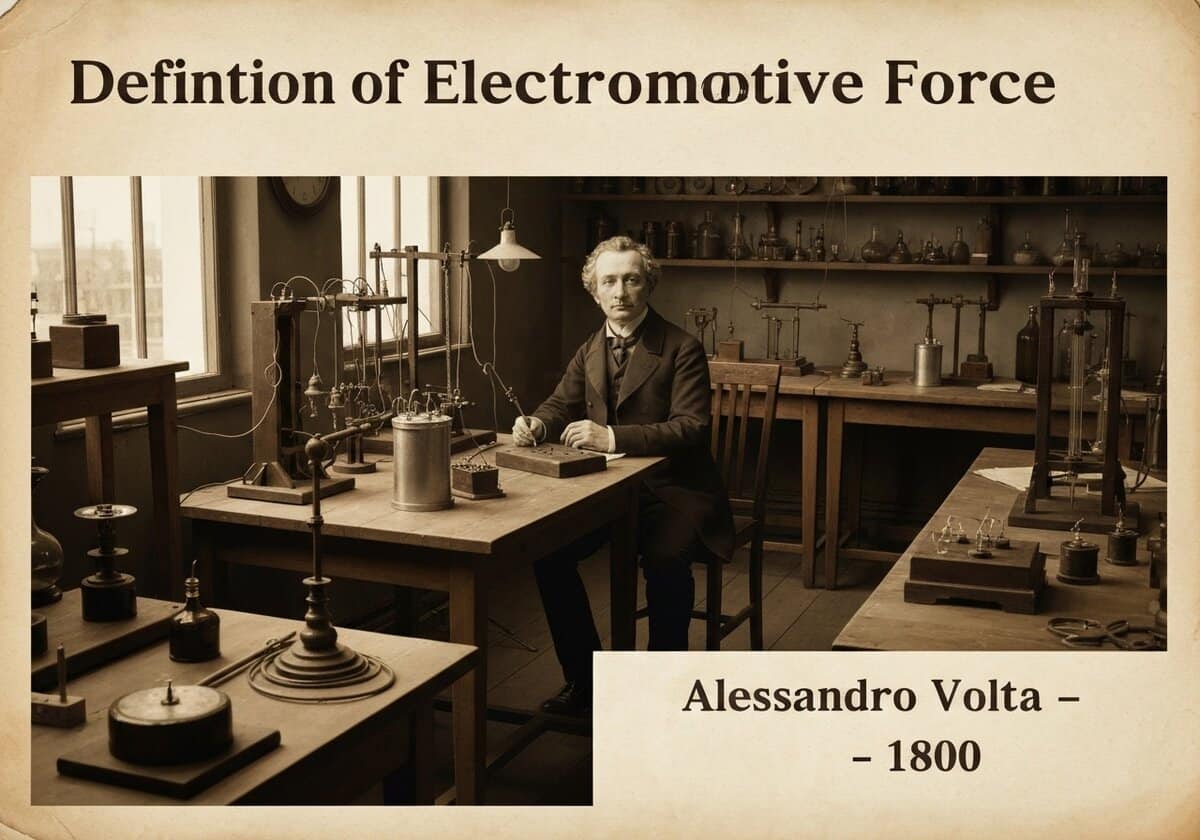
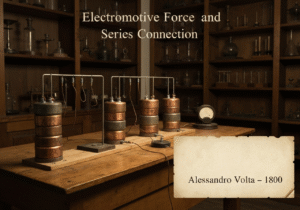
Definition of Electromotive Force (EMF)
Electromotive force (\(\mathcal{E}\)) is the work done per unit of electric charge by a non-electrical source, such as a battery or generator. Despite its name, it is not a mechanical force but an electric potential, measured in volts. It represents the energy converted from another form (chemical, mechanical) into electrical energy as a charge traverses the source.
Electromotive force, or EMF, is a fundamental concept in electromagnetism that quantifies the energy conversion process within a source. When a charge \(q\) moves through a device that provides EMF, the work done \(W\) on the charge is given by \(W = \mathcal{E}q\). This work is performed by a non-conservative field, often called an impressed field \(\mathbf{E}_{im}\), which is distinct from the conservative electrostatic field generated by static charges. The EMF is formally defined as the line integral of this impressed field around a closed loop: \(\mathcal{E} = \oint \mathbf{E}_{im} \cdot d\mathbf{l}\).
This distinction is crucial. An electrostatic field, described by Coulomb’s law, is conservative, meaning the work it does on a charge around any closed loop is zero. This is why a simple configuration of static charges cannot sustain a continuous current in a circuit. An EMF source, however, provides the “push” to drive charges against the electrostatic field’s potential gradient, maintaining a current. In a battery, this impressed field arises from chemical processes at the electrodes. In a generator, it’s due to a changing magnetic field (Faraday’s law) or the motion of a conductor in a magnetic field (motional EMF). The EMF represents the maximum potential difference the source can provide when no current is flowing, also known as the open-circuit voltage. When current flows, the terminal voltage across the source is typically lower than the EMF due to internal resistance within the source itself.
UNESCO Nomenclature: 2205
– Electricity and Magnetism
Precursors
- Luigi Galvani’s discovery of “animal electricity”
- Charles-Augustin de Coulomb’s formulation of the law of electrostatic force
- Understanding of electric potential and charge
Applications
- powering all electronic devices
- electric vehicles
- grid-scale energy storage
- portable electronics
Potential Innovations Ideas
Due to scrapping bot traffic, currently more than 40k per day, this content is reserved to community members.
> Login < or > Register < (100% free) to access this, so as all other restricted content and tools.
Related to: emf, electromotive force, voltage, potential difference, work, charge, battery, generator.