Product Design, Manufacturing & Innovation Resources
घर » विद्युतवाहक बल (EMF) की परिभाषा

विद्युतवाहक बल (EMF) की परिभाषा

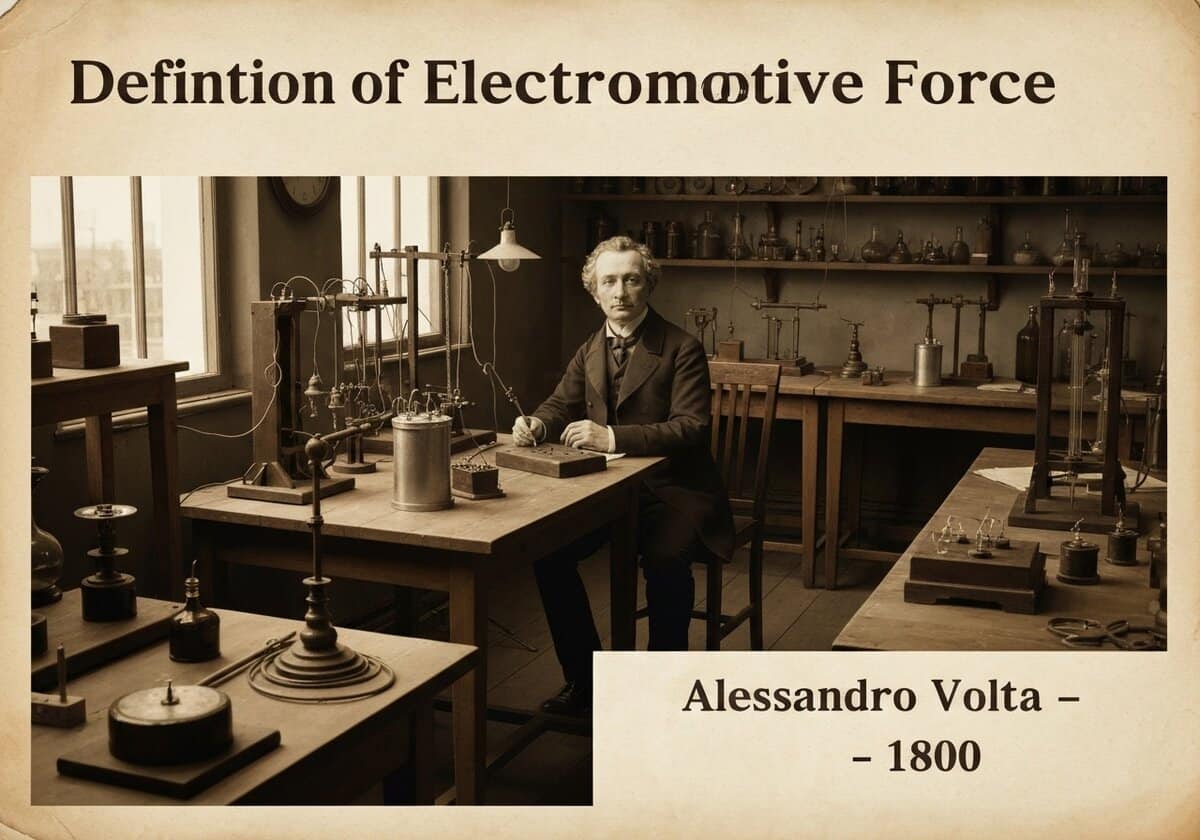
1800
  • Alessandro Volta
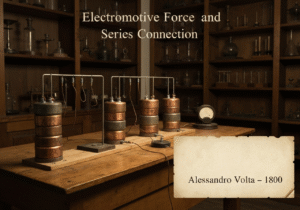
Alessandro Volta's laboratory demonstrating electromotive force with early electrical apparatus.

(यह छवि केवल उदाहरण के लिए बनाई गई है)

विद्युत-प्रेरक बल (E) किसी गैर-विद्युत स्रोत, जैसे बैटरी या जनरेटर द्वारा प्रति इकाई विद्युत आवेश पर किया गया कार्य है। नाम के बावजूद, यह एक यांत्रिक बल नहीं बल्कि एक विद्युत विभव है, जिसे वोल्ट में मापा जाता है। यह उस ऊर्जा को दर्शाता है जो किसी अन्य रूप (रासायनिक, यांत्रिक) से विद्युत ऊर्जा में परिवर्तित होती है जब आवेश स्रोत से होकर गुजरता है।


Electromotive force, or EMF, is a fundamental concept in electromagnetism that quantifies the energy conversion process within a source. When a charge [latex]q[/latex] moves through a device that provides EMF, the work done [latex]W[/latex] on the charge is given by [latex]W = \mathcal{E}q[/latex]. This work is performed by a non-conservative field, often called an impressed field [latex]\mathbf{E}_{im}[/latex], which is distinct from the conservative electrostatic field generated by static charges. The EMF is formally defined as the line integral of this impressed field around a closed loop: [latex]\mathcal{E} = \oint \mathbf{E}_{im} \cdot d\mathbf{l}[/latex].

This distinction is crucial. An electrostatic field, described by Coulomb’s law, is conservative, meaning the work it does on a charge around any closed loop is zero. This is why a simple configuration of static charges cannot sustain a continuous current in a circuit. An EMF source, however, provides the “push” to drive charges against the electrostatic field’s potential gradient, maintaining a current. In a battery, this impressed field arises from chemical processes at the electrodes. In a generator, it’s due to a changing magnetic field (Faraday’s law) or the motion of a conductor in a magnetic field (motional EMF). The EMF represents the maximum potential difference the source can provide when no current is flowing, also known as the open-circuit voltage. When current flows, the terminal voltage across the source is typically lower than the EMF due to internal resistance within the source itself.

UNESCO Nomenclature: 2205
विद्युत और चुंबकत्व

Type

सार प्रणाली

व्यवधान

क्रांतिकारी

उपयोग

व्यापक उपयोग

शगुन

  • लुइगी गैलवानी की "पशु विद्युत" की खोज
  • चार्ल्स-ऑगस्टिन डी कूलम्ब द्वारा विद्युतस्थैतिक बल के नियम का प्रतिपादन
  • विद्युत विभव और आवेश की समझ

आवेदन

  • सभी इलेक्ट्रॉनिक उपकरणों को शक्ति प्रदान करना
  • इलेक्ट्रिक वाहन
  • ग्रिड-स्तरीय ऊर्जा भंडारण
  • पोर्टेबल इलेक्ट्रॉनिक्स

पेटेंट:

NA

संभावित नवाचार विचार

बॉट ट्रैफिक को कम करने के कारण, जो वर्तमान में प्रति दिन 40,000 से अधिक है, यह सामग्री केवल समुदाय के सदस्यों के लिए आरक्षित है।
> लॉगिन < या > रजिस्टर < इस सामग्री और अन्य सभी प्रतिबंधित सामग्रियों और उपकरणों तक पहुंच (100% निःशुल्क) है।

संबंधित विषय: ईएमएफ, विद्युत-प्रेरक बल, वोल्टेज, विभवांतर, कार्य, आवेश, बैटरी, जनरेटर।

ऐतिहासिक संदर्भ

विद्युतवाहक बल (EMF) की परिभाषा

1757
1788
1800
1800
1800
1800
1801
1750
1785
1788
1800
1800
1800
1800
1802

(यदि तिथि अज्ञात है या प्रासंगिक नहीं है, उदाहरण के लिए "द्रव यांत्रिकी", तो इसके उल्लेखनीय उद्भव का एक अनुमानित आंकड़ा प्रदान किया गया है)

संबंधित आविष्कार, नवाचार और तकनीकी सिद्धांत

पंजीकृत सदस्यों के लिए पूर्ण आकार की छवियाँ और डाउनलोड 100% निःशुल्क उपलब्ध हैं।