Product Design, Manufacturing & Innovation Resources
Home » Green Fluorescent Protein (GFP) as a Wavelength Shifter

Green Fluorescent Protein (GFP) as a Wavelength Shifter

1990
  • Osamu Shimomura
  • Martin Chalfie
  • Roger Y. Tsien
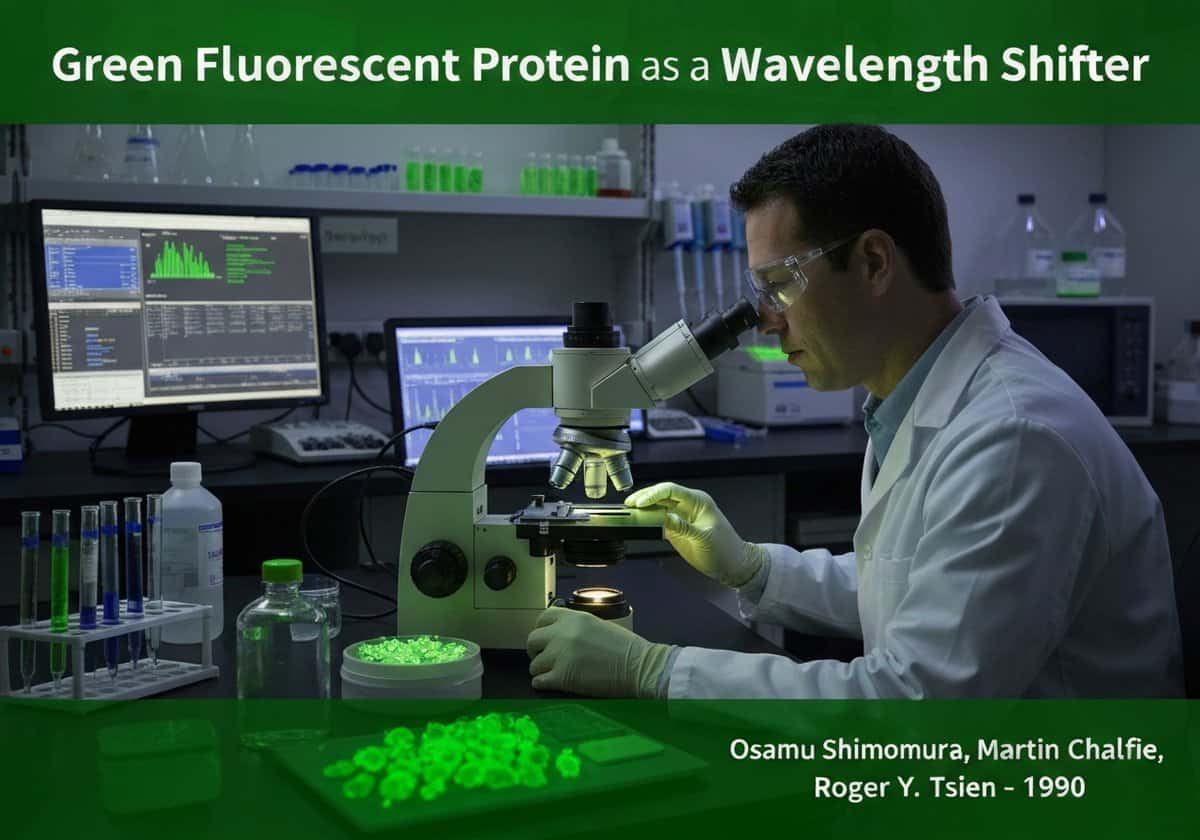
Laboratory experiment with Green Fluorescent Protein in biochemistry research.

(generated image for illustration only)

In some organisms like the jellyfish Aequorea victoria, the initial bioluminescent reaction produces blue light. This energy is then transferred to a secondary protein, the Green Fluorescent Protein (GFP), via Förster resonance energy transfer (FRET). GFP absorbs the blue light and re-emits it as green light, effectively shifting the color of the luminescence.

The discovery and application of GFP revolutionized cell biology. Osamu Shimomura first isolated GFP from *Aequorea victoria* in the 1960s while studying the bioluminescent photoprotein aequorin. Aequorin emits blue light upon binding with Ca²⁺ ions. Shimomura noticed the jellyfish glowed green, not blue, leading him to discover the energy transfer to GFP. The key feature of GFP is its chromophore, formed autocatalytically from a Ser-Tyr-Gly sequence within the protein’s primary structure. This chromophore is shielded within a beta-barrel structure, protecting it from the environment and enabling its bright fluorescence.

Martin Chalfie later demonstrated that the gene for GFP could be expressed in other organisms (*E. coli* and *C. elegans*), where it would function as a fluorescent marker without needing any species-specific cofactors. Roger Tsien’s work was crucial in understanding the mechanism of chromophore formation and in engineering a vast palette of GFP variants (BFPs, CFPs, YFPs, RFPs) with different colors, improved brightness, and photostability. This toolkit allows researchers to track multiple proteins or processes simultaneously within a single living cell, a technique known as multicolor imaging. The 2008 Nobel Prize in Chemistry was awarded to Shimomura, Chalfie, and Tsien for this work.

UNESCO Nomenclature: 2401
– Biochemistry

Type

Biological Molecule

Disruption

Incremetal

Usage

Widespread Use

Precursors

  • discovery of bioluminescence in aequorea victoria
  • understanding of protein structure and function
  • development of recombinant DNA technology
  • discovery of Förster resonance energy transfer (FRET)

Applications

  • reporter gene in molecular biology to visualize gene expression
  • tagging proteins to study their location and movement within cells
  • calcium imaging (with variants like gcamp)
  • high-throughput screening in drug discovery
  • creating transgenic glowing pets (e.g., glofish)

Patents:

  • US5491084A
  • US6146826A

Potential Innovations Ideas

Due to scrapping bot traffic, currently more than 40k per day, this content is reserved to community members.
> Login < or > Register < (100% free) to access this, so as all other restricted content and tools.

Related to: GFP, green fluorescent protein, aequorea victoria, fluorescence, FRET, reporter gene, protein tagging, chromophore, Osamu Shimomura, Roger Tsien.

Historical Context

Green Fluorescent Protein (GFP) as a Wavelength Shifter

1987
1990
1990
1990
1997
2000
1983
1988
1990
1990
1997
2000
2008

(if date is unknown or not relevant, e.g. "fluid mechanics", a rounded estimation of its notable emergence is provided)

Related Invention, Innovation & Technical Principles

Full size images and downloads are only available, 100% free, for registered members.

> Login <