Product Design, Manufacturing & Innovation Resources
Home » Definition of Electromotive Force (EMF)

Definition of Electromotive Force (EMF)

1800
  • Alessandro Volta
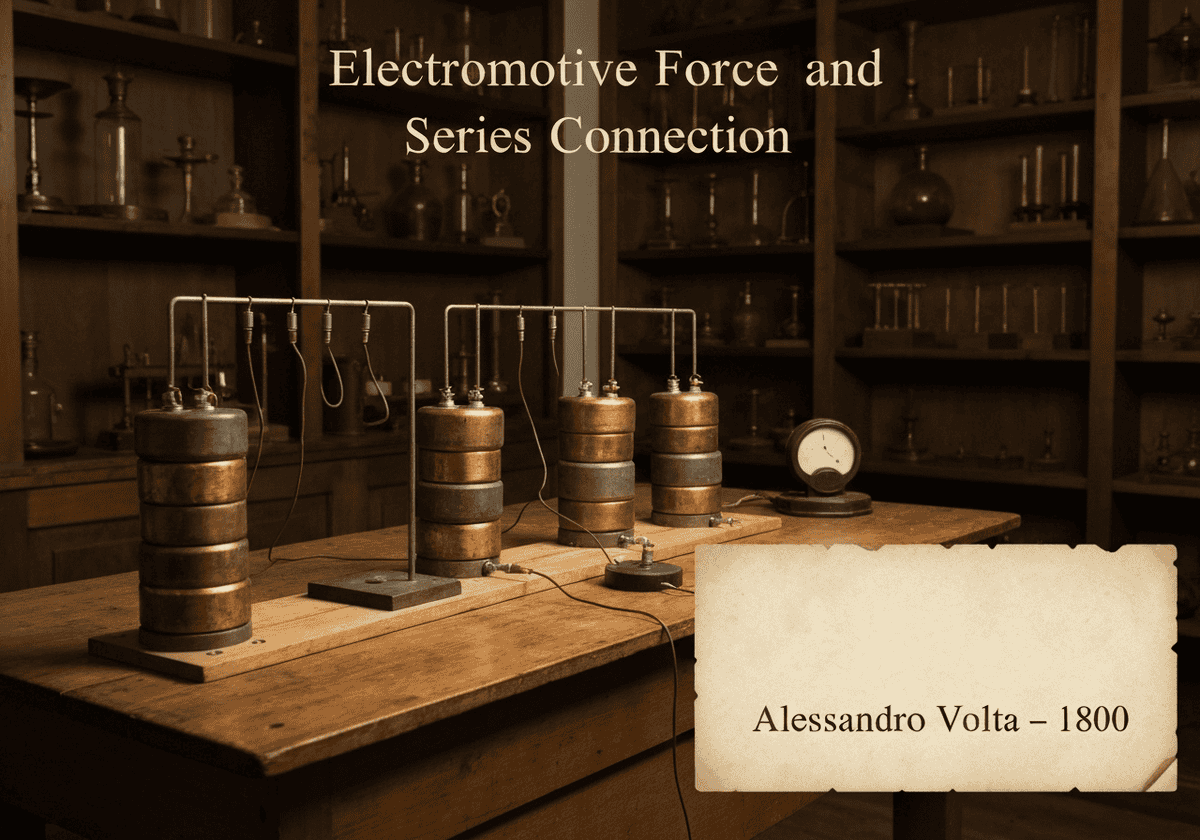
Alessandro Volta's laboratory demonstrating electromotive force with early electrical apparatus.

(generated image for illustration only)

Electromotive force (\(\mathcal{E}\)) is the work done per unit of electric charge by a non-electrical source, such as a battery or generator. Despite its name, it is not a mechanical force but an electric potential, measured in volts. It represents the energy converted from another form (chemical, mechanical) into electrical energy as a charge traverses the source.

Electromotive force, or EMF, is a fundamental concept in electromagnetism that quantifies the energy conversion process within a source. When a charge \(q\) moves through a device that provides EMF, the work done \(W\) on the charge is given by \(W = \mathcal{E}q\). This work is performed by a non-conservative field, often called an impressed field \(\mathbf{E}_{im}\), which is distinct from the conservative electrostatic field generated by static charges. The EMF is formally defined as the line integral of this impressed field around a closed loop: \(\mathcal{E} = \oint \mathbf{E}_{im} \cdot d\mathbf{l}\).

This distinction is crucial. An electrostatic field, described by Coulomb’s law, is conservative, meaning the work it does on a charge around any closed loop is zero. This is why a simple configuration of static charges cannot sustain a continuous current in a circuit. An EMF source, however, provides the “push” to drive charges against the electrostatic field’s potential gradient, maintaining a current. In a battery, this impressed field arises from chemical processes at the electrodes. In a generator, it’s due to a changing magnetic field (Faraday’s law) or the motion of a conductor in a magnetic field (motional EMF). The EMF represents the maximum potential difference the source can provide when no current is flowing, also known as the open-circuit voltage. When current flows, the terminal voltage across the source is typically lower than the EMF due to internal resistance within the source itself.

UNESCO Nomenclature: 2205
– Electricity and Magnetism

Type

Abstract System

Disruption

Revolutionary

Usage

Widespread Use

Precursors

  • Luigi Galvani’s discovery of “animal electricity”
  • Charles-Augustin de Coulomb’s formulation of the law of electrostatic force
  • Understanding of electric potential and charge

Applications

  • powering all electronic devices
  • electric vehicles
  • grid-scale energy storage
  • portable electronics

Patents:

NA

Potential Innovations Ideas

Due to scrapping bot traffic, currently more than 40k per day, this content is reserved to community members.
> Login < or > Register < (100% free) to access this, so as all other restricted content and tools.

Related to: emf, electromotive force, voltage, potential difference, work, charge, battery, generator.

Historical Context

Definition of Electromotive Force (EMF)

1757
1788
1800
1800
1800
1800
1801
1750
1785
1788
1800
1800
1800
1800
1802

(if date is unknown or not relevant, e.g. "fluid mechanics", a rounded estimation of its notable emergence is provided)

Related Invention, Innovation & Technical Principles

Full size images and downloads are only available, 100% free, for registered members.

> Login <